
Table of Contents
System Design for Freshers: Databases SQL vs NoSQL
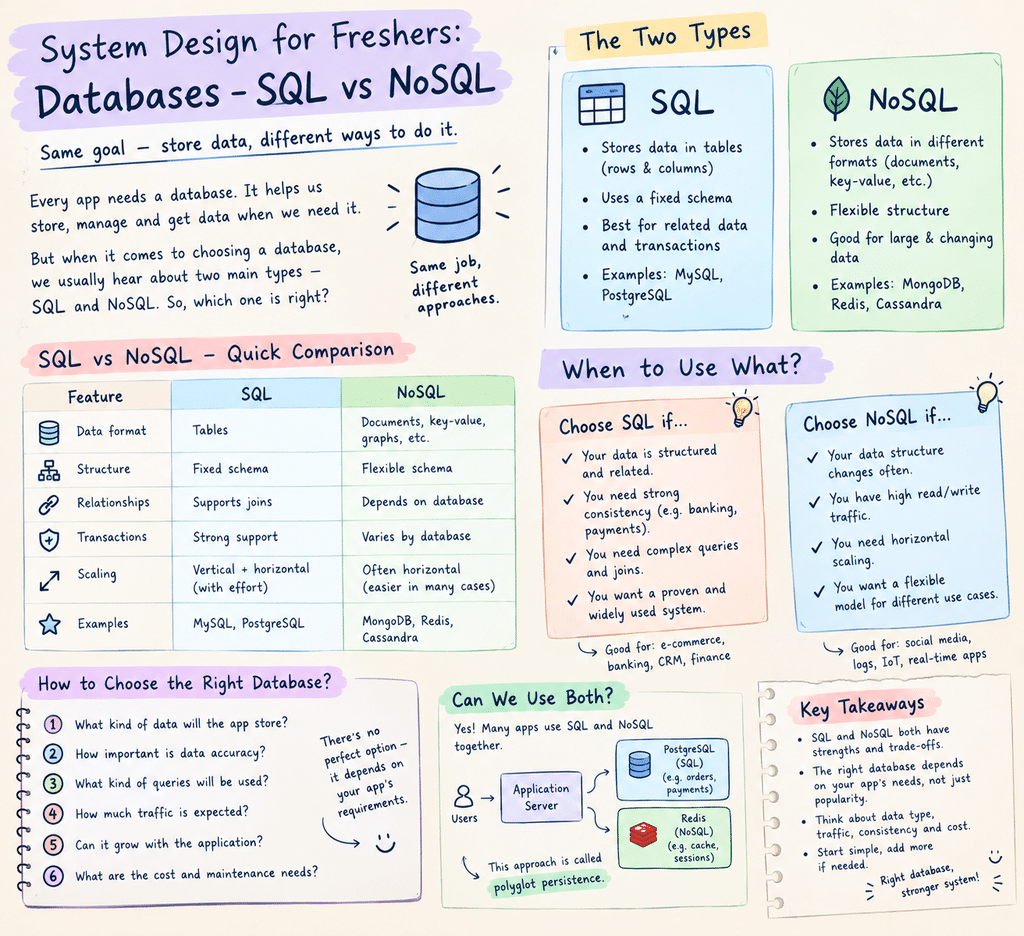
Source : chatgpt
Choosing a database is one of the first decisions developers face when building an application. At first, it may seem like a simple choice, but understanding SQL vs NoSQL can affect how your application stores information. For freshers learning system design, knowing the difference in SQL vs NoSQL is essential. Imagine building an online shopping app. You need to store customer details, product information, orders, and payments. All this data must be organised properly and retrieved quickly. This is where understanding SQL vs NoSQL becomes important. For freshers learning system design, knowing the difference between these two types of databases can make it easier to understand how real-world applications work.
What Are SQL and NoSQL Databases?
SQL databases store information in tables made up of rows and columns. They follow a structured format, which makes it easier to organise related information and maintain accuracy. MySQL and PostgreSQL are two popular examples.NoSQL databases use different ways to store information, depending on the database. They may store data as documents, key-value pairs, graphs, or wide-column records. MongoDB and Redis are common examples.The main difference is how these databases organise data and handle different requirements. SQL is often a good choice when data relationships and accuracy are important, while NoSQL can be useful when an application needs flexible data structures or a storage model suited to a particular workload.
SQL vs NoSQL: What Is the Difference?
The choice between SQL and NoSQL depends on what an application needs. Here are some important differences:
| Feature | SQL | NoSQL |
| Data format | Tables with rows and columns | Documents, key-value pairs, graphs, or other formats |
| Structure | Usually follows a defined schema | Often supports more flexible structures |
| Relationships | Supports joins and relational data | Depends on the database and data model |
| Transactions | Strong support for relational transactions | Transaction support varies by database |
| Scaling | Often scales vertically, with horizontal options available | Many systems support horizontal scaling |
| Examples | MySQL, PostgreSQL | MongoDB, Redis, Cassandra |
These are general differences, not strict rules. Modern SQL and NoSQL databases have overlapping capabilities, so the best choice depends on the specific application.
When Should You Choose an SQL Database?
SQL databases are useful when information is closely connected and must remain consistent. For example, a banking application needs to maintain accurate account balances and record transactions correctly.
An e-commerce website can also use SQL to manage customers, orders, products, and payments. These records are related, and SQL makes it possible to query them together and use transactions to keep important operations consistent.
Another advantage is that SQL has a standard query language. Once developers understand the basics, they can apply many of the same concepts across different relational databases.
How to Make the Right Database Choice in System Design
During system design, freshers should focus on the application’s requirements instead of choosing a database simply because it is popular.
Before making a decision, consider these questions:
- What kind of data will the application store? Structured, related records may fit SQL well, while flexible documents may suit a document database.
- How important is data consistency? Applications handling payments or financial records need careful transaction and consistency guarantees.
- How will the data be accessed? Frequent joins, complex queries, and specific lookup patterns can influence the choice.
- How much traffic is expected? Consider read and write volumes, growth, and the available scaling options.
- What will the database cost to maintain? Hosting, backups, monitoring, and the skills required to manage it all matter.
These questions help developers explain their decisions during a technical interview. A good answer should include the reason for the choice and the trade-offs involved.
SQL databases store information in tables… Learn more about the difference between relational and non-relational databases on AWS [Link to AWS].
Can SQL and NoSQL Work Together?
Yes, and many systems use different databases for different purposes.
For example, an online shopping website could use PostgreSQL to store customer orders and payment records. It could also use Redis to keep frequently accessed information ready for quick retrieval.
This approach is called polyglot persistence. In simple words, it means using more than one type of database in the same application.
Although this can be useful, it also adds extra work. Developers need to manage multiple systems, monitor them, and make sure information stays consistent wherever necessary.
For a small project, starting with one suitable database is often enough. Other databases can be added later if a real need arises.
Conclusion
Both options in the SQL vs NoSQL comparison are important parts of modern software. The best choice in SQL vs NoSQL depends on your data, traffic, and consistency needs. Understanding SQL vs NoSQL will help you explain your decision clearly in any tech interview. SQL and NoSQL are both important parts of modern software development. SQL is often a good fit for structured data, connected records, and applications that depend on reliable transactions. NoSQL offers different storage options for flexible data and workloads that suit its particular database models.
When learning system design, freshers should focus on understanding the problem before selecting a database. Instead of assuming that one option is always better, think about the data, the expected traffic, and the application’s needs.
This makes it easier to explain your database choice in a tech interview and understand how real applications are designed.
FAQs
1. What is the main difference between SQL and NoSQL?
SQL databases store data in tables with rows and columns and use a fixed schema. Examples are MySQL and PostgreSQL. NoSQL databases store data in different formats like documents, key-value, or graphs with a flexible schema. Examples are MongoDB, Redis, and Cassandra.
2. When should a fresher choose SQL over NoSQL?
Choose SQL if your data is structured and related, you need strong consistency like in banking or payments, you need complex queries and joins, and you want a proven and widely used system. Good for e-commerce, banking, CRM, and finance apps.
3. When should a fresher choose NoSQL over SQL?
Choose NoSQL if your data structure changes often, you have high read/write traffic, you need horizontal scaling, and you want a flexible model. Good for social media, logs, IoT, and real-time apps.
4. What is polyglot persistence in system design?
Polyglot persistence means using more than one type of database in the same application. For example, an online shopping app can use PostgreSQL for orders and payments and Redis for cache and sessions. Many real-world apps use SQL and NoSQL together.
5. Can SQL and NoSQL be used together?
Yes. Many systems use both. For example, you can store customer orders in PostgreSQL (SQL) for accuracy and store frequently accessed data in Redis (NoSQL) for speed. For a small project, start with one database and add another only when needed.
6. Which database is better for system design interviews for freshers?
There is no perfect option. It depends on your app’s requirements. Interviewers want to hear your reasoning. Think about: What kind of data will the app store? How important is accuracy? What kind of queries will be used? How much traffic is expected?
7. Is NoSQL faster than SQL?
Not always. NoSQL can be faster for high-volume, flexible data and horizontal scaling. SQL is often better for complex joins and transactions. The right choice depends on data type, traffic, consistency, and cost – not just speed.