
6 Best Resources to Learn System Design for Freshers
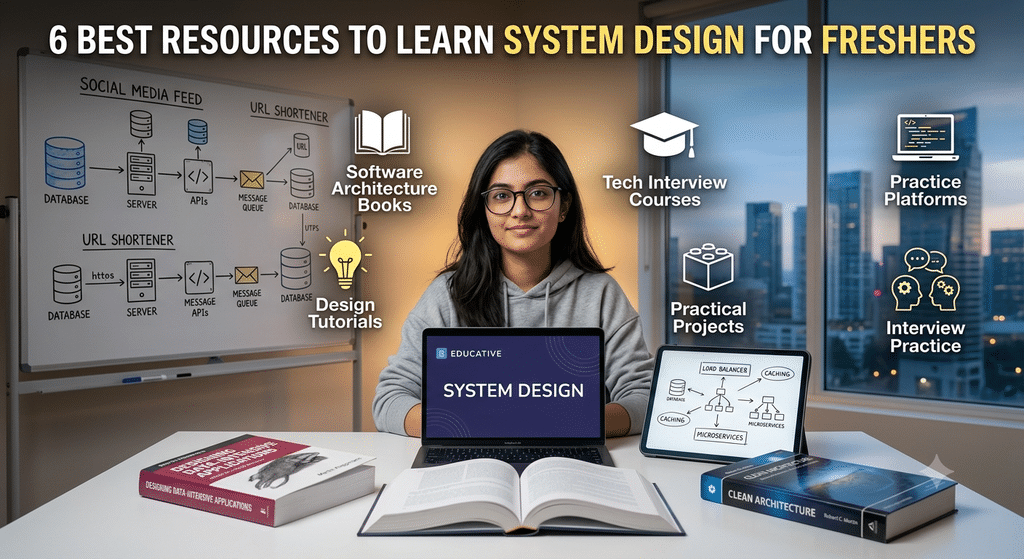
Source: Ai generated image
Learning system design can take freshers beyond the single program to an appreciation of a complete software system. It includes both how applications interact with users and data, traffic, failures, performance and growth.
System design has gained importance for students who are about to take up the role of a software engineer. It can feel daunting at first due to the fact that it consists of databases, APIs, servers, caching, load balancing, scalability, and distributed systems. But the learning process can be more structured and practical with the right resources.
The guide focuses on several of the best tools for mastering system design, such as system design books, tech interview courses, design tutorials, practice platforms, projects, and tech interview preparation.
1. Software Architecture Books
Books about software architecture are great for gaining a conceptual understanding. They provide in-depth explanations of design principles, scalability, databases, distributed systems, and architectural trade-offs; most short explanations of these found online do not provide as much detail.
The most recommended book is Designing Data-Intensive Applications by Martin Kleppmann. It provides practical knowledge of databases, data processing, replication, partitioning, consistency and distributed systems. The book might be difficult for a novice, but it is very useful once one has mastered the basics of some of the chapters.
Another helpful resource is Clean Architecture by Robert C. Martin. It provides the principles that can improve the understandability, testability and modifiability of software systems, and it explains how to design such systems that are maintainable and flexible.
Another book that would be useful for freshers is Fundamentals of Software Architecture authored by Mark Richards and Neal Ford. It covers architectural patterns, quality attributes, decision making and contemporary software architecture methods.
These software architecture books are particularly helpful for the students who wish to know the rationale behind the software design decision rather than just regurgitate the interview solution.
2. Tech Interview Courses
Tech interview courses are courses that offer a structured approach for learning system design, and preparing for technical interviews. Rather than having students gather data from separate sources, a curriculum path can be followed that will introduce concepts in a logical sequence.
Courses like platform, Educative, cover the general topics and design problems of system design. They will provide diagrams, examples and practice questions in their lessons, making complex concepts more comprehensible.
Coursera and Udemy also have courses for software architecture, databases, distributed systems, and system design. Students who have never taken a course should not base their decision purely on popularity or ratings. The course should start with the basics and move towards the advanced content.
A proper course for freshers should start with client-server architecture, APIs, databases, caching, load balancing, scalability, availability, and some basic questions related to distributed systems before getting into difficult questions of design.
3. Design tutorials and online guides.
Design tutorials are very useful for beginners as they break down how to design a system through diagrams, examples and breaking things down into steps. Using visual explanations helps in understanding the communication between different services and the flow of data in an application.
Online guides can be used to introduce a concept like horizontal scaling, database replication, sharding, message queues, content delivery networks, and caching. Tutorials which are based on familiar applications work well because they make the theory relevant to real-life applications
Students can learn about designing a URL-shortener, messaging app, food delivery service, video streaming service or social media feed, for instance. As they analyse each of the examples, they can determine who uses it, what it needs to do, what services are needed, which databases are used, and what possible bottlenecks exist, as well as which APIs are used.
To learn actively, students should not only read tutorials. They should study a design then sketch the design on their own and describe the function of each element of the design. This practice is a hands-on way to learning system design knowledge through passive reading.
4. Online Learning and Practice Platforms.
Students can use an online learning platform to practice and integrate theory, problem solving, and so more. LeetCode is famous for coding challenges but also offers resources for system design interview practice and community discussions. These resources provide guidance that could assist learners to develop an understanding of the kinds of inquiries that are typically encountered in a technical interview.
The other great resource is GitHub. System design notes, architecture diagrams, sample projects and learning repositories are published by the developers and educators. Students need to be careful however, as the quality and accuracy of public repositories can differ.
When learners are not sure, online communities can be of assistance too. Discussions enable students to compare approaches, look for trade-offs and to gain an understanding of why one approach might be more appropriate than another.
These platforms are best used to learn a concept, do a problem based on the concept and then check with explanations from the experts.
5. Practical Projects
Designing systems is a great way to learn system design. It’s great to read about architecture, but applying it is what gives you greater understanding.
If you are a fresher, then you might start with a simpler project such as shortener, web-based chatting service, book store website or notification service or food delivery application. It isn’t always necessary to develop a working product. Instead pupils should be encouraged to consider the organisation of the system.
Students are able to ask questions about each project such as: Who are the users? What do you need to do? What is the volume of traffic that the system could cope with? Which Database to use? What would be the benefits of caching? How would the network react if a server crashed? How can the system handle increasing numbers of users?
This helps them develop an understanding of problems of scalability, reliability, performance and availability. These are important skills for both real-world software development and technical interviews.
6. System Design Interview Practice
After understanding the fundamentals, freshers should regularly practise system design interview questions. The architecture should not be memorized in the interview as there could be multiple correct solutions to a problem.
The key components of a well-designed interview for a system design question would include an understanding of the system’s requirements, system scale, major components, APIs design, databases design, discussion of bottlenecks, and explanation of trade-offs. By repeatedly practicing these steps, candidates will be able to articulate their reasoning.
Learners have opportunities to practice typical questions like: How would you design a URL shortening service? How would you design a feed for social media? How would you design a messaging service? How would you design a site for online shopping? How would you design a ride-booking app? They should try to solve the problem on their own first and check against standard solutions afterwards.
What is the best approach for fresher to begin learning system design?
Avoid putting advanced distributed-system concepts into practice right away. It’s more effective to have a gradual learning path. Learn fundamental computer networks, databases, APIs, operating systems and object-oriented programming concepts. Then, understand some key aspects of system design, including scalability, availability, caching, load balancing, database replication, and partitioning.
From here, students will be able to study software architecture books, tech interview courses, design tutorials, and practical projects to further their studies. It’s possible to get huge improvements over time with just 30-60 minutes of daily practice.
The key element of designing a learning system is to know the rationale behind a design decision. For instance, students should not just learn that caching can help performance, but also understand when caching can be beneficial, what problems it can cause, and how cache invalidation can impact a system.
Conclusion
Getting started in learning system design can be difficult as a fresh graduate, but with the right resources, it can be systematic and easy to learn. The conceptual depth of software architecture books, the structure of tech interview courses, the design tutorials for difficult concepts, the practice from online resources, and personal projects for hands-on learning combine to give students a comprehensive experience.
Freshers should begin with building solid foundation and not get entangled in attempting to learn cutting-edge distributed systems at the first go. Technical understanding and communication skills can gradually be enhanced with consistent practice, architecture diagrams, real-world examples, and problem solving using interviews.
If you’re looking for resources-learn-system-design-freshers, it’s best to use multiple learning methods rather than relying on just one course or book. Given consistent effort, learners may build up confidence to discuss the system architecture and may have a better idea of how the modern software systems are designed for the approach to technical interviews.
References
[1] M. Kleppmann, Designing Data-Intensive Applications: The Big Ideas Behind Reliable, Scalable, and Maintainable Systems. Sebastopol, CA, USA: O’Reilly Media, 2017.
[2] R. C. Martin, Clean Architecture: A Craftsman’s Guide to Software Structure and Design. Boston, MA, USA: Prentice Hall, 2017.
[3] M. Richards and N. Ford, Fundamentals of Software Architecture: An Engineering Approach. Sebastopol, CA, USA: O’Reilly Media, 2020.
[4] Educative, “Grokking the System Design Interview,” Educative, 2026. [Online]. Available: https://www.educative.io/
[5] LeetCode, “System Design Interview,” LeetCode, 2026. [Online]. Available: https://leetcode.com/
FAQs
1. What is the best way for freshers to start learning system design?
The best way is to start with fundamentals – client-server architecture, APIs, databases, caching, and scalability. Don’t jump to advanced distributed systems. Follow a gradual path: basics -> key concepts -> books/courses -> practical projects -> interview practice. Even 30-60 minutes daily helps.
2. Which is the best book to learn system design for freshers?
The most recommended book is Designing Data-Intensive Applications by Martin Kleppmann for databases and distributed systems. For beginners, Clean Architecture by Robert C. Martin and Fundamentals of Software Architecture by Mark Richards & Neal Ford are also excellent for understanding design principles.
3. Which courses are best to learn system design for freshers?
Platforms like Educative (Grokking System Design), Coursera, and Udemy offer structured courses. A good course for freshers should start with APIs, databases, caching, load balancing, and availability before moving to complex design questions. Choose courses that provide diagrams and real examples.
4. How can freshers practice system design without building large systems?
You don’t need to build a working product. Start with simple projects like a URL shortener, chat app, bookstore, or notification service. Ask: Who are the users? What is the traffic? Which database to use? How to handle server failure? This builds scalability and reliability thinking.
5. What are the best free resources to learn system design for freshers?
GitHub repositories with system design notes and diagrams, LeetCode system design discussions, design tutorials on URL shortener, social media feed, and messaging apps, and online communities where you can compare approaches and trade-offs are great free resources.
6. How long does it take for a fresher to learn system design?
With consistent effort of 30-60 minutes daily, you can build a strong foundation in 2-3 months. Focus on understanding the reason behind a decision – for example, not just that caching helps performance, but when it helps, what problems it causes, and how cache invalidation works.
7. What are common system design interview questions for freshers?
Common questions include: How would you design a URL shortener? How would you design a social media feed? How would you design a messaging service or online shopping site? The interviewer checks if you understand requirements, components, API design, database design, bottlenecks, and trade-offs.