Table of Contents
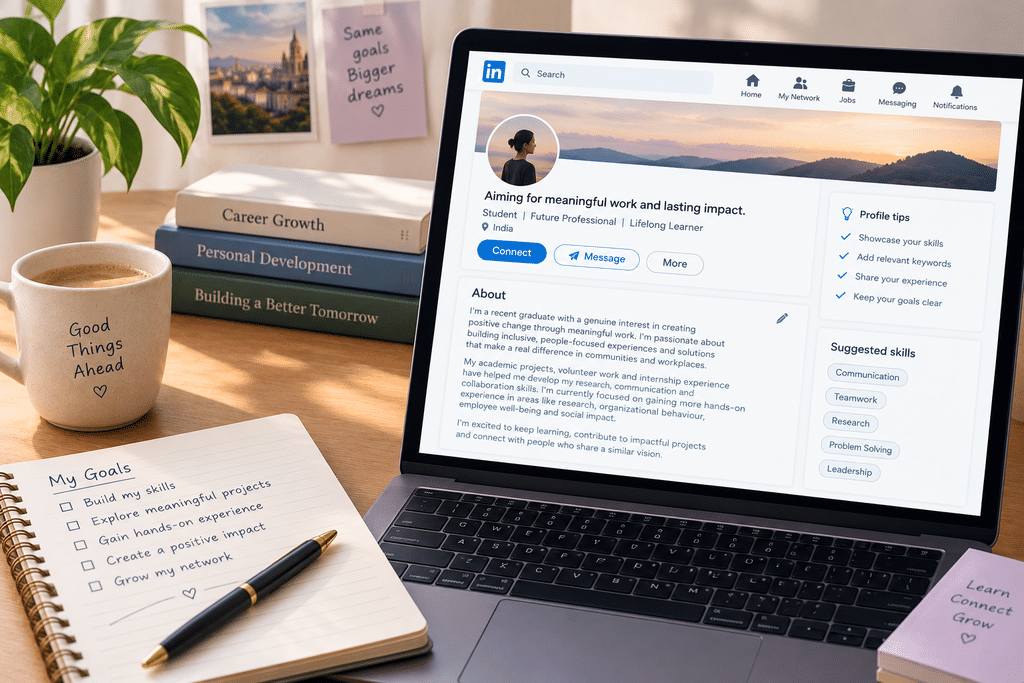
Your “about section” on LinkedIn is more than just a bio. It provides you the space to tell them what you care about professionally, what you can add, and where you want to go from there. This may be a strange writing situation for students and for others beginning their studies. This is about telling the truth about your interests, skills, and goals, not concealing gaps with a pretty package of words.
What the About section does:
About was named the Summary, but it’s where you tell readers about your professional self in your own words. The LinkedIn recruiter suggests discussing your mission, your motivation, and your skills. It gives space to 2,600 characters, including spaces, but be sure to check with the profile editor to see if the limit has been adjusted.
Select keywords that are appropriate for your objectives.
Job titles, skills, qualifications, and industry terms appear on LinkedIn profiles, and recruiters will be searching for these. Make sure you’re using the proper keywords, but not the same phrase over and over again, or it’s not going to magically raise your profile. LinkedIn never explained the percentages of how much each section would be given.
Find some of the key terms in job postings for positions you’re interested in that are mentioned repeatedly, like “project coordination,” “social media strategy” or “data analysis.” University career services typically instruct you to align your headings, abilities, and experiences with the types of jobs you are looking for.
Use keywords in the correct order, rather than in a list. Instead of just saying, “communication, teamwork, research, leadership,” mention where you applied those skills, in a project, placement, volunteer work, or in a university assignment, etc. If you can’t talk about it, don’t say it in an interview.
A helpful layout for the About section
- Start clearly. State what you are interested in, what job you want to get, or what you want to know about that is keeping you curious. Skip empty lines such as “I am a hardworking and passionate person.” Your readers should know what direction you are going within the first couple of pages.
- Give evidence. Discuss internships or school assignments that were beneficial, volunteer opportunities, research or responsibilities, and what you did and learned. Only use statistics if they are true; if they are not, they can hurt your credibility.
- Link skills with experience. Explain where you have used those abilities, instead of just listing them. If it’s research, something I’ve actually done, I can talk about literature reviews, writing surveys, collecting data, or analyzing data. I would only include the things that would fit into my experience.
- I would like to finish with a definite next step—what opportunities, conversations, or connections do I want to pursue? I can approach people and reach out to them in a friendly manner, not as a sales pitch.
I’ll try to keep the summary short and concise, using short paragraphs. Bullets can make it easier to read on LinkedIn.
This sample is just a guideline for students or recent graduates.
I need to change it so it reflects what I’ve really done.
I’m a psychology postgraduate with an interest in research, workplace well-being, and programs that genuinely enhance people’s experiences in organizations and communities. I found love in the evidence-based approach, as long as it is addressing real human problems rather than nice ideas on a page.
Academic projects, volunteer work, and placement experience have all sparked my own curiosity around research, communication, and community involvement. These experiences were clear: it is important to listen properly and that ideas will only succeed if they meet the real needs. Currently, my focus is particularly on psychological research, organizational behavior, employee well-being, and social impact work.
I want to continue developing my competencies in areas such as research, CSR, organizational well-being, etc. I’m interested in making professional connections and having conversations with people in these professions.
The rest of your profile should go in that direction. Your headline, Experience, Education, Skills, and Projects, should line up with it, not be separate. For research roles, include appropriate projects and methods as appropriate. You can also fill out the helpful sections and highlight your expertise or focus in the headline, as LinkedIn recommends.
An employer-friendly profile URL is much easier to share with employers and contacts. The public-profile settings need to be thoroughly reviewed because not only might people outside LinkedIn and search engines see more than you think, but they will be able to see more than you think. Changes don’t always appear in search results immediately.
Mistakes worth avoiding
- Writing an autobiography: Maintain a focus on your work interests and actually the experience.
- Filling in with keywords is counterproductive, too. Saying the same thing all over the place makes for a sluggish profile and will not even guarantee better search results.
- It’s worse to make up numbers. Use only results that you can verify and don’t claim a team win as your own.
- A dense set is difficult to read. Short paragraphs are easier to read, particularly on mobile phones.
- Not knowing what your goals are is another issue. The reader should be able to get a good idea of the fields you would like to investigate or what type of work you are looking for.
References
- LinkedIn, “Create a Good LinkedIn Profile,” LinkedIn Help. https://www.linkedin.com/help/linkedin/answer/a554351/edit-your-profile?lang=en
- LinkedIn, “Edit the About Section on Your Profile,” LinkedIn Help. https://www.linkedin.com/help/linkedin/answer/a553140/editing-the-about-section-in-your-profile?lang=en
- London School of Economics and Political Science, “LinkedIn: Looking for Work,” LSE Careers. https://info.lse.ac.uk/current-students/careers/information-and-resources/looking-for-work/linkedin
- LinkedIn, “How to Build a Strong LinkedIn Profile,” LinkedIn Social Impact. https://socialimpact.linkedin.com/content/dam/me/socialimpact-linkedin-com/lifg-resources/linkedin-training-content/linkedin-profile-tip-sheet.pdf
FAQs
1. What should I write in my LinkedIn About section?
Your LinkedIn About section should explain your professional interests, relevant skills, experiences, and career goals. Include examples from academic projects, internships, volunteering, or work experience to show how your interests connect to what you have actually done.
2. How do I write a LinkedIn About section with no work experience?
Focus on your education, academic projects, coursework, volunteering, personal projects, and transferable skills. Explain what you learned and what interests you about your chosen field. You do not need formal employment experience to create a credible LinkedIn profile.
3. How long should a LinkedIn About section be?
There is no ideal length for every profile. Aim to communicate your professional identity, relevant evidence, and goals in a few short paragraphs. LinkedIn’s character limit can change, so check the profile editor for the current limit.
4. Which keywords should I use in my LinkedIn About section?
Choose keywords related to your target roles, skills, industry, and qualifications. Review relevant job descriptions to identify recurring terms, such as research, project coordination, data analysis, or organizational behavior. Use them naturally and only when they reflect your experience or interests.
5. How can I optimize my LinkedIn profile for recruiters?
Use a clear headline, a focused About section, relevant experience and project descriptions, and accurate skills. Include role-specific keywords where appropriate and keep your profile consistent with the opportunities you want to pursue. Never claim qualifications or experience you cannot substantiate.
6. Should students write their career goals in the LinkedIn About section?
Yes. Students can explain the fields they want to explore, the questions that interest them, and the skills they are developing. Specific goals make a profile more informative than generic statements about being hardworking or passionate.
7. How often should I update my LinkedIn About section?
Review it whenever your career interests, skills, academic projects, or professional goals change. A quick review every few months can also help you remove outdated information and make your profile more relevant to your current direction.
8. Does adding keywords to LinkedIn guarantee better visibility?
No. Relevant keywords can help make your profile easier to understand and may help it match relevant searches, but visibility also depends on other factors. Keyword stuffing does not guarantee better rankings or recruiter attention.