
DSA Roadmap: Transitioning from Arrays to Graphs
Published: Oct 13, 2026
Key Points
- Understand Data Structures Progression: Follow a step-by-step learning path from arrays to graphs to build a strong foundation in data structures and algorithms (DSA).
- Master Arrays First: Practise array traversal, reversing, removing duplicates, two pointers, sliding windows, and prefix sums before moving to more advanced topics.
- Learn Essential Data Structures: Study strings, linked lists, stacks, and queues to understand how data is stored, accessed, and processed.
- Build Recursion Skills: Practise recursion with factorials, Fibonacci sequences, and subsets to prepare for tree and graph traversal.
- Understand Trees Before Graphs: Learn preorder, inorder, postorder, and level-order traversal to develop the skills needed for BFS and DFS.
- Explore Graph Fundamentals: Understand vertices, edges, directed and undirected graphs, weighted and unweighted graphs, adjacency matrices, and adjacency lists.
- Practise BFS and DFS: Learn breadth-first search (BFS) and depth-first search (DFS), two fundamental graph traversal algorithms used to solve many graph problems.
- Move to Advanced Algorithms: Progress to Dijkstra's algorithm, minimum spanning trees, union-find, and topological sorting after mastering graph traversal.
- Solve Problems Consistently: Practise problems such as counting islands, detecting cycles, cloning graphs, and scheduling courses to strengthen problem-solving skills.
- Focus on Consistency: Make steady progress through your data structures progression by solving problems regularly, reviewing mistakes, and revisiting difficult concepts.
1. Introduction
Every big skill starts with a small step
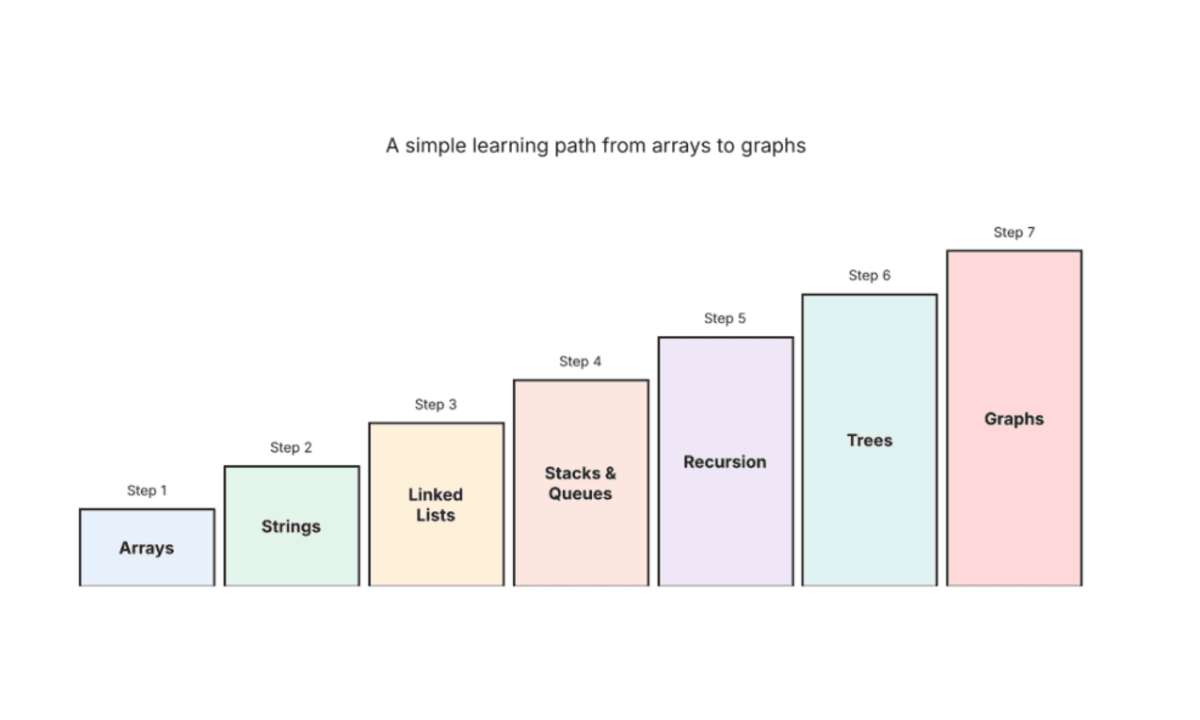
Most people begin their data structures journey with arrays, and honestly that is the right place to start. Graphs, on the other hand, are where a lot of learners get stuck. The jump feels huge because problems stop looking like lists and start looking like maps. This roadmap cuts that jump into smaller steps so the climb feels manageable instead of scary.
Following a structured data structures progression helps beginners understand how different concepts connect. By moving from arrays to linked lists, trees, and graphs, learners can develop problem-solving skills gradually and prepare for more advanced algorithms.
2. Start with Arrays
Learn to walk before you run
An array is a group of items of the same type stored next to each other in memory, and every item is reached through its index. That is why reading one element is so quick. Spend a few weeks here. Practise traversal, reversing, finding the largest value and removing duplicates. After that, move on to patterns that keep coming back, like two pointers, sliding window and prefix sums. These teach you to think about the cost of your code, a habit you will need again when graphs show up.
Arrays provide the foundation for data structures progression because they teach indexing, traversal, searching, and basic manipulation. Practising these operations helps learners understand how data is organized before moving on to more complex structures.
3. Strings and Linked Lists
Same idea, a little more freedom
Strings are close cousins of arrays, so they feel familiar. Linked lists are the first time you meet nodes and pointers. Each node holds a value and a link to the next one. It looks like a small idea, but it is the seed of every graph. If you can follow links without getting lost, you are already halfway ready. Try reversing a list and finding its middle node, since both problems use the same pointer thinking that graphs need.
4. Stacks, Queues and Recursion
Three tools you will use everywhere
A stack works last in, first out, while a queue works first in, first out. They are not just practice exercises. Depth first search leans on a stack and breadth first search leans on a queue. Recursion is the third piece, and you can think of it as a stack hidden inside your function calls. Do not rush it. Solve factorial, Fibonacci and subset problems until the order of the calls stops confusing you.
5. Trees
A graph with training wheels
A tree is a graph with no cycles and one clear starting point, which makes it the gentlest way to learn traversal. Practise preorder, inorder, postorder and level order. Notice that level order uses a queue while the others use recursion. That small difference is exactly the difference between BFS and DFS later. Even the well known textbook by Sedgewick and Wayne only reaches graphs in its fourth chapter, after fundamentals and sorting.
Trees represent an important stage in data structures progression. They introduce hierarchical relationships and traversal techniques that prepare learners to understand graph structures, where nodes can connect through multiple paths.
6. Meeting Graphs
Dots, lines and real world maps
A graph is a set of nodes joined by edges. Unlike a tree it can have cycles, many paths and no single root. Social networks, computer networks and the maps inside GPS apps all work this way. Learn the vocabulary first: directed and undirected, weighted and unweighted, connected and disconnected. Then learn the two common ways to store a graph, an adjacency matrix and an adjacency list. Lists save space when a graph has few edges, so they show up more often. Draw small graphs on paper before you write any code.
Understanding data structures progression becomes easier when you connect graph concepts with the structures you have already learned. Arrays introduce organized data storage, linked lists explain connections between nodes, and trees demonstrate hierarchical relationships. Graphs build on these ideas by allowing more flexible connections between vertices.
7. BFS and DFS
Two ways to explore the same map
Breadth first search visits nodes level by level, which makes it handy for finding the shortest path when every edge costs the same. Depth first search goes deep into one branch before backing up, and it suits cycle detection and topological sorting. Both run in O(V + E) time, where V is the number of vertices and E is the number of edges. Sedgewick and Wayne call them the two classic ways of searching a graph.
8. Beyond the Basics
Once traversal clicks, the rest follows
After BFS and DFS, move on to Dijkstra’s shortest path, minimum spanning trees with Prim and Kruskal, union find and topological sort. Then practise with classic problems such as counting islands in a grid, cloning a graph, detecting a cycle and scheduling courses. Try one problem a day and write down which pattern it used. That notebook will help you more than any video.
9. Conclusion
Progress beats speed
A successful data structures progression depends on consistent practice rather than memorizing algorithms. Solve problems for each topic, analyse time and space complexity, and revisit difficult concepts before advancing to more challenging graph algorithms.
Going from arrays to graphs is not a race. Plan for a few months of steady practice. The curve feels steep around recursion and again at graphs, and that is normal. Each topic you finish quietly prepares you for the next one. Keep notes, redo old problems, and do not feel bad about revisiting an earlier topic when something stops making sense. Slowly, graphs will start to feel like a bigger version of something you already know.
References
[1] R. Sedgewick and K. Wayne, “Algorithms, 4th Edition,” Pearson. [Online]. Available: https://www.pearson.com/us/higher-education/program/Sedgewick-Algorithms-Edition/PGM.html
[2] GeeksforGeeks, “Graph Algorithms,” GeeksforGeeks. [Online]. Available: https://www.geeksforgeeks.org/graph-data-structure-and-algorithms
[3] GeeksforGeeks, “Introduction to Arrays – Data Structure and Algorithm Tutorials,” GeeksforGeeks. [Online]. Available: https://www.geeksforgeeks.org/introduction-to-arrays-data-structure-and-algorithm-tutorials/
[4] R. Sedgewick and K. Wayne, “Algorithms, Part II,” Coursera. [Online]. Available: https://www.coursera.org/learn/algorithms-part
[5] PotatoScript, “Graphs,” GitHub Wiki. [Online]. Available: https://github.com/potatoscript/dsa/wiki/Graphs
Frequently Asked Questions
1. What is data structures progression?
Data structures progression is the process of learning data structures step by step, starting with basic concepts such as arrays and strings and advancing to linked lists, stacks, queues, trees, and graphs.
2. Why is understanding data structures progression important?
Understanding data structures progression helps learners build a strong foundation before tackling advanced topics. It makes complex concepts easier to understand and improves problem-solving skills.
3. Should I learn arrays before graphs?
Yes, learning arrays first is recommended because they introduce indexing, traversal, searching, and basic algorithmic thinking. These concepts provide a useful foundation for studying more advanced data structures, including graphs.
4. What should I learn after arrays in DSA?
After arrays, you can learn strings, searching and sorting algorithms, two pointers, sliding windows, prefix sums, and linked lists. These topics strengthen your understanding before you move to more advanced structures.
5. How long does it take to learn data structures and algorithms?
The time required depends on your programming experience, study schedule, and practice consistency. Beginners may need several months to build a solid foundation and longer to become comfortable solving advanced problems.
6. Are linked lists necessary before learning graphs?
Linked lists are helpful because they introduce nodes, references, and connections between elements. However, they are not strictly required before learning graphs if you already understand references and basic data structures.
7. What is the difference between a tree and a graph?
A tree is a connected, acyclic graph in its standard undirected definition. A graph is a more general structure that can contain cycles, disconnected components, and multiple paths between vertices.
8. What are the main topics to learn before graphs?
Before graphs, it is useful to understand arrays, strings, linked lists, stacks, queues, recursion, and trees. You should also be comfortable with basic programming, time complexity, and space complexity.
9. What is a graph in data structures?
A graph is a non-linear data structure consisting of vertices, also called nodes, and edges that connect them. Graphs are used to represent relationships in social networks, transportation systems, computer networks, and many other applications.
10. What is the difference between an adjacency matrix and an adjacency list?
An adjacency matrix represents a graph using a two-dimensional array, making edge lookups efficient. An adjacency list stores the neighbors of each vertex and is generally more space-efficient for sparse graphs.
11. What are BFS and DFS in graph algorithms?
Breadth-first search (BFS) explores a graph level by level, typically using a queue. Depth-first search (DFS) explores one path as far as possible before backtracking, typically using recursion or an explicit stack.
12. Which is easier to learn, BFS or DFS?
The answer depends on your experience. BFS can be easier to visualize because it explores level by level, while DFS may feel more intuitive if you already understand recursion. Practising both on small graphs is the best way to learn them.
13. What is the time complexity of BFS and DFS?
When a graph is represented using an adjacency list, both BFS and DFS typically run in O(V + E) time, where V represents the number of vertices and E represents the number of edges.
14. Do I need to learn recursion before trees and graphs?
Learning recursion before tree and graph algorithms is highly recommended because it helps you understand traversal and backtracking. However, many tree and graph algorithms can also be implemented iteratively using stacks and queues.
15. Which programming language is best for learning DSA?
C++, Java, and Python are all suitable for learning data structures and algorithms. Choose a language you understand well so you can focus on problem-solving rather than struggling with syntax.
16. What graph algorithms should I learn after BFS and DFS?
After BFS and DFS, study cycle detection, topological sorting, Dijkstra’s algorithm, minimum spanning trees using Prim’s and Kruskal’s algorithms, and disjoint-set union (union-find).
17. What are some common graph problems for beginners?
Beginners can start with graph traversal, counting connected components, detecting cycles, counting islands in a grid, checking whether a path exists, and finding the shortest path in an unweighted graph.
18. How many DSA problems should I solve daily?
Start with one to three problems daily, depending on their difficulty and your available time. Focus on understanding the approach, analysing complexity, and reviewing mistakes rather than solving a large number of problems without understanding them.
19. Can beginners learn graphs without mastering every data structure?
Yes. Beginners can start learning graphs once they understand basic programming, arrays or lists, queues, stacks, and the fundamentals of traversal. You can learn advanced graph algorithms gradually as your skills improve.
20. What is the best way to follow a data structures progression roadmap?
Follow a structured learning path: arrays and strings, linked lists, stacks and queues, recursion, trees, graph fundamentals, BFS and DFS, and advanced graph algorithms. Practise regularly, analyse time and space complexity, and revisit difficult problems to reinforce your understanding.
Citations & References
[1] R. Sedgewick and K. Wayne, “Algorithms, 4th Edition,” Pearson. [Online]. Available: https://www.pearson.com/us/higher-education/program/Sedgewick-Algorithms-Edition/PGM.html
[2] GeeksforGeeks, “Graph Algorithms,” GeeksforGeeks. [Online]. Available: https://www.geeksforgeeks.org/graph-data-structure-and-algorithms
[3] GeeksforGeeks, “Introduction to Arrays – Data Structure and Algorithm Tutorials,” GeeksforGeeks. [Online]. Available: https://www.geeksforgeeks.org/introduction-to-arrays-data-structure-and-algorithm-tutorials/
[4] R. Sedgewick and K. Wayne, “Algorithms, Part II,” Coursera. [Online]. Available: https://www.coursera.org/learn/algorithms-part
[5] PotatoScript, “Graphs,” GitHub Wiki. [Online]. Available: https://github.com/potatoscript/dsa/wiki/Graphs
Streamline Your Hiring with Eve Placement
Engage, assess, and recruit top talent through tailored AI hiring challenges that go beyond resumes. Ready to hire better? Contact our research team for a custom consultation.