
7 Powerful Caching Strategies Freshers Should Know for System Design
Published: Oct 15, 2026
Key Points
- Caching system design improves application performance by storing frequently accessed data in faster storage.
- Cache-aside is a beginner-friendly strategy that reduces repeated database queries.
- Time to Live (TTL) helps manage cached data freshness by setting an expiration time.
- Cache hits and misses help developers measure how effectively a cache serves requests.
- Cache eviction policies, such as Least Recently Used (LRU), manage limited cache memory efficiently.
- Write-through caching keeps the cache updated as part of the write process, while cache-aside commonly relies on cache invalidation.
- Cache invalidation prevents outdated information from remaining available after the original data changes.
- Cache stampedes and hot keys can affect performance under heavy traffic and require appropriate mitigation strategies.
- Monitoring cache hit rate, response time, memory usage, and database load helps evaluate caching performance.
- Choosing the right caching strategy depends on application requirements, data freshness, traffic patterns, and available resources.
Introduction
If you are preparing for your first system design interview, caching system design can sound more complicated than it really is. You hear terms such as cache hit, TTL, invalidation, cache-aside and write-through, and suddenly a simple “make the app faster” problem feels like a huge architecture discussion. The good news is that the basic idea is quite simple: keep frequently needed data somewhere faster than the main database, then reuse it when another request asks for the same thing.
Understanding caching system design helps beginners learn how modern applications manage frequently requested data. By selecting suitable caching strategies, developers can reduce database queries, improve response times, and build applications that handle increasing user traffic efficiently.
1. Start with Cache-Aside
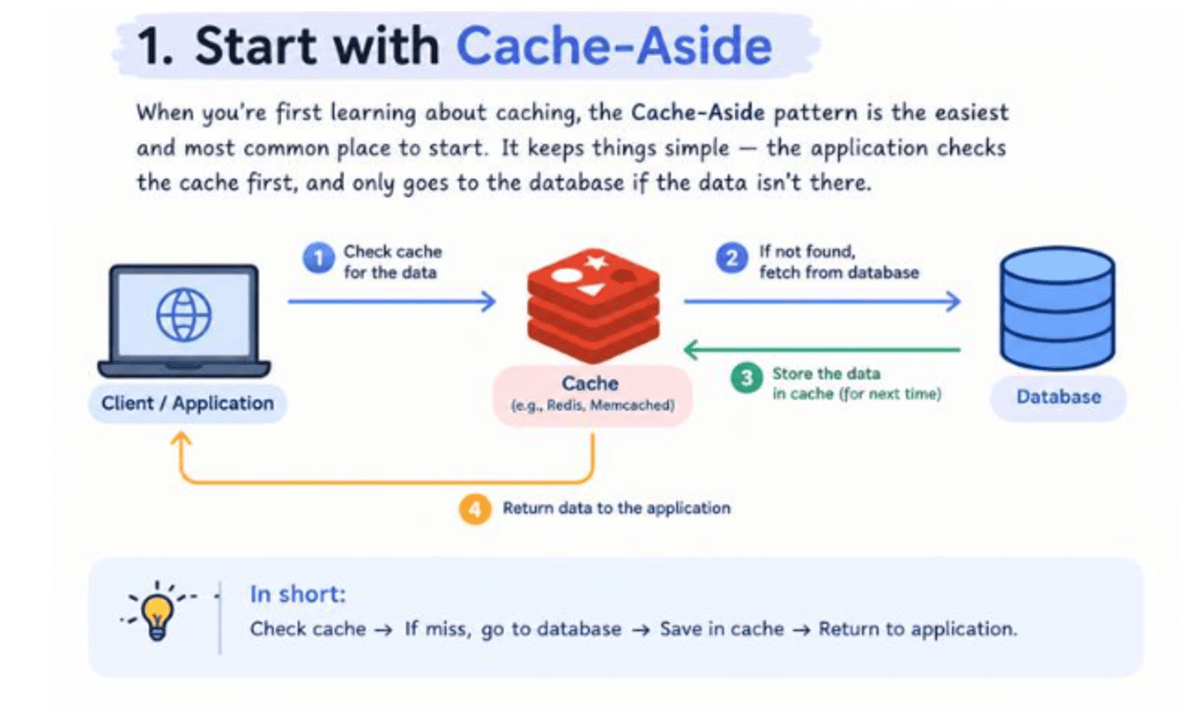
Cache-aside, also called lazy caching, is usually the easiest pattern for a fresher to understand. The application first checks the cache. If the requested data is there, it returns it immediately. If it is missing, the application gets the data from the database, puts a copy in the cache and then returns it to the user. The next request can use the cached copy instead of hitting the database again.
Imagine a food-delivery app showing the details of a popular restaurant. Thousands of users may request the same restaurant information. Reading that information from the database every time is unnecessary. With cache-aside, the first request may be slower because the data is not cached. After that, repeated requests can be served from memory. This is one reason cache-aside is a useful starting point when discussing performance optimization in an interview.
2. Use TTL Instead of Keeping Data Forever
A cache should not become a second permanent database. Cached information can become old, especially when the original record changes. TTL, or time to live, gives every cache entry a limited lifetime. For example, a restaurant menu could be cached for five minutes, while a rarely changing configuration value could stay cached much longer.
TTL is useful because it gives you a simple answer to the freshness problem. You do not have to manually remove every old entry immediately. Once the TTL expires, the application can fetch the latest value and populate the cache again. The exact TTL should depend on how quickly the underlying data changes and how much stale information the product can tolerate.
3. Understand Cache Hits and Cache Misses
Two small terms can tell you a lot about whether a cache is doing its job. A cache hit happens when the requested item is already available in the cache. A cache miss happens when it is not, so the application has to look somewhere else, usually the database.
Suppose an API receives 1,000 requests for data during a period and 800 of them are served directly from the cache. The cache hit rate is 800 ÷ 1,000 × 100 = 80%. A higher hit rate generally means the cache is taking more work away from the database, although a high hit rate alone does not prove that the entire system is healthy. This is an important metric to mention when discussing software architecture speed.
4. Pick a Cache Eviction Strategy
Cache memory is limited, so eventually some entries have to leave. This is where eviction policies become important. A common approach is LRU, or Least Recently Used. It removes entries that have not been used for a long time, making room for data that is being requested more often.
Other strategies can be useful depending on the workload. For example, an application might remove the item with the shortest remaining TTL or use a policy based on how frequently entries are accessed. For a fresher, the important point is not to memorize every policy. Instead, explain why you need eviction: cache memory is finite, and the system needs a sensible way to decide what stays.
5. Choose the Right Write Strategy
Caching is not only about reading data. You also need to think about what happens when information changes. In a write-through approach, the application writes the updated value to the cache as part of the write flow, so the cache is kept up to date along with the primary data store. In a cache-aside design, the application commonly updates the database and then invalidates the related cache entry. The next read repopulates the cache.
There is no single strategy that wins everywhere. If the application reads data far more often than it writes it, cache-aside can be a straightforward choice. If keeping the cache synchronized during writes is especially important, a write-through design may be worth considering. In an interview, explaining the trade-off is usually more valuable than simply naming a pattern.
In practical caching system design, developers must consider data consistency, cache expiration, and application traffic. A suitable strategy depends on how frequently the data changes, how quickly users need updated information, and how much memory is available.
6. Do Not Ignore Cache Invalidation
There is an old engineering joke that only a few things are hard: naming things, cache invalidation and off-by-one errors. The joke exists for a reason. A cache can make a system much faster, but stale data can create real product problems.
Consider a ride-booking app. If a driver’s availability is cached for too long, a customer could see a driver who is no longer available. That does not mean caching should be avoided. It means the data needs a strategy that matches its freshness requirements. You might use a short TTL, explicit invalidation after an update, or avoid caching that particular value altogether.
7. Watch for Stampedes and Hot Keys
Caching can also create problems when many requests arrive at once. A cache stampede can happen when a very popular item expires and a large number of requests suddenly miss the cache at the same time. Instead of protecting the database, the cache can accidentally send a wave of requests toward it.
One way to reduce this risk is to make only one request responsible for rebuilding a missing popular entry while other requests wait briefly or use an acceptable stale value. Another issue is a hot key: one particular cache entry receives an unusually large share of traffic. In a large system, that key may need special handling, such as replication or distributing the load.
What Should a Fresher Say in an Interview?
You do not need to throw every caching term into your answer. Start with the problem. Say that the database is receiving repeated reads and latency is increasing. Then propose a cache for frequently requested data. Explain the read flow: check cache, return on a hit, query the database on a miss, and populate the cache. After that, discuss TTL, invalidation, eviction, monitoring and failure cases.
For example, if an interviewer asks you to design a product-details service, you could say: “I would start with a cache-aside strategy because product details are read frequently. The service checks the cache first, falls back to the database on a miss, and stores the result with a TTL. When product information changes, I would invalidate the relevant key. I would monitor hit rate, latency, cache memory and database load.” That answer is simple, but it shows that you understand the architecture rather than just memorizing definitions.
Conclusion
Caching is basically a trade-off between speed, memory, freshness and complexity. The best design is not the one with the most caching. It is the one that caches the right data for the right amount of time and has a clear plan for stale or missing entries.
References
[1] Amazon Web Services, “Caching patterns – Database Caching Strategies Using Redis,” AWS Prescriptive Guidance. [Online]. Available: https://docs.aws.amazon.com/whitepapers/latest/database-caching-strategies-using-redis/caching-patterns.html
[2] Amazon Web Services, “Caching Best Practices,” AWS. [Online]. Available: https://aws.amazon.com/caching/best-practices/
[3] Redis, “Redis cache-aside,” Redis Documentation. [Online]. Available: https://redis.io/docs/latest/develop/use-cases/cache-aside/
[4] Mozilla Developer Network, “HTTP caching,” MDN Web Docs. [Online]. Available: https://developer.mozilla.org/en-US/docs/Web/HTTP/Guides/Caching
[5] Mozilla Developer Network, “Cache-Control header,” MDN Web Docs. [Online]. Available: https://developer.mozilla.org/en-US/docs/Web/HTTP/Reference/Headers/Cache-Control
Frequently Asked Questions
1. What is caching in system design?
Caching in system design is the process of storing frequently accessed data in a faster storage layer so applications can retrieve it quickly without repeatedly querying the primary database.
2. Why is caching important in system design?
Caching reduces response times, decreases database load, improves application performance, and helps systems handle more user requests efficiently.
3. What is the cache-aside pattern?
Cache-aside is a caching strategy in which an application checks the cache first. If the data is missing, it retrieves the data from the database, stores it in the cache, and returns it to the user.
4. What is TTL in caching?
TTL stands for Time to Live. It specifies how long a cached item remains valid before it expires and may need to be fetched again from the original data source.
5. What is a cache hit?
A cache hit occurs when the requested data is found in the cache and can be returned without querying the primary database.
6. What is a cache miss?
A cache miss occurs when the requested data is not available in the cache. The application must retrieve it from another source, such as a database.
7. What is cache hit rate?
Cache hit rate is the percentage of cache requests successfully served from the cache. It is calculated by dividing cache hits by total cache requests and multiplying by 100.
8. What is a cache eviction policy?
A cache eviction policy determines which items should be removed when the cache reaches its memory limit. Common policies include LRU, LFU, and FIFO.
9. What is the LRU caching strategy?
LRU stands for Least Recently Used. It removes the cache entry that has not been accessed for the longest time when space is needed for new data.
10. What is the difference between cache-aside and write-through caching?
Cache-aside typically updates the database and invalidates the related cache entry, allowing the next read to repopulate it. Write-through updates the cache as part of the write flow alongside the primary data store.
11. What is cache invalidation?
Cache invalidation is the process of removing or marking cached data as outdated when the original data changes, helping prevent applications from serving stale information.
12. What is a cache stampede?
A cache stampede occurs when many requests simultaneously attempt to retrieve data from the database after a popular cache entry expires or becomes unavailable. It can increase database load significantly.
13. What is a hot key in caching?
A hot key is a cache entry that receives a disproportionately large number of requests. It can create a performance bottleneck and may require replication or load distribution.
14. Which caching tools are commonly used in system design?
Redis and Memcached are popular in-memory caching technologies. Applications may also use browser caches, content delivery networks (CDNs), and HTTP caching to improve performance.
15. How should freshers explain caching system design in an interview?
Freshers should explain why caching is needed, describe the cache-aside read flow, discuss TTL and cache invalidation, and mention monitoring metrics such as hit rate, latency, memory usage, and database load.
16. What are the main benefits of caching system design?
Caching system design reduces database load, improves response times, and helps applications handle more user requests. It is especially useful when multiple users frequently request the same data.
17. When should developers use caching in system design?
Developers should consider caching when data is requested frequently, database queries are expensive, or low response times are important. The caching strategy should also account for data freshness requirements.
18. What are the common challenges in caching system design?
Common challenges in caching system design include stale data, cache invalidation, limited memory, cache stampedes, and hot keys. Developers can address these issues with appropriate expiration policies, monitoring, and cache management techniques.
19. How does caching system design improve application scalability?
Caching system design improves scalability by serving repeated requests without querying the primary database every time. This reduces database workload and allows the application to handle higher traffic more efficiently.
20.How do you choose the right caching system design?
Choosing the right caching system design depends on application traffic, data freshness requirements, memory limits, and database load. Developers should evaluate caching patterns, expiration policies, and invalidation methods before selecting an approach.
Citations & References
[1] Amazon Web Services, “Caching patterns – Database Caching Strategies Using Redis,” AWS Prescriptive Guidance. [Online]. Available: https://docs.aws.amazon.com/whitepapers/latest/database-caching-strategies-using-redis/caching-patterns.html
[2] Amazon Web Services, “Caching Best Practices,” AWS. [Online]. Available: https://aws.amazon.com/caching/best-practices/
[3] Redis, “Redis cache-aside,” Redis Documentation. [Online]. Available: https://redis.io/docs/latest/develop/use-cases/cache-aside/
[4] Mozilla Developer Network, “HTTP caching,” MDN Web Docs. [Online]. Available: https://developer.mozilla.org/en-US/docs/Web/HTTP/Guides/Caching
[5] Mozilla Developer Network, “Cache-Control header,” MDN Web Docs. [Online]. Available: https://developer.mozilla.org/en-US/docs/Web/HTTP/Reference/Headers/Cache-Control
Streamline Your Hiring with Eve Placement
Engage, assess, and recruit top talent through tailored AI hiring challenges that go beyond resumes. Ready to hire better? Contact our research team for a custom consultation.