
Table of Contents
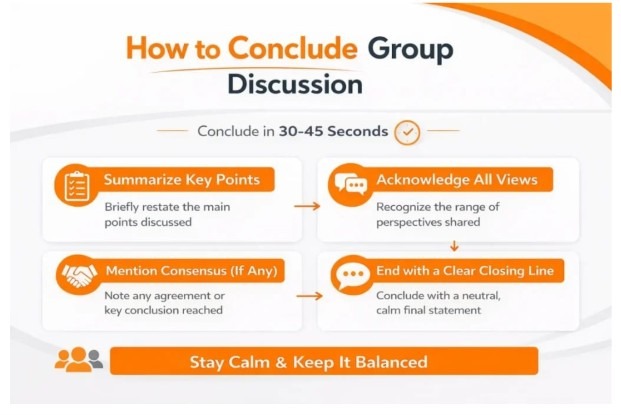
Group discussion (GD) plays a very important part of campus placement and recruitment. They evaluate and pass judgment not only a candidate’s knowledge. Communication, confidence, ability to listen, work well as part of a team, logical thinking, and presentation of ideas are also assessed. The art of being able to summarise is one of the most important skills in the GD. A well written conclusion can help make a good impression especially during the closing of the discussion, if a candidate can write such a conclusion.
Why is it important at all to summarise in a GD?
The summary combines the essential elements presented by the various participants. Shows that you heard and considered more than one perspective. Careful organisation is also indicative of thoughtfulness, analysis and good communication.
This will certainly bring attention to a candidate in campus placement GDs when he/she is able to complete the GD with confidence and objectivity. A summary, however, should not present a new idea. Rather, it should link the key points spoken about in the GD and offer a well-rounded end.
This is a simple formula to use for summarizing GD.
The following is a helpful guideline for a group discussion:
Listen → Identify → Organize → Summarize → Conclude
1. Listen Actively
Respect others’ comments during discussion. Record the most compelling arguments, examples to support the arguments, counterarguments, and points of agreement. Don’t prepare own speech while another person is talking.
2. Identify Key Points
The summary doesn’t need to include all statements. Make sure to emphasize the most important and common concepts. List the key arguments, pros and cons, issues and solutions that were presented by the group.
3. Organize the Ideas
Arrange points in the proper order. They can be presented from a different perspective such as advantages and disadvantages, cause and effect, problem and solution or opinion.
4. Summarize Clearly
Start with a statement like, “To sum up the discussion…”. State the overall opinion, referring to and criticising individuals is not recommended.
End with a well-rounded conclusion.
The ending should be suitable to the discussion. Express a realistic solution or fair position (if any). Ending should be short and bold.
What NOT to Do?
Summarize, don’t restate the entire discussion. The summary should be brief, concise and succinct. Don’t assume that your opinion was the only right one, interrupting others, or putting in “irrelevant” information.
Avoid saying ‘except me. Rather, attempt to use professional language such as, “The discussion reflected varying viewpoints with some participants discussing benefits and challenges.”
The following examples show how to write a good GD conclusion.Following are some examples of a good GD conclusion.
When a topic is provided as “Is Artificial Intelligence a Threat to Employment?”.
A likely conclusion is
To sum up, the talk pointed out both opportunities and concerns concerning AI. Some jobs will be automated, while new skills will be required and people will need to undergo new training to use AI, creating new career opportunities and increasing productivity. The battle against the use of AI is by no means over, but at the same time, how to prepare people with the right skills and training to face the future of the workplace is indeed a challenge.
This type of conclusion will demonstrate listening and thinking, communicating, and integrating multiple perspectives.
In Interview Rounds, summarization is used to convey the meaning of a section of a conversation.
Skills shown in a GD will also be beneficial for personal interviews. Employers will want individuals that can convey their ideas in an understandable manner, listen better, think through what they hear, and be assertive. Successful summarization is a clue that the candidate is able to “think inside the box” and communicate the material in a logical sequence.
Therefore, practising GD summaries can be beneficial for communication skills not only for placements in the campus but also for the interview.
Final Thoughts
The critical element in a good GD isn’t to talk the most. It’s about adding value and taking others’ point of view, and going forward. The ability to use all of these skills in a single, eloquent closing statement is best combined in effective summarization.
Keep in mind the acronym L.I.O.S.C:Listen, Identify, Organize, Summarize, Conclude. Candidates can develop their confidence level and improve communication skills by practising regularly and make a good impression in campus placement and interview rounds and preparing for group discussions.
References
[1]Source: gdpiwat.in
https://share.google/6F6N4pfoVYNxCj7kn
[2]Source: Pearson PTE
https://share.google/RNwZ7MQLD5H2WLmdE
[3] Source: New Horizon International School
https://share.google/Odgcx4JwXBybRu0Hh
FAQs
1. Why is summarizing important in group discussion GD?
The summary combines essential elements presented by various participants. It shows you heard and considered more than one perspective. Careful organisation indicates thoughtfulness, analysis and good communication, bringing attention to a candidate in campus placement GDs.
2. What is the L.I.O.S.C formula to conclude group discussion?
L.I.O.S.C = Listen → Identify → Organize → Summarize → Conclude. 1. Listen actively and note compelling arguments. 2. Identify key points, pros/cons. 3. Organize ideas as advantages/disadvantages or problem/solution. 4. Summarize clearly starting with “To sum up the discussion…”. 5. Conclude with balanced, realistic solution.
3. How to conclude group discussion in 30-45 seconds?
Use 4 steps: 1. Summarize Key Points – briefly restate main points discussed. 2. Acknowledge All Views – recognize range of perspectives shared. 3. Mention Consensus (If Any) – note any agreement or key conclusion reached. 4. End with a Clear Closing Line – conclude with neutral, calm final statement. Stay calm and keep it balanced.
4. What NOT to do while summarizing GD?
Don’t restate entire discussion, don’t add new ideas, don’t say your opinion was the only right one, don’t interrupt others, don’t put irrelevant information, don’t criticize individuals. Avoid saying “except me”. Use professional language like “The discussion reflected varying viewpoints…”
5. Can you give an example of good GD conclusion?
For topic “Is Artificial Intelligence a Threat to Employment?”: “To sum up, the talk pointed out both opportunities and concerns concerning AI. Some jobs will be automated, while new skills will be required and people will need new training to use AI, creating new career opportunities and increasing productivity. The challenge is how to prepare people with right skills for future workplace.”
6. How does GD summarization help in interview rounds?
Skills shown in GD – conveying ideas understandably, listening better, thinking through what you hear, being assertive – are beneficial for personal interviews. Successful summarization shows candidate can “think inside the box” and communicate logically, improving communication for campus placements and interviews.