
Table of Contents
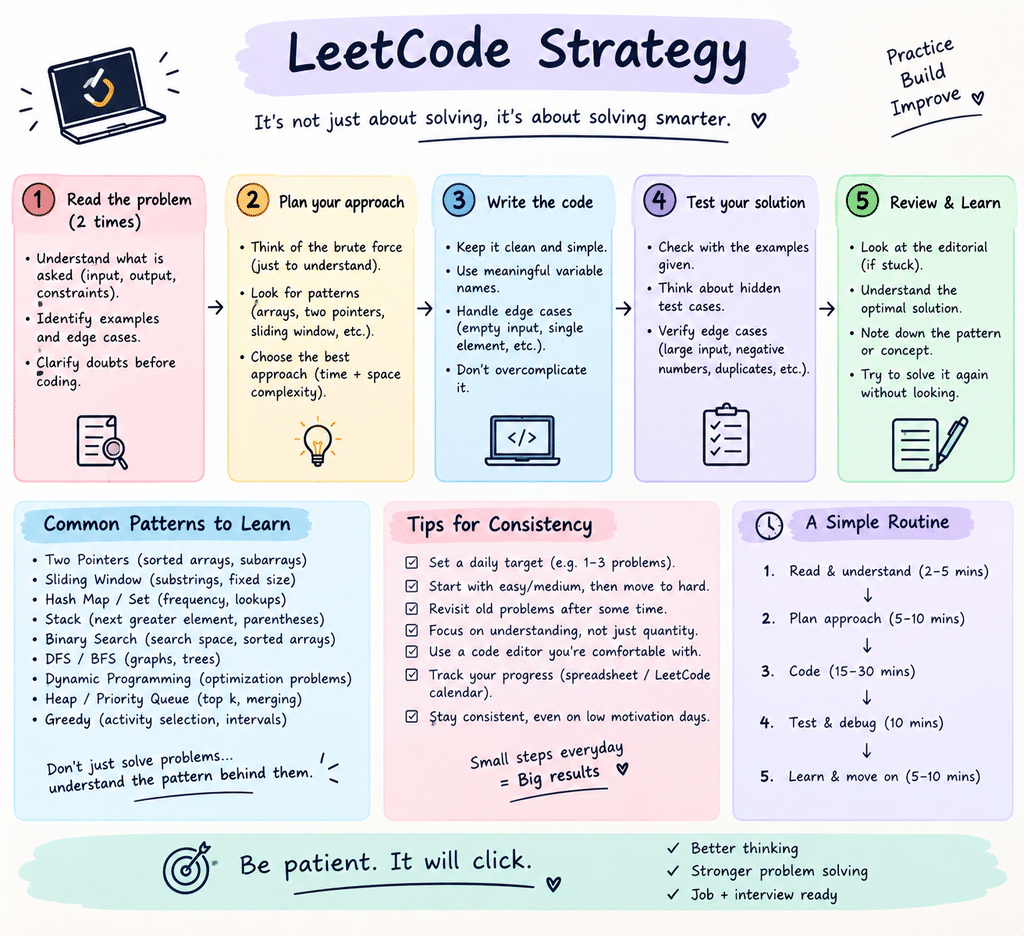
LeetCode Strategies: How to Maximize Your Problem-Solving Speed
Solving DSA problems is not about writing code. It is actually understanding the question first , then choosing the right approach as to how to solve it and ensuring DSA problem solutions work correctly. Following a proper process can make solving the problem easier and helps to perform better in coding interviews.
Why Speed Matters
Speed is really important when you are, in an interview. There might be only forty five minutes to solve a problem. Explain it in your own way . Write the code, check it. Explain ways to make it better. Spend thirty to forty minutes trying to understand the basic way to start.
It is not necessary that every problem needs to be solved in twenty minutes. Some problems are really hard and complicated. The goal is to know patterns well enough. So do time trying to decide where to start.
A Simple 6-Step Framework for Solving DSA Problems
Solving DSA problems is more than writing code.Understanding the problem is a step. Picking the approach is next. It is necessary to ensure the solution works correctly for the problem. If you follow a fixed process, problem solving becomes easier. Doing this can help you perform better in coding interviews.
Here are six steps I can follow while solving a data structures and algorithms problem whether it is easy, medium or hard.
Step 1: Understand the Problem Properly.
Before writing any code I make sure to read the question at least twice. First, figure out what the question is asking. Then examine the examples carefully.and look for any cases that might influence the solution. Make sure to read the question at least twice. Figure out what the question is asking. Examine the examples carefully. Look for any cases that might influence the solution.
Ask yourself:
- What needs to be found or returned?
- What should happen if the input is empty or contains one element?
- Can the input contain numbers, zeros or duplicates?
- Is the array sorted or’s the array unsorted?
- Are the indices starting from 0 or are the indices starting from 1?
Step 2: Check the Constraints
Constraints tell you how big the input can get. They give you a clue about what kind of solution might work.
For example if a question asks you to find a substring that does not have repeating characters the sliding window method can help you. If the array has 100,000 elements using the sliding window method, this task could take too long. The key point is to look at the constraints. That way you can avoid solutions that’re probably too slow.
Step 3: Think of the Brute-Force Approach First
- Before looking for an efficient solution it is important to take a moment to think first about the simple way to solve the problem. And this is called the brute-force approach. It might not be the fastest. It works. It helps you understand the problem better.
- For instance if the question asks you to find a substring with no repeating characters the sliding window method is a way to think about it. It helps you move through the input in a way one step, at a time.
- As you keep solving problems you’ll start to recognize these patterns naturally.
- If you’re stuck and can’t see which method to use, go back. Look again at the limits of the input. Think about how the data’s set up. Also ask yourself what the problem wants you to find. Sometimes the answer is hidden in the details.
Step 4: Identify the Right DSA Pattern
This is often the part, especially when you are just starting out with DSA. Many problems seem different at first. Can be solved with the same methods.
Trying to remember every answer focuses on learning to spot common ways to solve problems.
For instance if a problem wants you to find the substring that has no repeated letters the sliding window method is a good way to think about it.
If you do not see a way to review the limits, examine how the input is set up and understand what the problem is asking you to find.
Step 5: Write Clean and Understandable Code
Once you have chosen a way to fix the problem you should begin writing code. If you prefer, try to make code fast or short.
Remember these ideas:
- Use names for variables that make sense. Names like left, right and target are easier to understand than letters when they show what the variables are for.
- Handle important edge cases. Ensure code works, for inputs, single elements and other relevant special cases. Keep logic organized. Do not make code unnecessarily complicated.
- In an interview it becomes helpful to explain while coding. For example, say, “I am using two pointers to examine the array without checking every pair.” This allows the interview to follow an approach and give feedback if needed.
Step 6: Test, Verify and Optimize Your Solution
- Double check the code and ensure that the code runs smoothly
Before moving, do three things.
1. Dry-run your code
The examples that are provided in the question , walk through those examples and code carefully one step at a time.
2. Check the time and space complexity
Learn how time and extra memory your solution takes.
The real complexity depends on the way you build it so make sure you can explain why those values are correct.
3. Test the edge cases again
Go back to Step 1 and make sure your answer works for them.
At the end, consider if there is a way. Can you do steps or use less extra space?
If someone wants your answer to be better see it as a chance to try methods and look at the pros and cons.
Source: ChatGpt
Reference:
[1] “How to Solve LeetCode Problems Faster: The Complete Speed Guide,” DEV Community, Feb. 27, 2026.[Online].[Available] How to Solve LeetCode Problems Faster: The Complete Speed Guide – DEV Community
[2] “How to Solve LeetCode Problems: A Step-by-Step Framework (2026),”. [Online]. [Available]. How to Solve LeetCode Problems Faster: The Complete Speed Guide – DEV Community
FAQs
1. What is the best process to solve any DSA problem?
Follow a fixed 6-step framework: 1) Understand the problem properly, 2) Check constraints, 3) Think of brute-force first, 4) Identify the right DSA pattern, 5) Write clean code, 6) Test, verify and optimize. This prevents you from jumping straight into code and getting stuck.
2. Why should I not start coding immediately?
Because most mistakes happen due to misunderstanding the question. Reading the question twice, checking examples, and clarifying edge cases like empty input, duplicates, sorted/unsorted array, and 0-based vs 1-based indexing saves you 30-40 minutes of debugging.
3. Why are constraints so important?
Constraints tell you what solution will pass. If n <= 10^3, O(n^2) might work. If n <= 10^5, you need O(n log n) or O(n). Constraints help you choose between brute-force, sliding window, two pointers, binary search, DP, etc.
4. Why should I think of a brute-force solution first?
Brute-force is not a waste of time. It helps you:
- Prove you understood the problem
- Have a fallback solution to explain in an interview
- Identify the repetitive work that you can optimize with a pattern
5. How do I identify the right DSA pattern quickly?
Don’t memorize 500 problems, memorize 15-20 patterns. Some clues:
- Find subarray/substring without repetition, max/min -> Sliding Window
- Sorted array, find pair/target -> Two Pointers / Binary Search
- Top K, frequent elements -> Heap
- Combinations, permutations -> Backtracking
- Shortest path, levels -> BFS / DFS
- Optimization with choices -> Dynamic Programming
If you’re stuck, re-read the constraints and what the problem asks you to return.
6. Why does speed matter in a coding interview?
You usually have only 45 minutes to: understand the problem, explain your approach, code it, dry-run it, and optimize. Interviewers are not looking for 20-minute solutions for every problem. They are looking for a structured approach and clear communication. If you know patterns, you don’t waste time deciding where to start.
7. How should I write code in an interview?
Keep it clean and explainable:
- Use meaningful variable names:
left, right, targetinstead ofi, j, k - Handle edge cases: empty array, single element, all duplicates
- Keep logic modular and avoid over-complication
- Talk while you code: e.g., “I’m moving the left pointer to shrink the window when we have a duplicate.”
8. How do I properly test my solution?
Do these 3 things before you say you’re done:
- Dry-run: Walk through the given examples line-by-line.
- Complexity check: State Time and Space complexity and justify it.
- Edge case test: Test with
[],[1],[1,1,1], negative numbers, zeros.
9. What if I get stuck and can’t find the pattern?
Go back to Step 1 and Step 2. Ask yourself:
- What exactly do I need to return?
- How is the input structured?
- What do the constraints allow?
Often the answer is hidden in the details. Also try to reduce the problem to a smaller example.
10. Do I need to give the most optimal solution every time?
No. Start with brute-force, then optimize. Interviewers prefer seeing your thought process from simple -> better -> optimal. If you can explain trade-offs between time and space, that’s a strong signal.