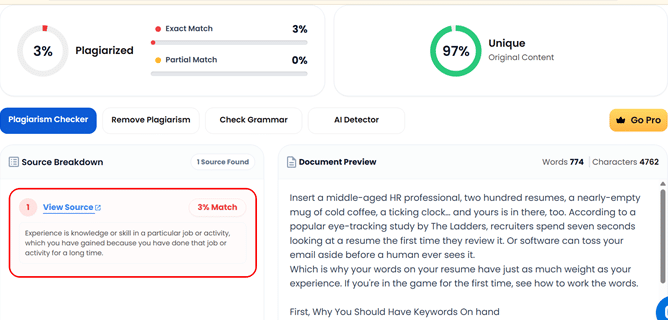
Resume Keywords to Get Noticed
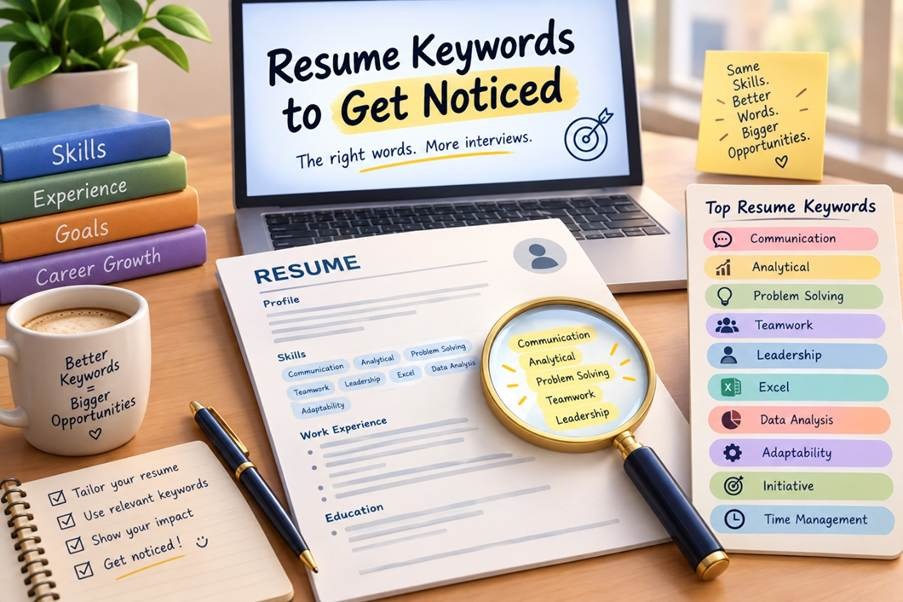
Insert a middle-aged HR professional, two hundred resumes, a nearly-empty mug of cold coffee, a ticking clock… and yours is in there, too. According to a popular eye-tracking study by The Ladders, recruiters spend seven seconds looking at a resume the first time they review it. Or software can toss your email aside before a human ever sees it.
Which is why your words on your resume have just as much weight as your experience. If you’re in the game for the first time, see how to work the words.
First, Why You Should Have Keywords On hand
Applicant Tracking System (ATS) ‘loads’ companies use an ATS to collect, sort and filter applications. It isn’t a person. It searches for the job title, skills, tools, accreditation – and then points to words that appear on both your CV and the job spec.
Quick fact to remember. ATS won’t actually turn you down (they prefer to put you in the right pile, ready for recruiters to search the resume database for pivotal words). You won’t get any ‘hits’ if your resume doesn’t have the words in it that they’re searching for. A Harvard Business School and Accenture 2021 research report on Human Resources trends identified that this rigidity of the automated recruiting process is allowing talented job seekers to go unseen – so don’t leave your visibility to fate!
Step 1: Scrape the job description.
The most relevant topics aren’t in the blog, but you can see them in the job description you’re applying for.
Put it into a new document and underline the words that appear often. The software tools listed below are Excel, Python, and Salesforce. The A has offered listed here are actually information evaluation and also client engagement. In this way, the favourite is proposing that if a condition is utilised 3 times, that’s enough.
15 if you truly want to… Replicate exactly the way they talk. For instance, they might say “customer success”, and you reply with ‘client support’ Don’t make any adjustments. These are the things you save for the interview.
step 2 : use action words that show you made a difference- ‘Was in charge of delivering the social media’ explains what you did, ‘Increased Instagram engagement by 35% over three months’ explains what the outcome was.
A strong action verb resume replaces filler and uncertain words with potent, specific words:
Leadership: Organized, Mentored, Coordinated, Led
Analysis: Evaluated, examined, forecast, discovered
New: unusual, strange, odd, novel, original, fresh, different, cool Better: improved, benefited, further, grow, gained, enhance, strengthen, better, sharpen, upgrade… Established: laid, related, lined, designed, constructed, extended, ranged, laid out..
Step 3: Choose industry keywords related To the industry in which you operate.
Industry-specific language applies to technical skills, too. A marketing candidate, for example, would be expected to know things like ‘content strategy’, ‘SEO’ and ‘Google Analytics’. A graduate with a software degree would know things like ‘REST APIs’, ‘Git’, and ‘agile’, while a finance graduate would talk about ‘financial modelling’ and ‘reconciliation’.
Also, include industry keywords that a fresher can genuinely claim, so focus on what you own (e.g., Academic projects, internships, hackathons, college clubs, certifications (Google, Coursera, NPTEL, etc.), and volunteer work). If you’ve done a final-year project in SQL/Python, treat it as real experience and label it.
Step 4: Put Keywords Where It Matters
Distribute keywords in these sections naturally:
Summary: A1 or two or three lines about what you want to achieve and the best about what you can do.
Skills: Clearly defined skills and tools (think “skills list”). SEO is always spelt out in full at first use.
Practical experience & samples: the very words you would like to see in your real accomplishment – where they are most needed.
Education and certificates: Courses and certificates relevant.
Step 5: Make the Format ATS-Friendly
You could even have the perfect keyword list, but if you use a heading like “Career Path” that the software won’t recognise as “Experience,” it won’t do you any favours. Stick to a plain-vanilla, single-column document with common fonts and no text boxes, graphics, skill-rating bars, or other frills. Send it only as a PDF, in case your employer didn’t request something else.
The Real Secret
Keywords will get you noticed, but clarity gets you in. Keywords are the door, but your story is what opens it. Be honest, support your story and use keywords to relate you to the job.
It might seem like your first time in the job search echoes in the wind, but writing your resume in an employer’s voice (with strong action words, industry-related keywords, and results) will make sure you are heard.
References
- TheLadders, Eye-Tracking Study (2012; updated 2018), on how long recruiters spend scanning resumes.
- Fuller, J. B., Raman, M., et al., Hidden Workers: Untapped Talent, Harvard Business School and Accenture (2021).
- Jobscan, ATS Resume Guide and annual ATS research, jobscan.co.
- Indeed Career Guide, “Resume Keywords” and “Action Verbs for Resumes,” indeed.com/career-advice.
- National Association of Colleges and Employers (NACE), Career Readiness Competencies, naceweb.org.
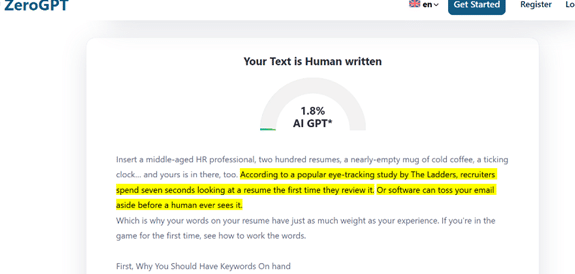
AI detection
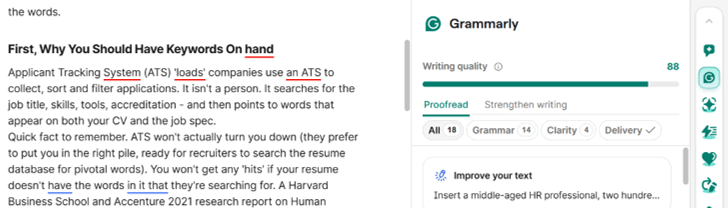
Proofreading
Plagiarized