
Behavioural Interview Stories: How to Build Your STAR Bank in One Weekend
Most candidates prepare the night before the interview by reading a list of questions, hoping to think of a relevant story, then panicking when the interviewer says, “Give me an example of a time when…” The solution does not lie in more cramming done right before the interview. It lies in building a small but effective bank of stories that one can use to answer almost any question.
Why behavioural interviews reward preparation
Behavioural interview questions are premised on the concept that a person’s past behaviour is the most accurate predictor of their future behaviour. The reason why employers ask these kinds of questions is to have some sense of how the thought process of the candidate operates as far as their ability to resolve conflicts, time management and teamwork is concerned (Colorado State University, 2025). There is no shortage of literature backing up the use of such an interview style. According to Schmidt & Hunter (1998), in their thorough review of eighty years’ worth of studies on employment testing, the validity of the structured interview stands at .51 compared to .38 for the unstructured interview. In another meta-analysis carried out by McDaniel et al. in 1994, structured interviews were shown to be a better predictor of job performance than unstructured interviews. As noted by Sackett et al. in 2022, this observation was reiterated in a meta-analysis conducted in the same year.
The STAR method in 60 seconds
STAR approach is a format for answering a behavioural question, which involves mentioning the Situation, Task, Action and Result (University of Wisconsin-Madison, n.d.; DePauw University, n.d.). Each step always receives similar advice from career centres. Pick up a concrete instance instead of a broad practice. Stick to the personal perspective and say “I” instead of “we”. End up with a good result; if the result is poor, include your lesson learned.

The most frequent error is spending too much time on the background portion. Since the interviewers are evaluating your performance, you should dedicate more time to this part, as depicted in Figure 1.
The weekend plan
Consider this a mini-project that requires two focused days, each five hours long. The time plan is illustrated in Figure 2 below.
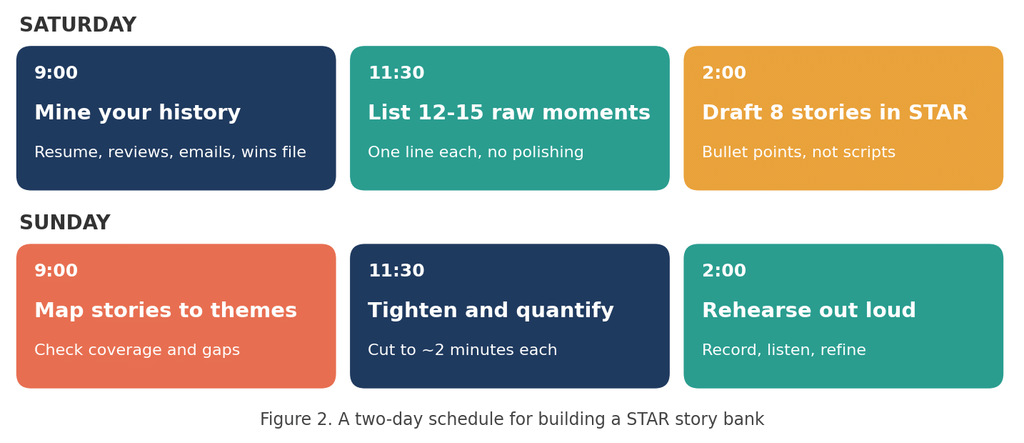
Saturday Morning: Unearth your history. Pull out your resume, comments, project details, thank-you cards, and all other wins that you’ve been saving. Under stress, your memory won’t work, so use the documentation.
Saturday Mid-day: Write your raw memories. You need to write 12-15 lines about instances where you have been a leader, problem-solving, learning, having an argument or performing well. No editing required now. Quantity gives options later.
Saturday afternoon: draft eight stories. Select the best of your memories and develop each of them as four to six bullets, with one for each STAR step. Bulleting keeps options open as memorised speeches are mechanical. Include at least one instance where things did not go as planned, as even a story with a bad ending could demonstrate your resilience if you tell what you changed (University of Wisconsin–Madison, n.d.).
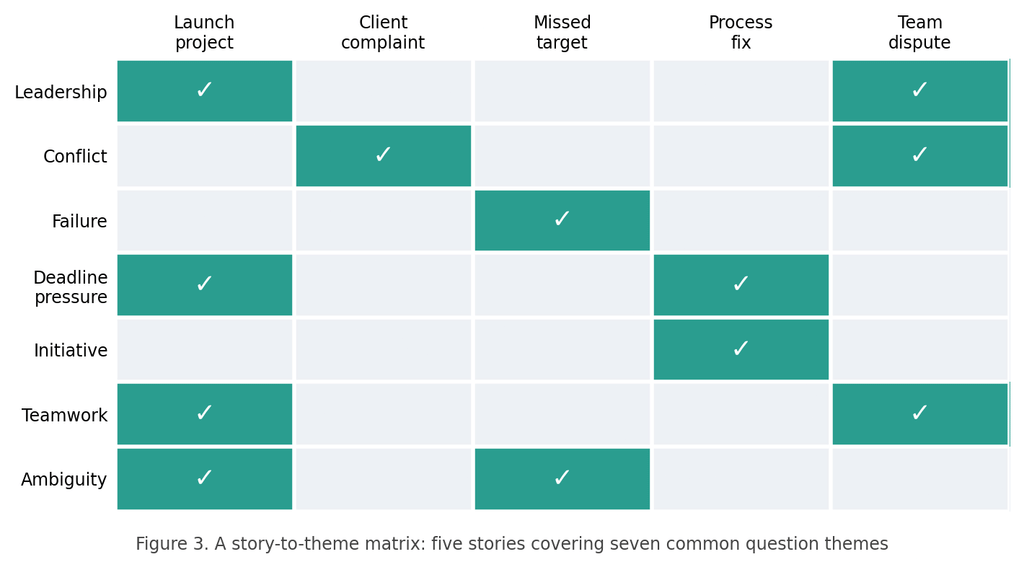
Sunday morning: allocate stories to themes. Create a matrix like Figure 3.List down topics like leadership, conflict, failure, time pressures, initiative, teamwork, and uncertainty; thereafter, tag those stories that could support these topics. Five to eight stories would do since there may be stories that will serve more than one topic.
Midday Sunday: Tighten and quantify. Cut your stories down to two minutes each. Include as many numbers as you can honestly fit in: time saved, money made, people impacted, percentages. A good example from an online university career guide is one that tells about how a student tried to regain lost advertising income at his university’s newspaper, put together a package to promote it and got 15 old advertisers and five new advertisers for special supplements (DePauw University, n.d.). The details make it believable.
Afternoon Sunday: Rehearse aloud. Make a recording of yourself using your mobile and then listen to it. Ensure that your actions are clear, your results are specific, and your story doesn’t go on forever. Do the weak stories two times. It’s all about practice (University of Cincinnati, n.d.).
A quick quality checklist for every story
- Specific: One particular experience with a beginning, a middle, and an ending.
- Personal: Your actions become apparent and not those of your group alone.
- Measurable: There is some numerical, decisive, or tangible output to the experience.
- Flexible: It can be applied to at least two other topics besides this one.
- Honest: No exaggerations are included since there are follow-up questions.
After the weekend
Your Story Bank is a dynamic document. After each real interview, update it with the stories that made the cut and questions that came as a surprise. Update your story bank periodically based on any new projects that arise. That way, you will never be starting from scratch when an opportunity arises. Having a few pre-rehearsed STAR stories means never having to say I don’t know.
References
Colorado State University, College of Business (2025, March 13). Interview tips – The STAR method. https://bizcareers.colostate.edu/blog/2025/03/13/interview-tips-the-star-method/
DePauw University (n.d.). The STAR method [PDF]. https://www.depauw.edu/files/resources/star-method.pdf
McDaniel, M. A., Whetzel, D. L., Schmidt, F. L., & Maurer, S. D. (1994). The validity of employment interviews: A comprehensive review and meta-analysis. Journal of Applied Psychology, 79(4), 599–616.
Sackett, P. R., Zhang, C., Berry, C. M., & Lievens, F. (2022). Revisiting meta-analytic estimates of validity in personnel selection: Addressing systematic overcorrection for restriction of range. Journal of Applied Psychology, 107(11), 2040–2068.
Schmidt, F. L., & Hunter, J. E. (1998). The validity and utility of selection methods in personnel psychology: Practical and theoretical implications of 85 years of research findings. Psychological Bulletin, 124(2), 262–274.
University of Cincinnati (n.d.). STAR method for behavioral interviews. https://www.uc.edu/campus-life/career-co-op-support/interviews/biginterview/star-method-behavioral-interview.html
University of Wisconsin–Madison, SuccessWorks (n.d.). The STAR method. https://successworks.wisc.edu/the-basics/preparing-for-your-interview-2/the-star-method/
- Ai Detection Report
- Plagiarism Report

- Proofreading Report
