How to Make a Resume With No Experience
I recall the blank page that I faced, blinking cursor, and thinking: “What am I supposed to write here?” If you are a recent graduate, a student, or a career changer, you’ve definitely been there. Each job description requires “1-2 years of experience” and you’re wondering: “How does one even get that first year?”
And here’s the good news: Employers looking for entry-level candidates already know you aren’t experienced. They’re not after a long resume. Instead, they want to see potential, energy, and evidence that you’re capable of learning. The more you realize that, the easier it is to learn how to write a resume with no experience.
First, Change How You Think About “Experience”
Experience isn’t just paid jobs. It can be anything that involved overcoming an obstacle, collaborating with others or completing a task:
College assignments and group projects
Volunteering or NGO work
Organizing a college fest or club event
Freelance gigs, even tiny ones
Online courses and certifications
Keeping a family shop in good shape or assisting a part-time business
You’ve achieved more than you think. It’s how you’ve made it look.
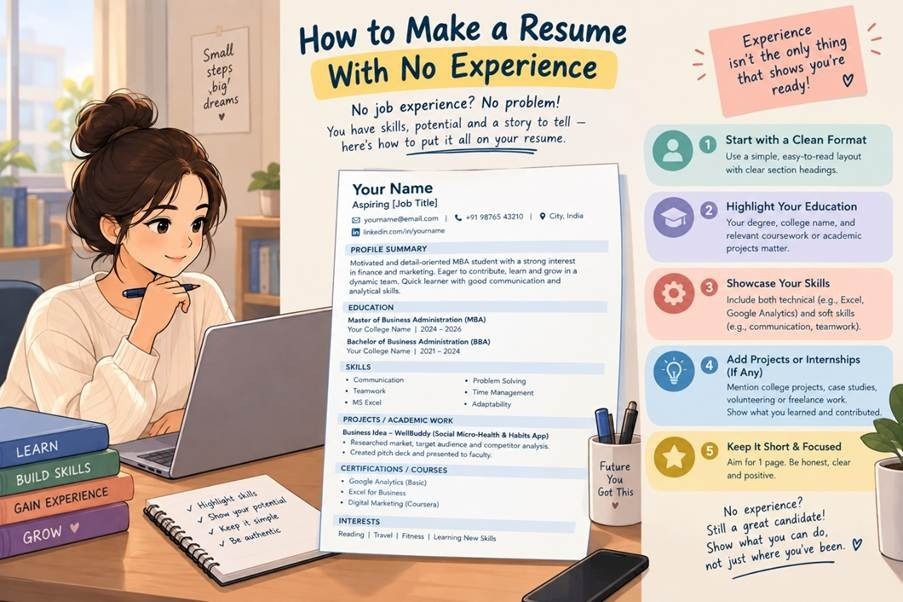
Step 1: Pick a Clean, Simple Format
They don’t read every word: Recruiters tend to skim. The Ladders’ famous eye-tracking study found recruiters spend about 7 seconds on a first read, so you’ll win by making your resume clear over eye-catching.
Never write more than one page. You don’t need more than one page.
Choose a legible font (Calibri, Arial, Georgia), 10-12 pt.
Avoid graphics, colour, and fancy columns. Many companies use Applicant Tracking Systems (ATS) that scan your resume and can’t interpret complicated formatting.
If it feels like a lot, a fresher resume builder can help. Perhaps you want a general template to get you started. Platforms such as Canva, Zety, Resume.io, or the free Google Docs and Word templates offer a clean design so you can focus on the content. Just steer clear of the frilly ones!
Step 2: Give us your summary to begin with (keep it short and sweet, and be honest).
Replace the old-fashioned “Objective” that says “seeking a challenging position” with two or three lines that describe who you are and what you offer.
Recent B. Com graduate with expertise in Excel and practical experience handling a college fest budget of Rs. 1.2 lakh. Seeking a challenging role to make an impact and build finance expertise through hands-on experience.
“It is concrete, it is human, it points a direction,” she wrote. “Do not copy this paragraph. Change the details for yours.
Step 3: Have Your Projects Speak for Themselves
This is your opportunity to shine. If you have no work history to include in a student resume, projects demonstrate your skills. Include a “Projects” section that appears before your experience or education at the top.
For each project, mention:
What you built or did (one line)
The tools or skills you used
The end or effect, with figures if feasible
For example:
Created a personal expense tracker with Python and SQL; taught 15 classmates how to use it for monthly budgets.
Produced a 10-page market research report on local cafes comprising an online survey of 60 customers.
Founded and took over an Instagram account for a college club, growing it from 0 to 800 followers within 2 months.
Small numbers, like one, make the situation a reality. As previously mentioned, don’t ignore anything-even a tiny number.
Step 4: Highlight Skills, But Be Real
Mention skills that will make you fit for that job. For example, you can mention skills required for the job, such as technical skills (like Excel, Canva, Python, Tally, Photoshop, etc.) and non-technical skills (like communication skills, teamwork, time management, etc.).
A little tip: soft skills are irrelevant unless demonstrated. Don’t just write “good leader” as part of a bullet point, like “Led 6 volunteers to arrange a blood donation camp.” Let your story do the talking.
Step 5: Don’t Ignore Education and Certifications
Education If you have little work experience, then your education section weighs more. Mention your degree, university, graduation year and CGPA if high. Mention relevant coursework, awards and scholarships.
Free and low-cost certifications on Coursera, Google Career Certificates, HubSpot Academy, or LinkedIn Learning show motivation, which employers look for in entry-level candidates.
Step 6: Tailor It for Every Job
This takes 10 minutes more, but it pays off big. Read that job description and find the keywords it mentions over and over again. If it says “data entry” and “attention to detail” and you’ve done that very thing in a project, use those same words. The ATS and the human will know you’re a good fit.
Mistakes to Avoid
Prevarication or swelling. It’s revealed in interviews.
Typos. Read it out loud, or have a friend proofread it.
Using a generic resume for every job.
Including unnecessary information, such as your father’s name or a list of your hobbies.
Writing in paragraphs. Use short bullet points.
Final Thoughts
Everybody has a beginning. Your first resume isn’t meant to look like a pro’s. It needs to show potential companies that you’re interested, qualified, and ready to work. For the projects section: Don’t be afraid to be honest about your knowledge of the role and keep the layout uncluttered.
Send it off, anticipate a few no’s (they’re nothing but support), and revise. Soon enough you’ll be editing this very same resume for your first real job, and this blank page will be a thing of the past.
References and Further Reading
- Indeed Career Guide, “How to Write a Resume With No Experience”: indeed.com/career-advice
- Harvard Office of Career Services, Resume & Cover Letter Guide: ocs.fas.harvard.edu
- The Muse, resume writing advice for entry-level candidates: themuse.com/advice
- Coursera, career resources and beginner certifications: coursera.org
- Jobscan, guidance on ATS-friendly resumes: jobscan.co
- The Ladders, “Eye-Tracking Study” on recruiter resume review time: theladders.com
- NACE (National Association of Colleges and Employers), research on skills employers seek in new graduates: naceweb.org
AI Detection
Proofreading
Plagiarized