Handling Salary Expectations Questions in HR Rounds for Freshers
There cannot be anything tougher than the question “What are your salary expectations?” posed by the interviewer during an interview at college or a fresh job. After all your attempts to make the best impression on the interviewer in the past twenty minutes, you now have to speak about money. How could you, a fresher, react? You can be surprised, state any number without giving it a thought, or say that salary doesn’t matter. None of these reactions will help you. This article will assist you in understanding the reason for this question and its proper answer.
Why do recruiters ask about salary expectations?
The question is rarely a trap. Every position has a budget range, and recruiters want to know early whether a candidate’s expectations fit inside it [2][5]. Asking during the interview saves time for both sides: if the gap is too wide, each party can move on rather than invest in further rounds [5]. The question also reveals how well you have prepared and how realistic your understanding of the market is [3]. Though freshers may not necessarily be worth a premium, they must at least prove that they have put some effort into research work.
The four-step framework
Excellent solutions are rarely arrived at spontaneously. Figure 1 sets up the scenario where an awkward situation is turned into a process which one can prepare for ahead of time.
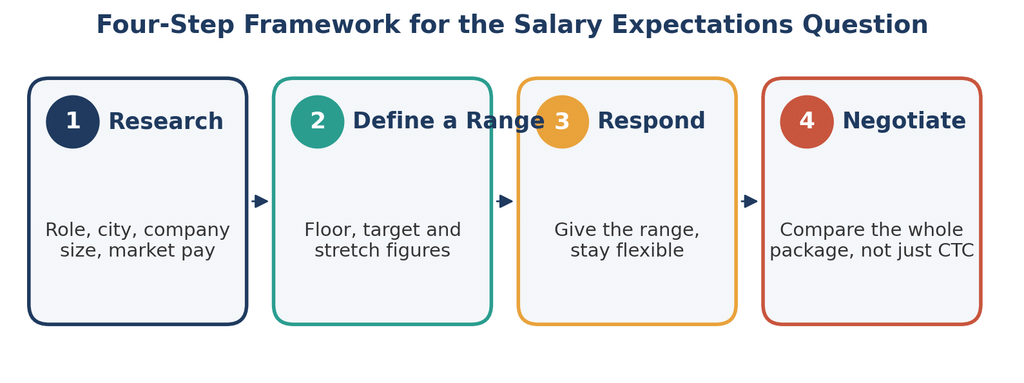
Step 1: Research. Research typical compensation packages for the same position, city and organisation size through job portals, campus seniors and organisational websites. Career guidebooks always recommend that one should research salary packages prior to the interview and not go by one’s instinct [3][7]. Skills in high demand, such as in-demand technical skills, can justify a higher position within the range [3].
Step 2: What is a range? Select three numbers: your minimum number (the one you won’t accept), the realistic number and the stretch number. Your response should be in the form of a range using these numbers.
Step 3: Respond. When asked, offer the researched range and say you are flexible depending on the role and the overall package [1][3]. Advice from graduate career services is to sound polite, informed and pragmatic, never defensive or arrogant [6].
Step 4: Negotiate. Compensation goes beyond the set amount. Benefits, learning opportunities, variable pay and growth prospects all matter, so weigh the entire package before reacting to the first offer [8].
Why a range works better than one number
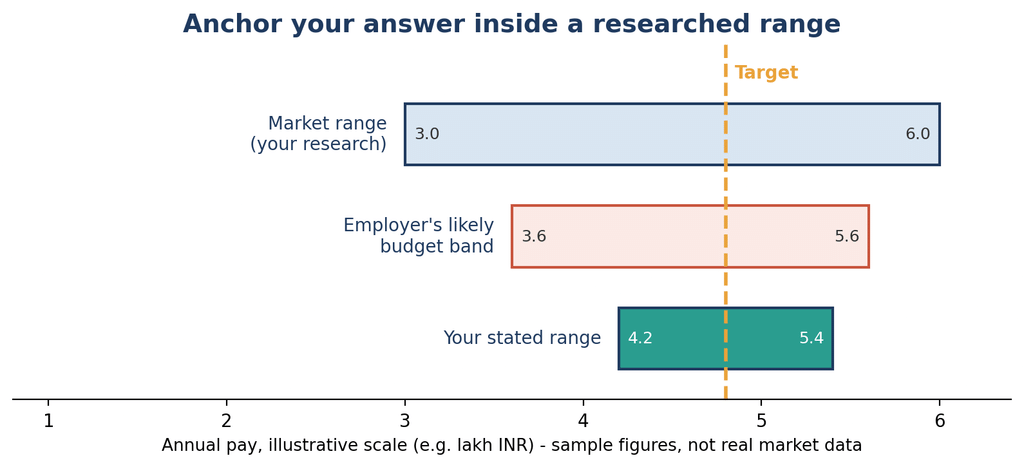
Naming one figure leaves little room: aim too high, and you may be filtered out; aim too low, and you may be locked into it. A range lets you signal that you have researched the market while keeping the conversation open [3]. Figure 2 provides an illustration using actual numbers. The range you give must be contained within the market rate, while the low end of the range must still be an acceptable number for you.
Sample answers you can adapt
- The researched-range answer: “Based on my research for this role and city, I understand the range for freshers to be around X to Y. I am open to discussing it based on the responsibilities and growth involved.”
- The flexible learner answer: “At this stage, I am focused on learning and contributing, so I am flexible.I would like to know about the range of skills that your company plans for this position.”
- Flipping the question answer: If you really do not have any number in mind, then you can ask the recruiter about the budget set aside for the position [1][3].
It is important to note that all the above examples are polite and demonstrate preparation on the part of the interviewee, as well as keeping one’s options open. Remember not to parrot the above phrases but use them as guides.
Common mistakes to avoid
Freshers often overcorrect in a bid to look humble. Saying that money does not matter to you sounds unrealistic and can weaken your position later [4]. Quoting a figure with no basis, or comparing yourself with a friend’s package, has the same effect. In addition, the candidate is likely to make a bad impression when trying to fill the silence after giving out your phone number; one helpful tip would be to stay silent after you have answered [8]. In conclusion, do not fabricate any information about other offers or how much money you earned from past jobs.

Final thoughts
It is, indeed, a tough question to pose, but then you have to remember that you do not have to tell the right answer; instead, you have to prove your maturity and readiness [7]. Make an effort to do some research on the job, find out your range, which consists of the lowest, your target, and the highest, prepare yourself, and remember that what you say now is only the beginning of the negotiations.
References
[1] Naukri.com (n.d.). How to Answer “How Much Salary Do You Expect?” for Freshers. Naukri Blog. https://www.naukri.com/blog/how-to-answer-how-much-salary-do-you-expect-for-freshers/
[2] Naukri Campus (n.d.). How to Answer “What Is Your Salary Expectations?” – Best Answers for Freshers. https://naukri.com/campus/career-guidance/what-is-your-salary-expectations
[3] Coursera Staff (n.d.). How to Answer Salary Expectations Questions in an Interview. Coursera. https://www.coursera.org/articles/how-to-answer-salary-expectations
[4] The Muse (2024, February 16). How to Answer “What Are Your Salary Expectations?” When You Have No Experience. https://www.themuse.com/advice/how-to-answer-salary-expectations-with-no-experience
[5] GradConnection (n.d.). How to Answer “What Are Your Salary Expectations?” https://au.gradconnection.com/career-advice/article/how-to-answer-what-are-your-salary-expectations/
[6] University of Salford (n.d.). How to answer the “What are your salary expectations?” job interview question as a graduate. Salford Graduate Life blog. https://blogs.salford.ac.uk/salford-graduate-life/how-to-answer-the-what-are-your-salary-expectations-job-interview-question-as-a-graduate
[7] PlacementPreparation.io (2026, April 10). How to Answer Salary Expectations in Interviews. https://www.placementpreparation.io/blog/how-to-answer-salary-expectations/
[8] TalentAlly (n.d.). How to Answer the “Salary Expectations” Question. https://talentally.com/resources/how-to-answer-salary-expectations-question
- AI Detection Report
- Plagiarism Report

- Proofreading Report