
Table of Contents
100 Essential Full-Stack Interview Questions for Tech Placements
Source : AI generated image
100 Essential Full-Stack Interview Questions for Tech Placements
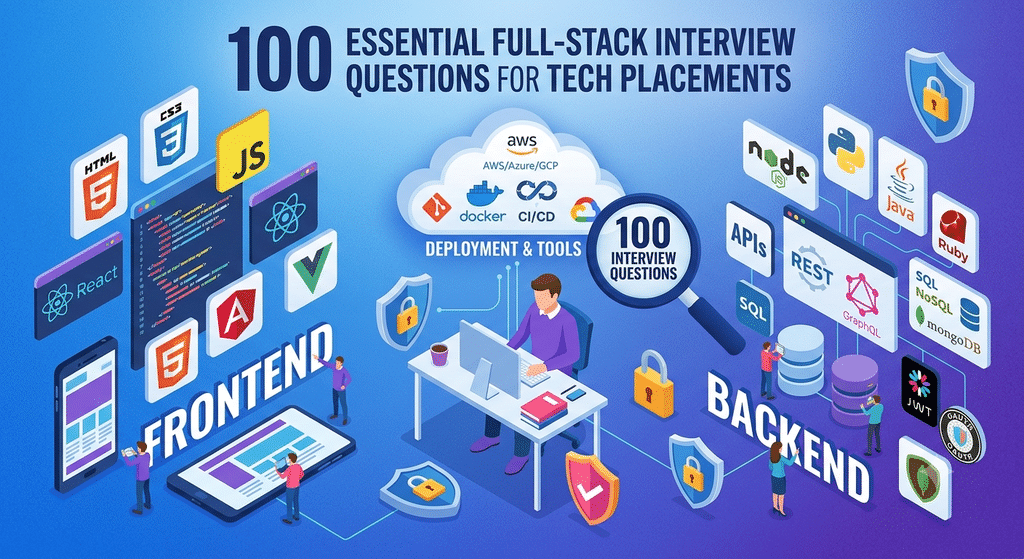
Source : AI generated image
The full stack developer role is one of the most in-demand in the tech world. Employers seeking full-stack developers typically expect them to be proficient with both the front and back ends of a website, as well as database, API, version control, deployment, security, and software development best practices. When students or freshers are preparing for tech interviews, it is good to know what they are expected to face in an interview to prepare accordingly.
This guide has 100 front-end and back-end interview questions with all the frontend and backend frameworks, databases, API concepts, and security topics covered along with Git and deployment. These are the coding Q&A topics that can aid in preparation for technical interviews and web development interview rounds.
1. The use of HTML and Web Fundamentals.Using HTML and Web Fundamentals.
- What is HTML? and why it is used?
- So what’s the difference between HTML and HTML5?
- What are Semantic HTML elements?
- What is the difference between <div> and <section>?
- What are HTML Attributes?
- What does <meta> tag do?
- What are the differences between block level and inline elements?
- What does forms do in HTML?
- What is the function of alt attribute on images?
- What are the differences between cookies, local storage and session storage?
Knowing HTML well is vital since this is the backbone of web applications. Candidates should be familiar with semantic markup, accessibility, forms, multimedia and browser storage.
2. CSS and Responsive Design
- What is CSS?
- What is CSS Box Model?
- What are the difference between margin & padding?
- What is the meaning of specificity in CSS?
- What is the difference between Flexbox and CSS Grid?
- What is the best way to have a site that is responsive?
- What are media queries?
- What are the difference between relative, absolute, fixed and sticky positioning?
- What is pseudo-classes and pseudo-elements?
- What’s the difference between display: none and visibility: hidden?
Remain responsive by creating a responsive webpage during an interview or discussing how they would create a responsive webpage for a specific interview. Confidence can be boosted through small UI components practice.
3. JavaScript
- What is JavaScript?
- What’s the difference between var, let and const?
- What is primitive data type and reference data type?
- What is it in JavaScript that is hoisting?
- What is a closure?
- What is difference between == and ===?
- Why do you need to use an arrow function?
- What are promises?
- What does asynchronous programming mean?
- What is async and await?
- What is the JS event loop?
- What is event bubbling?
- What is event delegation?
- What does synchronous and asynchronous code mean?
- What are higher order functions?
One of the most crucial sections of full stack interviews is JavaScript. Candidates should be able to explain concepts and not just definitions. They should also learn to write small JavaScript programs with arrays, objects, functions, promises and asynchronous operations.
4. Frontend Frameworks
- What is React?
- Which of the following are components of React?
- What’s the difference between props and state?
- What is a React Hook?
- What is useState()?
- What is useEffect()?
- What is Virtual DOM?
- What is component lifecycle?
- How do we manage states in Frontend Applications?
- What is Client-side Routing?
Candidates might also be asked questions regarding the following front-end technologies: Angular, Vue, Next.js. They should thus concentrate on comprehending the structure employed in the role, not upon learning all the frameworks that can be found.
5. Backend Development
Backend Development:
- What is it and why is it important?
- What is Node.js?
- What is Express.js?
- What is middleware?
- What is REST architecture?
- What is an API?
- What are the difference between REST and SOAP?
- What are the methods of http?
- What’s the difference between GET, POST, PUT, PATCH and DELETE?
- What do you understand by status codes in HTTP?
- What is authentication?
- What is authorization?
- JWT is the acronym for what?
- What do you mean by Session-based authentication?
- What does a backend use to communicate with a database?
In the backend questions, they are checking to see if candidates know how applications respond to requests from clients, interact with data, authenticate clients, and interact with other services.
6. Databases and Data Management
- What is a database?
- What is the difference between SQL and NoSQL database?
- A primary key is?
- A foreign key is:
- What is the concept of database Normalization?
- What are SQL joins?
- What is an index?
- What does transaction mean?
- What do you mean by Acid Properties?
- What is the meaning of database replication?
- Explain the concept of database sharding.
- Explain the difference between MongoDB and MySQL?
- What would be some of your optimizations for a slow query on a database?
Full stack developers often deal with data models, queries, relationships, indexes, and database performance, making it crucial to have database expertise in these roles.
7. Git and Development Tools.
- What is Git?
- What is GitHub?
- What are the difference between Git and GitHub?
- What is a Git repository?
- What is a branch?
- What do you mean by a merge conflict?
- What is the difference between git merge and git rebase?
They should be familiar with some basic Git commands and know how version control aids in the collaboration of software development.
8. Security and Performance
- What is XSS?What happens when you experience Cross-Site Scripting (XSS)?
- So what is SQL Injection?
- So what is Cross-Site Request Forgery (CSRF)?
- What are safe methods to store a password?
- What is HTTPS?
- What is CORS?
- What is caching?
- What are ways to make a Web application fast?
- What is Lazy loading?
- What are some ways you would secure an API from unauthorized access?
Full stack developers handle user information, authentication, databases, and APIs, making security questions vital.
9. Deployment and Practical Questions
- What is Cloud Computing?
- What is Docker?
- What is CI/CD?
- What are the differences between development environment, testing environment, and production environment?
- What would you do to deploy a full application?
- What is a reverse proxy?
- So, what is load balancing?
- What would you do to solve a production problem?
- What would you do to make a web app scalable?
- Describe a complete project that you have built from front-end to deployment.
The last question is significant especially for freshers. People frequently are asked to describe their projects when they are being interviewed as this is a sign of their grasp of technologies on their resume. Candidates should be ready to talk about the architecture, database, APIs, front end, challenges, security, deployment process of their project.
How to Prepare for Full-Stack Interviews
The best way to prepare for the full-stack interview questions is to learn the concepts as well as code. Learn HTML, CSS, and JavaScript first then as you get more comfortable, learn frontend frameworks and backend technologies. Then come to learn databases, APIs, authentication, deployment, and basic security.
As for tech placements, it is also good practice to solve various problems related to arrays, strings, objects, recursion, sorting, searching, and basic data structures. Candidates can develop the ability to present solutions effectively with mock interviews.
Most importantly, create at least one fully functioning project. If you’ve built a project with a front end, back end, database, authentication, API integration and deployment, you will have something that can be good material for the interview.
Conclusion
Full Stack Interviews will be talking about everything from the fundamentals of Web Development to Backend Architecture and Deployment. Students can use these 100 full-stack tech interview questions to determine key areas and streamline their preparation.
Candidates should not attempt to recall answers to questions, but rather understand how technologies function, and how they are used in actual projects. Coding Q&A, hands-on development, project practice, and mock interviews can all make a difference in confidence levels during a web dev interview and excel them in the technical placement rounds of an interview.
References
[1] Mozilla, “Web technology for developers,” MDN Web Docs. [Online]. Available: https://developer.mozilla.org/en-US/docs/Web
[2] Mozilla, “HTML: HyperText Markup Language,” MDN Web Docs. [Online]. Available: https://developer.mozilla.org/en-US/docs/Web/HTML
[3] Mozilla, “CSS: Cascading Style Sheets,” MDN Web Docs. [Online]. Available: https://developer.mozilla.org/en-US/docs/Web/CSS
[4] Mozilla, “JavaScript,” MDN Web Docs. [Online]. Available: https://developer.mozilla.org/en-US/docs/Web/JavaScript
[5] Mozilla, “HTTP: Hypertext Transfer Protocol,” MDN Web Docs. [Online]. Available: https://developer.mozilla.org/en-US/docs/Web/HTTP
[6] React, “Quick Start,” React Documentation. [Online]. Available: https://react.dev/learn
[7] React, “React Reference Overview,” React Documentation. [Online]. Available: https://react.dev/reference/react
[8] Git, “Git Documentation,” Git. [Online]. Available: https://git-scm.com/doc
[9] Docker, “Docker Documentation,” Docker. [Online]. Available: https://docs.docker.com/
[10] OWASP Foundation, “OWASP Top 10:2025,” OWASP. [Online]. Available: https://owasp.org/www-project-top-ten/
FAQs
1. What are the most important full-stack interview questions for tech placements?
Top questions cover: HTML semantics, CSS Box Model & Flexbox/Grid, JavaScript (closures, promises, event loop), React (hooks, virtual DOM), Node.js & Express, REST APIs, SQL vs NoSQL, authentication (JWT), Git, and deployment (Docker, CI/CD). Interviewers also ask you to explain a full project from frontend to deployment.
2. How should freshers prepare for full-stack interviews?
Learn in order: HTML, CSS, JavaScript first, then a frontend framework like React, then backend with Node.js/Express, then databases (MySQL/ MongoDB), APIs, authentication, and basic security & deployment. Build at least one complete project with frontend, backend, database, and deployment, and practice mock interviews.
3. What frontend questions are asked in full-stack interviews?
Common frontend questions: Difference between HTML and HTML5, div vs section, block vs inline, CSS Box Model, margin vs padding, Flexbox vs Grid, var vs let vs const, closures, promises, async/await, props vs state in React, useState/useEffect, and how to make a site responsive with media queries.
4. What backend questions are asked in full-stack interviews?
Common backend questions: What is Node.js and Express? What is middleware? What is REST? Difference between GET, POST, PUT, PATCH, DELETE, HTTP status codes, authentication vs authorization, JWT vs session-based auth, how does backend communicate with database, and how to secure an API.
5. Do I need to know both SQL and NoSQL for full-stack placements?
Yes. Interviewers expect you to know difference between SQL and NoSQL, primary key, foreign key, normalization, SQL joins, indexes, ACID properties, and MongoDB vs MySQL. You should also explain how to optimize a slow query and when to use replication or sharding.
6. How important is Git and deployment in full-stack interviews?
Very important. Expect questions like: What is Git vs GitHub? What is a branch and merge conflict? Difference between git merge and rebase? What is Docker, CI/CD, load balancing, reverse proxy, and how would you deploy a full application and handle a production issue?
7. What is the best way to answer “Describe a project you built”?
This is the most important question for freshers. Be ready to explain your project’s architecture, frontend, backend, database choice, APIs, authentication, security measures, challenges you faced, and how you deployed it. Don’t memorize answers – understand how technologies work together.