
Microservices vs Monoliths: System Design for Freshers
Published: Oct 15, 2026
Key Points
- Understand the basics: Microservices monoliths design focuses on choosing between a single application and multiple independent services based on project requirements.
- Start with a monolith: Monolithic architecture is often suitable for small applications, startups, and teams that want simpler development and deployment.
- Know when to use microservices: Microservices architecture can help large applications scale individual services independently and support multiple development teams.
- Compare the trade-offs: Monoliths offer simpler testing and deployment, while microservices introduce additional challenges involving network communication, monitoring, and infrastructure.
- Avoid unnecessary complexity: Small projects rarely need multiple independent services, API gateways, and message queues unless specific requirements justify them.
- Focus on scalability: Microservices can support independent scaling, but performance also depends on databases, caching, load balancing, and system design.
- Prepare for interviews: Freshers should explain their architectural decisions using application requirements, expected traffic, team size, and operational complexity.
- Choose architecture based on requirements: Neither monolithic architecture nor microservices is universally better. The right choice depends on the application's needs and future growth.
Let’s be honest. The first time you hear the words “microservices architecture,” “monolithic architecture,” and “distributed systems,” system design can suddenly feel like a subject meant for people who have been coding since birth.
You open an interview preparation guide and there it is:
“Design the architecture for a large-scale application.”
And you’re sitting there thinking, Wait… where do I even start?
Here’s the good news: you don’t need to know every complicated architecture pattern to understand the basics.
At its simplest, the whole microservices monoliths design discussion comes down to one question:
Do we build the application as one big system, or do we split it into smaller pieces?
That sounds simple. And honestly, it is.
The tricky part is knowing when each approach makes sense.
So, if you’re a fresher preparing for system design or a tech interview architecture question, let’s break it down without turning it into a textbook.
Understanding microservices monoliths design helps freshers learn how applications are structured and why developers choose different architectural approaches. By comparing both options, beginners can understand the trade-offs between simplicity, scalability, and maintenance.
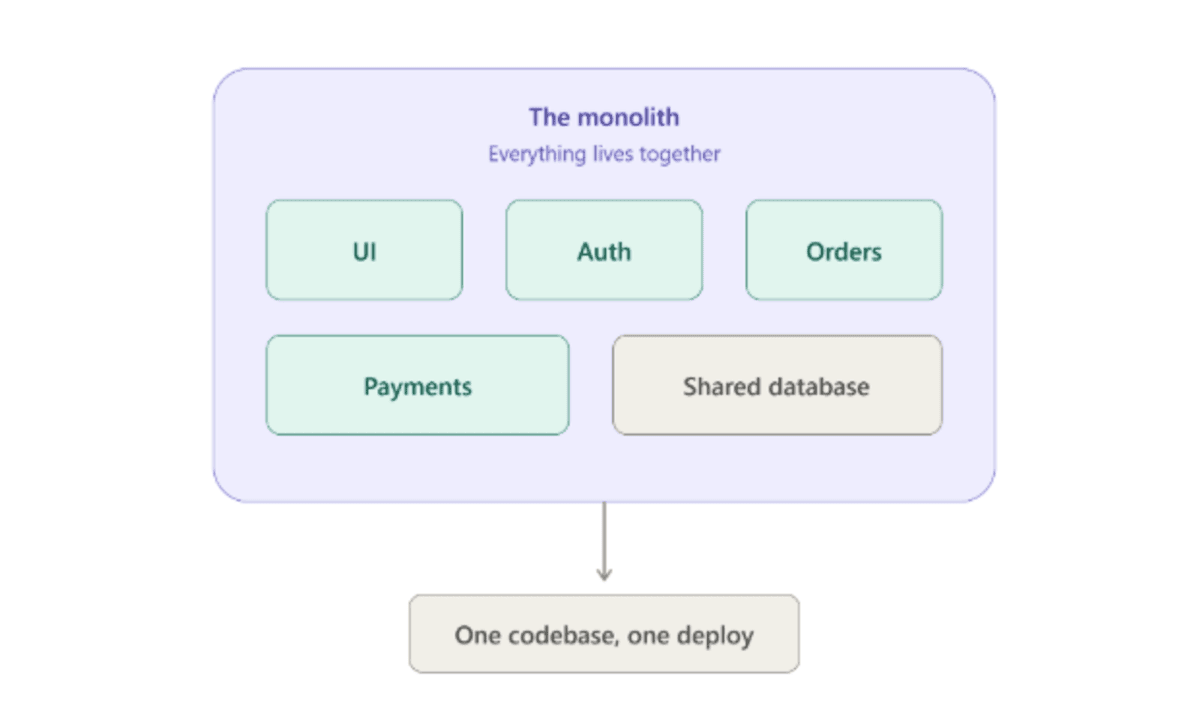
1. The Monolith: The “Everything Lives Together” Approach
Imagine you’re building a food delivery application.
You need users, restaurants, orders, payments, and notifications.
With a monolithic architecture, these features can all live inside one application.
Think of it like one big apartment building.
There are different rooms for different purposes, but they’re all part of the same building.
Need to change the payment feature?
You work inside the same application.
Need to update restaurant search?
Same application.
Need to fix something in orders?
Yep. Still the same application.
For a small team or a new product, this can actually be a good thing.
You don’t have five different systems to deploy, monitor, and troubleshoot when your entire user base is basically your college class.
2. Then Things Get Big
Here’s where the monolith can start becoming uncomfortable.
Imagine that your food delivery app suddenly becomes extremely popular.
Now you have millions of users.
Search is getting hammered with requests.
Orders are increasing.
Payments need extra security.
Notifications are being sent constantly.
The application keeps growing, and suddenly that once-simple codebase feels like a giant cupboard where everyone keeps throwing things in.
You can still make it work.
But maintaining it becomes harder.
And this is where people start thinking:
“Maybe we should split this thing up.”
Enter microservices.
3. Microservices: Cut the Big System into Smaller Pieces
Instead of putting everything inside one application, microservices divide the system into smaller services.
Our food delivery application might now look something like this:
User Service
Restaurant Service
Order Service
Payment Service
Notification Service
Each service has its own responsibility.
The Order Service handles orders.
The Payment Service handles payments.
The Notification Service handles notifications.
It’s almost like turning one giant department into several smaller teams, where each team has a specific job.
That’s the basic idea behind microservices.
Simple, right?
Well… mostly.
4. The Catch: Small Pieces Mean More Things to Manage
Microservices sound amazing until you realize something important.
Those services have to communicate with each other.
The Order Service might need to contact the Payment Service.
The Payment Service might need to confirm something.
The Notification Service might need to know that an order was successfully placed.
Now you’re dealing with APIs, network requests, failures, monitoring, logs, deployment, and service communication.
So while you reduced the size of individual applications, you increased the complexity of the overall system.
That’s the trade-off.
Microservices aren’t some magical upgrade button.
They solve certain problems while introducing new ones.
5. So Which One Is Better?
This is probably where a fresher makes the classic interview mistake.
Interviewer:
“Would you choose monolith or microservices?”
Candidate:
“Microservices because they’re scalable.”
Technically, that isn’t a terrible sentence.
But it’s not a great answer either.
Why?
Because you haven’t explained why the system needs microservices.
Imagine you’re building a simple college attendance application.
You have 500 students.
Maybe 10 teachers use the dashboard.
The application has login, attendance, student profiles, and reports.
Do you really need four or five independent services?
Probably not.
A simple monolithic application could be perfectly reasonable.
You don’t need to bring a bulldozer to plant a flower.
When comparing microservices monoliths design, developers should evaluate the application’s size, expected traffic, development team, and operational requirements. These factors help determine which architecture offers the best balance between performance and complexity.
6. When Microservices Actually Start Making Sense
Now change the situation.
Your application has millions of users.
Search receives huge amounts of traffic.
Payments have strict security requirements.
Orders need to be processed independently.
Different engineering teams are working on different parts of the product.
Now separating major components can become much more useful.
For example, if the search system needs additional resources during a traffic spike, you can scale that service independently instead of scaling the entire application.
That’s one of the biggest attractions of microservices.
You’re not treating the whole application as one giant block anymore.
7. The “Don’t Overcomplicate It” Rule
This is probably the most useful lesson for freshers.
Just because something is technically possible doesn’t mean you should build it that way.
Imagine making a simple calculator application with:
- User Service
- Calculation Service
- Authentication Service
- Notification Service
- API Gateway
- Message Queue
- Five databases
Sounds impressive.
Also sounds completely unnecessary.
Your architecture should solve the problem, not create extra problems just so your diagram looks impressive.
This is one of the most important ideas behind software architecture patterns.
8. Monolith Doesn’t Mean Bad Architecture
There is a weird misconception that monolithic architecture means “old” or “bad.”
That’s not true.
A well-structured monolith can have separate modules for different responsibilities.
For example:
Users → Orders → Payments → Notifications
The code can still be organized properly even though the application is deployed as one unit.
For a small product, this can make development, testing, deployment, and debugging much easier.
The problem isn’t simply that something is a monolith.
The real question is whether the architecture still makes sense as the system grows.
9. Microservices Don’t Mean “Unlimited Scalability”
Microservices can help with independent scaling, but they don’t automatically make an application infinitely scalable.
You still need to think about:
- Databases
- Network communication
- Caching
- Load balancing
- Failure handling
- Monitoring
- Data consistency
Breaking one application into ten services doesn’t magically solve all system-design problems.
In fact, if the architecture is poorly designed, you might end up with ten small problems instead of one big one.
10. What About Other System Types?
Once you start learning system design, you’ll hear about more than just monoliths and microservices.
You may come across event-driven systems, layered architectures, distributed systems, and other approaches.
Don’t panic.
You don’t need to memorize every architecture pattern on day one.
Start by understanding what problem each approach is trying to solve.
For example, an event-driven system can be useful when different parts of an application need to react to events without everything happening in one direct request.
Imagine:
Order Placed → Payment Processed → Notification Sent
Instead of making everything happen as one giant operation, different components can react to events.
The important part isn’t memorizing the fancy name.
It’s understanding the reason behind the design.
11. How Freshers Can Answer This in an Interview
If the interviewer asks:
“Monolith or microservices?”
Don’t rush.
First understand the requirements.
Ask yourself:
How many users are there?
How much traffic is expected?
How big is the development team?
Do different parts need independent scaling?
How frequently will different components change?
Can the team handle additional infrastructure complexity?
Then make your decision.
For a small application, you might say:
“I would start with a modular monolith because the system is relatively small, and introducing microservices would add unnecessary operational complexity.”
For a large application, you can explain which parts need to scale independently and why separating them could help.
That’s a much stronger interview answer.
12. The Easiest Way to Remember It
If you forget everything else before your interview, remember this:
Monolith = one main application.
Microservices = multiple smaller services working together.
Small system = don’t overcomplicate it.
Large system = consider separating components when there is a real reason.
And most importantly:
Architecture should follow requirements.
Not trends.
Not buzzwords.
Not whatever technology sounds the coolest.
Final Thoughts
System design can look intimidating when you’re starting out.
There are diagrams everywhere, complicated terms flying around, and everyone seems to be talking about scalability, distributed systems, queues, caching, and microservices.
But don’t try to learn everything at once.
Start with the basics.
Understand why a monolith can be useful. Understand why microservices exist. Learn the trade-offs between them. Then slowly move toward other system types and architecture patterns.
Because in a real interview, the goal isn’t to prove that you know the most complicated architecture.
It’s to show that you can look at a problem and make a sensible decision.
And honestly, that’s what good system design is all about for microservices monoliths design.
References
[1] Martin Fowler, “Microservices,” martinfowler.com.
[2] Martin Fowler, “MonolithFirst,” martinfowler.com
[3] Sam Newman, Building Microservices, O’Reilly Media.
[4] AWS, “Microservices on AWS,” Amazon Web Services.
Frequently Asked Questions
1. What is microservices monoliths design?
Microservices monoliths design refers to choosing between building an application as one unified system or dividing it into smaller, independently deployable services. The right approach depends on project requirements, scalability, and complexity.
2. What is monolithic architecture?
Monolithic architecture is a software design approach in which an application’s major components are developed and deployed as a single unit. It is often suitable for small applications and projects with limited infrastructure requirements.
3. What is microservices architecture?
Microservices architecture divides an application into small, independent services. Each service handles a specific business function and communicates with other services through APIs or messaging systems.
4. What is the main difference between monoliths and microservices?
The main difference is how an application is structured and deployed. A monolith typically runs as one deployable application, while microservices consist of multiple independently deployable services.
5. Which architecture is better for beginners?
Monolithic architecture is generally easier for beginners because it simplifies development, testing, debugging, and deployment. Beginners can learn microservices later as they gain experience with distributed systems.
6. Are microservices better than monolithic architecture?
Microservices are not always better than monolithic architecture. They can support independent scaling and deployment, but they also introduce network communication, monitoring, and infrastructure challenges.
Microservices can improve scalability by allowing individual services to scale independently. However, effective scalability also depends on databases, network communication, caching, load balancing, and system design.
7. What are the disadvantages of microservices?
Microservices can increase operational complexity, deployment overhead, network latency, monitoring requirements, and data consistency challenges. They also require careful service communication and failure handling.
8. What are the advantages of monolithic architecture?
Monolithic architecture offers simpler development, straightforward deployment, easier local testing, and less infrastructure overhead. It can be an efficient choice for small teams and applications with manageable complexity.
9. Can a monolith be converted into microservices?
Yes, a monolithic application can be gradually divided into microservices. Developers can identify business modules, separate suitable components, define APIs, and migrate functionality incrementally.
10. What is the difference between microservices and distributed systems?
Microservices are an architectural approach that organizes an application into independent services. Distributed systems are broader systems whose components communicate across multiple processes or machines. Microservices commonly use distributed-system principles.
11. How should freshers answer microservices vs. monoliths in system design interviews?
Freshers should compare project requirements, expected traffic, team size, independent scaling needs, deployment frequency, and operational complexity. For a small application, a modular monolith is often a sensible starting point; microservices may be appropriate when specific requirements justify the additional complexity.
12. Why is microservices monoliths design important in system design?
Microservices monoliths design helps developers choose an appropriate architecture based on application requirements, team size, scalability, and maintenance needs. Understanding both approaches allows developers to build efficient applications without introducing unnecessary complexity.
13. What factors should developers consider in microservices monoliths design?
Developers should consider application complexity, expected traffic, team size, deployment frequency, infrastructure costs, database requirements, and independent scaling needs. These factors help determine whether a monolithic application or microservices architecture is more suitable.
14. Which is more cost-effective: monolithic architecture or microservices?
Monolithic architecture is generally more cost-effective for small applications because it requires less infrastructure and operational management. Microservices may justify their additional costs when independent scaling, team autonomy, and separate deployment provide significant business benefits.
15. How does microservices monoliths design affect application maintenance?
A monolithic application can be easier to maintain when its code is well-organized and the system is relatively small. Microservices can make individual components easier to develop and deploy independently, but they require additional monitoring, communication, and coordination across services.
16. What is the best microservices monoliths design strategy for freshers?
Freshers should start by understanding monolithic architecture, modular design, APIs, databases, and basic scalability principles. A modular monolith is often a practical starting point for small projects. Developers can explore microservices when specific requirements justify the additional complexity.
Citations & References
[1] Martin Fowler, “Microservices,” martinfowler.com.
[2] Martin Fowler, “MonolithFirst,” martinfowler.com
[3] Sam Newman, Building Microservices, O’Reilly Media.
[4] AWS, “Microservices on AWS,” Amazon Web Services.
Streamline Your Hiring with Eve Placement
Engage, assess, and recruit top talent through tailored AI hiring challenges that go beyond resumes. Ready to hire better? Contact our research team for a custom consultation.