
Table of Contents
Testing: Full‑Stack Tech Interview Questions Every Developer Must Know
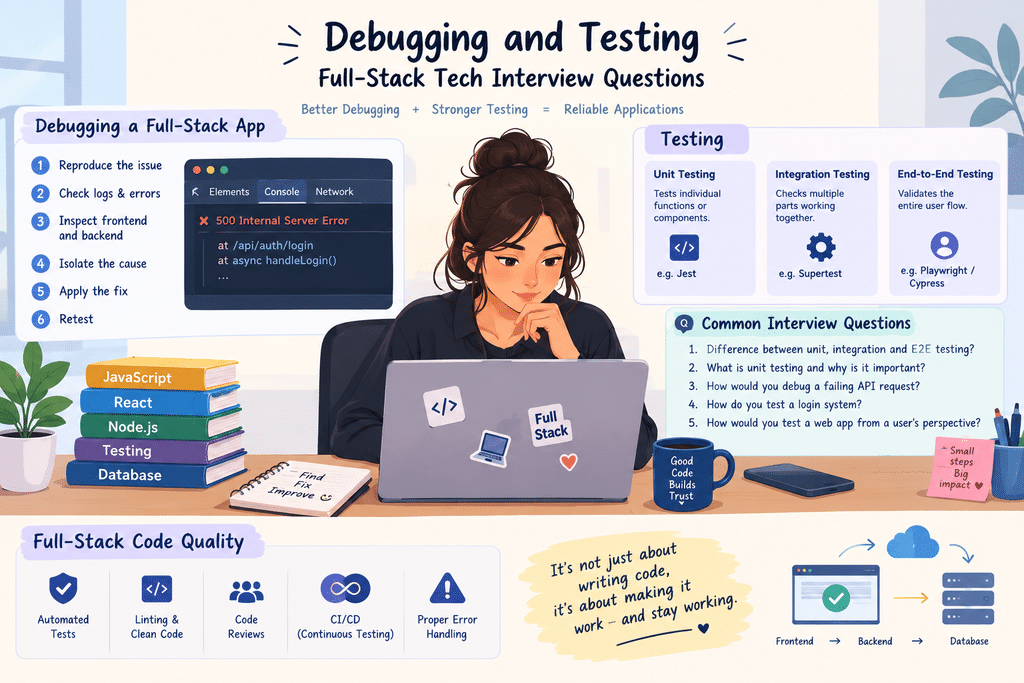
A full-stack developer is expected to not only write code but also to analyze bugs and prevent errors. It is common for a testing interview for full-stack roles to include debugging questions. Recruiters use a testing interview to evaluate your debugging approach, not just definitions.
Source: Open AI
Here are the most asked testing interview questions for full-stack developers that recruiters ask to check code quality.
Why the Skill of Debugging Matters in Full‑Stack Development
Suppose that a user clicks a Login button, but the application does not respond. The error can be in a frontend button handler or even the JavaScript logic, API request, backend authentication logic, database query or server configuration. In order to locate the error, a full‑stack developer is to follow a defined debugging process.
When it comes to debugging web development, browsers have tools that allow you to see HTML, CSS, JavaScript, network requests, console errors and application behavior. JavaScript debugging typically requires placing breakpoints to view values and the call stack.
When answering an interview question, a strong debugging example should be a step‑by‑step process of reproducing error, locating a faulty part of the code tree, using logs or breakpoints to identify the cause, fixing the issue and making sure that everything functions properly.
Common Testing Interview Questions
1. What is the difference between unit, integration and end‑to‑end testing?
While unit testing looks at a part of code (a function or component), integration testing ensures that the multiple parts (API and database) function correctly together. End‑to‑end (E2E) testing is all about the application flow (e.g. a user registers, logs in and makes a purchase). The choice of testing methods depends on the situation. Combining several strategies will typically produce higher quality software.
2. What is unit testing, Why is it important?
Ensuring that each individual unit (such as a function) works as expected, unit testing guarantees that software is fit for purpose. A full‑stack developer will write tests that check whether a function under test (CUT) will return expected outputs for given inputs. Testing frameworks such as Jest would allow full‑stack developers to write and run JavaScript tests.
3. How would a full‑stack developer debug a failing API request?
First, a full‑stack developer would want to examine the network tab in the browser to make sure that request URL, method and headers are correct, as well as that the request body is properly structured. Frontend console errors and server logs also give clues about the problem. For example, 404 means that the server did not find the requested resource, 401 that the user is not authorized, while 500 Internal Server Error suggests a server‑side issue that requires backend debugging.
4. How would a full‑stack developer test a login system?
Testing a login feature involves scenarios of successful and failed login attempts, invalid inputs, expired sessions and attempts to access unauthorized areas. A full‑stack developer would also have to test security aspects, such as authentication, authorization, secure session handling, input validation and error handling. OWASP Web Security Testing Guide identifies these areas as essential for application security.
5. How would a full‑stack developer test a web application from a user’s perspective?
The goal is to replicate the actions that a real user would perform in a given scenario. Reference 6 suggests that tests should resemble the way developers actually use the application. For complex user flows, a full‑stack developer can use Playwright, which simulates user interactions as a browser would. Playwright tests run on all browsers (Chromium, Firefox, Webkit), making cross‑browser validation simple.
A Simple Debugging Approach for Interviews
When an interviewer gives a link to an application, a full‑stack developer should not modify the code immediately. Instead, they should follow the debugging steps: Reproduce → Observe → Isolate → Diagnose → Fix → Test → Prevent. First, a full‑stack developer must be able to reliably reproduce the error. Next they have to observe the changes that have occurred in the application. After isolating the root cause of the error, a full‑stack developer can fix the problem. Make sure that the application passes all tests. When a single code area is fixed, a regression testing will confirm that no new bugs have appeared.
Building Better Full‑Stack Code Quality
Code quality is not a decision, between working and non‑working code. Production-grade code requires maintenance steps: automated testing, error handling, linting and code reviews. MDN Web Docs suggests that a full‑stack developer should validate code, and use linters to enforce a style, before delving into detailed JavaScript debugging and error handling. In an interview, a full‑stack developer should be able to demonstrate the ability to think about code quality and design
principles. For example, when building a feature, a full‑stack developer will not only write code, but also create tests, write documentation and apply error handling and logging techniques.
References
[1] MDN Web Docs, “JavaScript debugging and error handling,” MDN Web Docs. [[Online]. Available: MDN JavaScript Debugging](https://developer.mozilla.org/en-US/docs/Learn_web_development/Core/Scripting/Debugging_JavaScript?utm_source=chatgpt.com)
[2] Jest, “Getting Started,” Jest Documentation. [[Online]. Available: Jest Getting Started](https://github.com/jestjs/jest/blob/main/docs/GettingStarted.md?utm_source=chatgpt.com)
[3] Playwright, “Writing Tests,” Playwright Documentation. [[Online]. Available: Playwright Writing Tests](https://playwright.dev/docs/writing-tests?utm_source=chatgpt.com)
[4] OWASP Foundation, “OWASP Web Security Testing Guide,” OWASP. [[Online]. Available: OWASP Web Security Testing Guide](https://owasp.github.io/www-project-web-security-testing-guide/stable/?utm_source=chatgpt.com)
[5] Testing Library, “Introduction,” Testing Library Documentation. [[Online]. Available: Testing Library Documentation](https://testing-library.com/docs/?utm_source=chatgpt.com)