
Video-Based Soft Skills Assessment
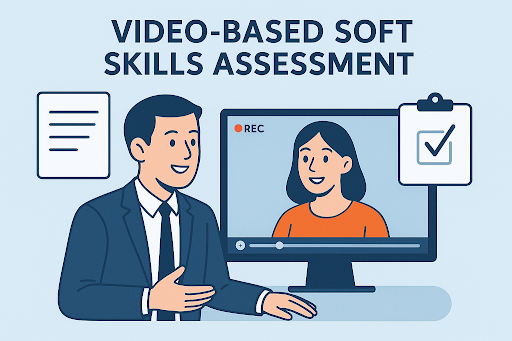
Topics: video soft skills assessment, communication evaluation
Today, assessing candidates’ soft skills—especially how candidates communicate—is increasingly vital in the recruitment and training space. Traditional resume analysis and interviews only provide limited data. A video soft skills assessment can capture the candidates’ communication style in a richer, more nuanced way that captures not only what candidates say, but also how they respond, their tone, body language, and gestures, their levels of adaptability, and emotional intelligence.
Why Video Soft Skills Assessment?
Video assessments allow recruiters and trainers to hear and see candidates in action. The candidate’s body language, facial expression, vocal tone, and pacing all become measurable inputs. As an example, cloud-based platforms such as X0PA AI offer video-assessment tools that assess behavioral competencies by interpreting sentiment, emotion, and communication patterns.
Flexibility is another benefit: candidates can use video to respond to prompts or questions in an asynchronous way, allowing them to record whenever it fits their schedule. Recruiters can then review the candidates’ responses without any scheduling concerns, also allowing recruiters to make comparisons across candidates.
4 Elements of Communication Assessment in Video Evaluations
- Verbal Clarity and Organization: Assessment of a candidate’s capacity to present ideas clearly, the degree to which they logically sequence thoughts, vocabulary use, and fluency.
- Nonverbal Cues: Eye contact, facial expression, gestures, and posture all contribute to the assessment of communication in ways that written or audio-only formats cannot.
- Emotion and Empathy: Capacity to express emotional awareness or respond to emotional context; capacity to pick up on cues and output—e.g., responses to hypothetical or scenario-based questions.
- Adaptability and Engagement: How a candidate addresses follow-up or unanticipated questions, pauses, clarifies, and makes adjustments. This is generally yielded in video assessments using either scenario- or role-play-style questions.
Advantages and Disadvantages
Advantages:
Standardization and Objectivity: Use of a rubric and scoring/assessment models defined ahead of time, limits bias and creates increased fairability in comparison of many candidates.
Scalable and Time Saving: Recruiters can screen large numbers of candidates in asynchronous formats. Reviewing video can often be less time-consuming than coordinating multiple interviews.
Greater Understanding: Creating opportunity for assessment beyond words provides more insight for evaluators on personality, emotional intelligence, presence, etc for an array positions.
Disadvantages
- Performance is susceptible to technology bias (whether that is internet connectivity, poor video/audio quality).
- Some candidates may not be comfortable being recorded, which could lead to anxiety that interferes with their nonverbal performance.
Conclusion
A video soft skills assessment is a valuable vehicle for modern hiring and development, and more opportunities exist for organizations to conduct richer communication evaluation beyond traditional methods. When designed properly, it elevates objectivity, speeds the hiring or evaluation cycle, and (polished candidates) reveals candidates who not only demonstrate what they know, but also how they connect, convey and adapt. This will only increase in popularity as remote and hybrid work continues to increase.
FAQ’s
- What is a video soft skills assessment?
A video soft skills assessment is a digital tool that evaluates candidates’ communication, emotional intelligence, adaptability, and overall professional presence through recorded responses. - How does video assessment enhance communication evaluation?
It allows recruiters to observe verbal clarity, tone, body language, gestures, and engagement, providing a richer assessment than traditional interviews alone. - What are the key elements assessed in video soft skills evaluation?
Core elements include verbal clarity, nonverbal cues, emotion and empathy, and adaptability when responding to questions or scenarios. - How does asynchronous video assessment benefit candidates and recruiters?
Candidates can record responses at convenient times, while recruiters can review submissions without scheduling conflicts, saving time and increasing flexibility. - Can video soft skills assessments reduce bias in hiring?
Yes, using standardized rubrics and scoring models ensures objective comparison and fair evaluation across all candidates. - What challenges exist with video soft skills assessments?
Challenges include potential technology bias, such as poor internet or recording quality, and candidate discomfort with being recorded, which may affect performance. - How can organizations use video assessments for large candidate pools?
Video assessments are scalable, allowing evaluators to efficiently review many candidates asynchronously while maintaining assessment quality. - How does this method improve overall communication evaluation?
By capturing tone, expressions, gestures, and adaptability, it gives a more complete picture of a candidate’s interpersonal and professional communication skills. - What platforms support video soft skills assessment?
Platforms like X0PA AI, eSkill, and AsyncInterview provide tools to measure behavioral competencies, sentiment, and communication effectiveness in candidates. - Why is video soft skills assessment important in modern recruitment?
It offers objective, standardized insights, accelerates hiring cycles, and helps identify candidates who not only know the content but can connect and communicate effectively.
References
- X0PA AI, “AI Video Tools for Soft Skill Evaluation: Top Features,” X0PA. [Online]. Available: https://x0pa.com
- eSkill, “Video Assessment Tools & Interview Questions for Employers,” eSkill. [Online]. Available: https://www.eskill.com
- AsyncInterview, “The Benefits of Video Interviews to Assess Candidate Soft Skills,” AsyncInterview. [Online]. Available: https://asyncinterview.app
- SkillsYouNeed, “Using Video for Soft Skills Development,” SkillsYouNeed. [Online]. Available: https://www.skillsyouneed.com
- Riverway Business Services, “7 Ways to Assess Soft Skills in Video Interviews,” Riverway Business Services. [Online]. Available: https://www.riverwaybusiness.com
Penned by Raashi Jain
Edited by Reeya Kumari, Research Analyst
For any feedback mail us at [email protected]
Streamline Your Hiring with Eve Placement’s Custom Assessments
Eve Placement helps you engage, assess, and recruit top talent through tailored hiring challenges that go beyond resumes. From technical quizzes and real-world case studies to psychometric evaluations and audio/video submissions, our platform enables smarter, data-driven hiring decisions. Advanced security features ensure authenticity and eliminate fraud, giving you reliable results. Ready to hire better? Know More.
Mail us at [email protected]