Top Soft Skills Employers Are Hunting For in 2025
Topics: top soft skills for 2025
Introduction
Soft skills are vital for today’s ever-evolving professional space. As we approach the end of 2025, the workplace has been shaped by automation and artificial intelligence(AI). These flexible working models have shaped the sustainable push to soft skills, which has become top of the ladder in 2025. Both the employers and the personnel realized that employability skills – the personal qualities and social abilities that technology can’t replace are vital for career growth and long-term success, without any exception. This article will explore the skills most sought after and how to develop them. How individuals & organizations can enhance them to stay competitive in the future workplace , and the top soft skills for 2025 which that most employable.
Evolving Definition of Employability
The definition of employability has changed dramatically in recent years. The technical skills, although foremost in making hiring decisions, have taken a back seat after the integration of digital tools and automations, which were previously dominated by formal qualifications and technical expertise. These days, being employable is defined by having the capacity to pick things up quickly, collaborate well with others, and adapt to change.
As year passes, prominent research entities emphasize that soft skills are now crucial for career success.
According to the World Economic Forum’s Future Report 2025, nearly 39% of core job skills are expected to change by 2030. Comprehending today’s research, Deloitte Research predicted that the importance of this skill will grow twice as fast as the traditional job by 2030. In consideration of this, the definition of employability has changed to the extent that one can easily learn, collaborate effectively, and adapt to complex and evolving work dynamics.
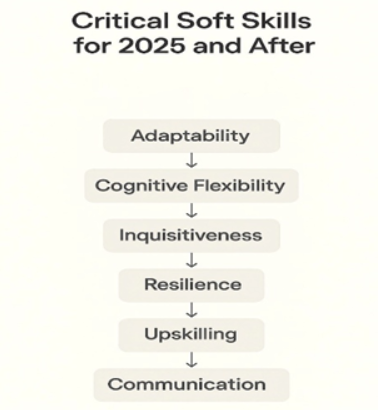
Ways to Develop Skills
- Self-Evaluation– Determine your area of strength and growth by reflecting on yourself or getting input from mentors and peers
- Engage in Active Listening– To make conversation for enriching and engaging, one should pay close attention, without interrupting much. Also, for making interaction more fruitful genuine questions are must.
- Acquire Negotiation skills– Enroll in negotiation and conflict resolution classes or workshops to effectively use leadership
- Develop EI– By taking into account various points of view and constructively controlling your emotions under intense pressure, you could demonstrate Emotional Intelligence.
- Practice Teamwork– Teamwork in practice can be enhanced by a variety of activities like volunteering, taking part in group projects, or joining student organizations.
Notable Skills for 2025
- Systematic Thinking and Brainstorming– One of the esteemed abilities is systematic thinking, which involves assessing intricate circumstance logically and considering decisions based on data. For example, an employee understands how their actions impact other teams and verticals by understanding the previous year metrics.
- Creativity and Innovation– Creativity and Innovation, beyond their traditional cultural uses, are pivotal for handling new difficulties in innovative ways. Whether it’s applied to enhance product designs or client service, creativity remains a foremost element that distinguishes skill-rich companies from others.
- Elasticity and Lifelong Learning– The charging market shifts make adaptability a prerequisite; employees who stimulate change acquire skills and nurture a growth mindset are more likely to sustain rewarding careers and contribute positivity to their organizations.
- Emotional Intelligence– (EI) empower individuals by enhancing their ability to decide by using logic to assess situations, by managing their own emotions, and appreciating other perspectives. This skill fosters effective conflict resolution and builds a strong cooperative working environment.
- Alliance and Communication– Team performance is improved through vehement and open communication. In complex and elongated workplaces, the ability to listen intently, mould communication for various audiences, and collaborate with coworkers is essential.
- Time Management and Organization– Professionals need to shift, prioritize, organize, and manage their workloads in light of growing workload intensification. Time management reduces workplace stress and has a direct bearing on efficiency. An employee who showcases time management completes projects before deadlines maintain a work life balance.
- Self-Awareness– Nowadays, being able to foresight and upskill is essential for career growth. Personnel who are self-conscious can understand their areas of strength and improvement, welcome complaints, and pursue new desires to live relevantly.
- Flexibility and Agility– Skills help individuals stay composed and effective during uncertainty, disruption, and changes such as remote work transitions or market shocks. Agility in employees thrives the whole team, navigates ambiguity, and supports business standards
Why Develop these Skills
Businesses and individuals must invest in developing these critical skills if they want to prosper in 2025. Achievable strategies for people include volunteering for new tasks to increase flexibility, asking for feedback to improve communication, and taking part in workshops or online courses to improve emotional intelligence and problem-solving skills. Putting personal knowledge of dreams and retaining a journal about studies are two more methods to cultivate resilience and self-awareness.
By imparting mentorship applications, fostering common teamwork opportunities, and praising workforce members who show off smooth abilities, corporations play a critical role. Providing specialized training periods based on actual workplace difficulties enables employees to apply newly acquired abilities in a context and guarantees ongoing team development.
Conclusion
The top soft skills for 2025, such as analytical, creativity, time management, and resilience, have become the foremost employability skills. Both personnel and gaffers must emphasize soft skills to re-mould, refine, and succeed in the changing world. By making a tradition of perennial growth and focusing on human capabilities, institutions and individuals can curate lasting workplaces of tomorrow.
Commonly Asked FAQs:
Q1. What are the top soft skills for 2025?
The top soft skills for 2025 include systematic thinking, creativity, lifelong learning, emotional intelligence, teamwork and communication, time management, self-awareness, and flexibility. These skills are valued because they cannot be automated and are essential in adapting to dynamic workplaces.
Q2. Why are the top soft skills for 2025 more important than technical skills?
Technical skills remain important, but automation and AI can replace many of them. The top soft skills for 2025—like adaptability, problem-solving, and emotional intelligence—cannot be automated. Employers see them as the foundation of employability because they determine how effectively professionals can work, learn, and lead in uncertain environments.
Q3. How can employees develop the top soft skills for 2025?
Self-reflection to identify strengths and weaknesses.
Active listening to improve communication.
Taking online workshops on negotiation, leadership, and creativity.
Volunteering for group projects to practice teamwork.
Journaling to improve self-awareness and resilience.
Q4. What role does emotional intelligence play among the top soft skills for 2025?
Emotional intelligence (EI) is one of the most important soft skills. It allows professionals to manage their emotions, recognize others’ feelings, and make logical decisions under pressure. In 2025, EI is a critical factor in conflict resolution, leadership, and collaboration, making it central among the top soft skills for 2025.
Q5. How do employers benefit from hiring candidates with the top soft skills for 2025?Employers benefit by gaining workers who adapt quickly to change, collaborate effectively, and foster a positive work culture. Employees with the top soft skills for 2025 also improve productivity, handle stress better, and contribute innovative ideas. This makes organizations more resilient in competitive markets.
Q6. Which industries value the top soft skills for 2025 the most?
Technology – for creativity and adaptability.
Healthcare – for empathy, teamwork, and communication.
Finance and Consulting – for systematic thinking and problem-solving.
Education and Training – for lifelong learning and adaptability.
Q7. How can students prepare for the top soft skills for 2025?
Joining clubs and group projects to build teamwork.
Practicing time management by balancing academics and extracurriculars.
Developing creativity through innovation challenges.
Seeking mentorship to gain feedback.
This ensures they graduate with both academic knowledge and the top soft skills for 2025.
Q8. Is creativity still considered one of the top soft skills for 2025?
Yes. Creativity and innovation remain essential. As workplaces face unprecedented challenges, employees who can think outside the box to improve processes, design better products, or solve problems in unique ways will remain highly employable. Creativity is firmly in the list of top soft skills for 2025.
Q9. How does time management fit into the top soft skills for 2025?
Time management ensures employees can prioritize tasks, meet deadlines, and maintain work-life balance. With workloads increasing and hybrid models growing, managing time effectively is crucial. That’s why time management ranks high among the top soft skills for 2025.
Q10. Why is lifelong learning listed in the top soft skills for 2025?
Lifelong learning ensures professionals stay relevant. As technology and industries evolve, employees who constantly upgrade their skills remain valuable. Employers see curiosity and willingness to learn as essential traits, making lifelong learning one of the top soft skills for 2025.
Q11. How do teamwork and communication enhance the top soft skills for 2025?
Teamwork and communication enable collaboration across diverse teams. In 2025’s hybrid and global work environments, employees must adapt communication styles to different audiences, listen actively, and resolve conflicts smoothly. This makes teamwork and communication critical among the top soft skills for 2025.
Q12. Can self-awareness improve the top soft skills for 2025?
Yes. Self-awareness allows professionals to recognize strengths, weaknesses, and areas for growth. When employees are self-aware, they accept feedback better and pursue opportunities to improve. Self-awareness supports growth in all other top soft skills for 2025.
Q13. How does flexibility prepare employees for 2025 challenges?
Flexibility helps employees handle disruptions like market shocks, remote work, or organizational changes. Workers who remain calm and adaptable during uncertainty become invaluable. Flexibility and agility are therefore non-negotiable in the list of top soft skills for 2025.
Q14. Are the top soft skills for 2025 universal across cultures?
Yes, though emphasis may vary. For instance, teamwork may be more emphasized in some regions, while creativity is valued more in innovation-driven industries. However, adaptability, emotional intelligence, and communication are universally recognized as top soft skills for 2025.
Q15. What are examples of daily practices to build the top soft skills for 2025?
Setting goals and reviewing them for time management.
Asking thoughtful questions to strengthen communication.
Practicing mindfulness to enhance emotional intelligence.
Reading and learning regularly for lifelong learning.
These small habits gradually improve the top soft skills for 2025.
Q16. Do employers provide training for the top soft skills for 2025?
Yes. Many companies now invest in soft skills training. Employers provide workshops on leadership, emotional intelligence, negotiation, and communication. Some even use simulations and mentorship programs to help employees practice and improve the top soft skills for 2025.
Q17. How can organizations encourage employees to develop the top soft skills for 2025?
Create mentorship programs.
Reward employees who demonstrate strong soft skills.
Provide real-world training simulations.
Encourage cross-department projects.
Such efforts help employees cultivate the top soft skills for 2025 within real work environments.
Q18. Do AI and automation increase the need for the top soft skills for 2025?
Yes. As automation takes over repetitive tasks, the human edge lies in skills AI cannot replicate—creativity, empathy, adaptability, and emotional intelligence. The rise of AI makes the top soft skills for 2025 even more critical for employability.
Q19. Can mastering the top soft skills for 2025 guarantee career success?
While no skill guarantees success, mastering the top soft skills for 2025 significantly boosts employability. Combined with technical expertise, they ensure professionals stand out in competitive markets and adapt smoothly to evolving job roles.
Q20. What is the long-term benefit of developing the top soft skills for 2025?
Long-term benefits include greater career growth, leadership opportunities, resilience in shifting industries, and the ability to thrive in complex work environments. Employees who master the top soft skills for 2025 will not only stay relevant but also lead the workforce of tomorrow.
References
- The power of soft skills in today’s workplace : 6 Benefits for hiring candidate with strong soft skills https://bluelynx.com/blog/the-power-of-soft-skills-in-todays-workplace/
- Importance of soft skills in Today’s competitive professional landscape (January 2024) https://vati.io/career-guide/the-importance-of-soft
- 19 skills employee will need in the next five years ( January 2025) https://www.forbes.com/councils/forbeshumanresourcescouncil/2025/01/03/19-skills-employees-will-need-in-the-next-five-years/
- why soft skills are essential for career success in 2025 https://huroorkee.ac.in/blog/why-soft-skills-are-essential-for-career-success/
- The future jobs report 2025 ( January 2025) https://www.weforum.org/publications/the-future-of-jobs-report-2025/in-full/3-skills-outlook/
- Top 10 skills you’ll need in 2025 tara.com/articles/the-top-10-skills-youll-need-in-2025/
Penned by Priyansh Sharma
Edited by Sneha Seth, Research Analyst
For any feedback mail us at [email protected]
Streamline Your Hiring with Eve Placement’s Custom Assessments
Eve Placement helps you engage, assess, and recruit top talent through tailored hiring challenges that go beyond resumes. From technical quizzes and real-world case studies to psychometric evaluations and audio/video submissions, our platform enables smarter, data-driven hiring decisions. Advanced security features ensure authenticity and eliminate fraud, giving you reliable results. Ready to hire better? Know More.
Mail us at [email protected]