
The Rise of Remote Internships: Are they equally valuable?
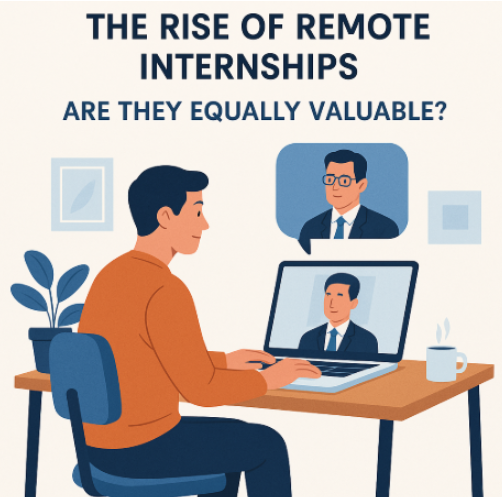
How Remote Internships Are Changing the Game for Students Like Us
A few years back, if someone mentioned working for an overseas company without leaving my hometown, I’d probably chuckle. At that time, internships meant relocating to a new city, navigating public transport, trying to blend into a new office… the whole package, but now?
The situation has changed.
After the pandemic turned everything on its head, internships became remote. , it seemed odd. Like a quick fix. But it remained. And for many students, myself included, it seems to function well. From our kitchen table, we can intern for a company in Mumbai or a startup in Berlin.
No worries, no accommodation costs, no commute. Just the internet, our computer, and ourselves.
Internships
Remote internships are not a new phenomenon; they started during the pandemic. They have been around long enough, even though they were not very well funded. Next, everything in the world has changed dramatically with the emergence of COVID-19. People stopped travelling, closed their business establishments or storefronts, and everything went online. True short-term shortcuts became a long-term trend.
It dawned upon companies that through remote work, they could have access to a global talent pool with no geographical boundaries. The next thing you know, a German graduate could be employed by a firm in Singapore, and a Kenyan student could work in an internship in a San Francisco-based startup. Other than the convenience, it creates an inclusivity and transforms the region-specific model into a global model.
Remote Internships by the Numbers
The statistics support the fact that remote internships are here to stay:
- 74% of employers say that remote internships are now a crucial component of their hiring strategies (Internship.com, 2023).
- Eighty percent of students believe that their remote internships improved their time management and flexibility, two qualities that are critical in any line of work.
- A Hire Pro survey of more than 200 companies and 20,000 students revealed a strong preference for internships lasting four to six months, which strike a balance between flexibility and depth.
- Sixty-eight percent of students are willing to move for the right opportunity.
- The average monthly stipend for an internship now ranges from ₹15,000 to ₹40,000
However, there are still differing views on remote internships. Despite the fact that 79% of students favour them, 71% of businesses are wary, pointing to difficulties with mentorship and practical training.
Debate over Remote Internships
The flexibility that remote internships provide is undeniable. Students can work from any location, save money, and get access to jobs they might not otherwise be able to find in their area. Because of the increasing digital nature of work, 67% of colleges are also accepting this format.
“How do we properly train, mentor, and engage someone we’ve never met in person?” is a legitimate concern for some employers, though. It can be more difficult to simulate hands-on learning on screens.
Additionally, there is a discrepancy in expectations. Even though 86% of students are amenable to part-time internships, 55% of businesses oppose this model, indicating a disconnect between productivity and flexibility.
General Internship Statistics
During the pandemic, internships suffered greatly and were either cancelled or moved online.
Approximately 50–60% of students obtained internships prior to COVID. After that, that percentage fell to just 21.5%.
Internships are still valuable, though. They are more crucial than before:
- Of students, 44.9% completed remote internships, whereas 47.8% completed in-person internships.
- Internships typically last 4.5 months, and 36.4% of respondents reported being very satisfied with their experience.
- A lot of students lost out: 59.4% were unsure how to locate an internship, and 67.3% desired one but were unable to obtain one.
- Employers prefer open applications and typically begin hiring interns eight months in advance.
- Nearly 68% of interns seek experience in their chosen field, with the majority working in analytics or project management.
The good news is that hiring is increasing once more. Businesses intend to hire 22.6% more interns, while nonprofits will increase hiring by 31.6%. Graduates in business, accounting, and finance are particularly sought after by employers.
Internships and the Chances of Getting Hired
Internships continue to serve as a springboard into the working world, pandemic or not. Data shows that 70% of businesses offer full-time positions to interns.
- Eighty per cent of students take those offers.
- Students who interned received an average of 1.17 job offers, compared to 0.98 for those who did not, and internships increased job offers by 16%.
- Internship experience is constantly regarded by employers as a crucial hiring consideration, particularly when it occurs within the same business or sector.
Furthermore, in increasingly competitive job markets, experience is frequently the deciding factor rather than merely a benefit.
Rising Intern Wages
Particularly in the tech sector, internships are becoming more and more compensated. Take a look at these figures:
- An intern with a bachelor’s degree typically makes $19.05 per hour.
- Employers frequently provide housing allowances, travel reimbursements, and signing bonuses;
- Facebook interns can earn up to $8,000 per month, which is nearly double the average American salary.
These advantages not only draw in talent but also open up internships to students from a wider range of backgrounds.
Conclusion
The pandemic did not start remote internships. They have already been in existence in a long period but not very well backed financially. After that, the world flipped with the emergence of COVID-19. People stopped travelling and closed offices, and all the activities were forced online. A stopgap solution that was not intended to be permanent became a permanent solution.
The companies started to understand that by implementing remote working, they do not have to geographically limit themselves when it comes to available talent. Suddenly, a Korean university student could become an employee of a company in Singapore, and a German student would have a chance to do work-related internships in California. Other than convenience, it leads to inclusivity and alters the model to be global instead of region-specific.
FAQs
Q1. Would students take up remote internships more frequently if they were as beneficial as traditional ones?
Yes They would, as remote internships provide exposure to international markets, flexibility, and ease of operation usually without the face-to-face networking, direct hand-holding or mentoring, and complete immersion into office culture that is generally required and done in the case of in-person internships.
Q2. What other factors make students prefer remote internships more?
The cost of moving, paying rent, and traveling is a very attractive factor for many. Many students pay a high cost of international internships in foreign countries where they have relocated to balance their studies.
Q3. Why do some employers express worry when it comes to offering remote internships?
Most employers give preference to quality training, engagement, and performance evaluation under the remote model. Furthermore, they feel it tough to measure team cohesion and offer informal mentorship over screens.
Q4. Do remote internships increase someone’s chances of getting hired?
Absolutely. According to the data, internships, remote or not, are still a significant boost in job offers and many employers are more interested in what you can do and have accomplished as opposed to having you physically there all working hours.
Q5. Today, is there any remuneration associated with virtual internships?
Yes, especially in the tech, analytics, and finance sectors. Pay varies, but most companies now offer stipends, allowances, and even bonuses in a bid to attract and support diversity.
Works Cited
- Business Insider.
“Monthly Wages for Top-Paying Internships in the US (2019).”
CompareCamp, 2019.
Source: Business Insider, 2019.
Accessed via: https://comparecamp.com/internshipstatistics - National Association of Colleges and Employers (NACE).
“Intern Conversion Rates from 2015–2019.”
2019 Internship & Co-op Survey Report.
Created by CompareCamp.com, 2019. - Yello.
“Student Sentiments on Canceled Internships (2020).”
Virtual Internship Statistics and Trends.
Created by CompareCamp.com, 2020. - Open Education Portal.
“The Rise of Remote Internships: A Global Trend.”
Open Education Portal, 2023.
https://www.openeducationportal.com/remote-internships - India Today.
“79% Prefer Remote Internships, but 71% Employers Remain Hesitant: Report.”
India Today, 1 Oct. 2024.
https://www.indiatoday.in/information/story/79preferremote-internships-but-71-employers-remain-hesitant-report-2609355-2024-10-01
Penned by Nishita Kumari
Edited by Sneha Seth, Research Analyst
For any feedback mail us at [email protected]
Streamline Your Hiring with Eve Placement’s Custom Assessments
Eve Placement helps you engage, assess, and recruit top talent through tailored hiring challenges that go beyond resumes. From technical quizzes and real-world case studies to psychometric evaluations and audio/video submissions, our platform enables smarter, data-driven hiring decisions. Advanced security features ensure authenticity and eliminate fraud, giving you reliable results. Ready to hire better? Know More.
Mail us at [email protected]