
Decent Work Shortage: Sustainable Development Goal 8 and Jobs
Introduction
The Sustainable Development Goal 8, as the United Nations defines it, emphasises ‘promoting sustained, inclusive, and sustainable economic growth, full and productive employment and decent work for all.’
This goal has faced significant challenges due to the global outbreak of COVID-19, trade tensions, rising debt of many developing countries and geopolitical conflicts. Global economic growth has been impacted because of these factors.
And although real GDP per capita saw a rebound in 2021 globally, it experienced a break in 2022 and has continued to slow down by an additional 1.5 per cent in 2025 due to increased trade tensions and policy unpredictability.
Targets of SDG 8
I will discuss more about the status of SDG 8 and shortages of jobs in general, but let’s first concentrate on the primary targets of SDG 8:
• Target 8.1- Sustainable Economic Growth
The per capita economic growth shall be maintained in accordance with the national circumstances. The UN has set the goal of 7 per cent GDP growth per annum in even the least developed countries.
• Target 8.2- Increase in economic productivity through diversification, innovation and upgradation
Economic productivity can be achieved through diversification of labour, technological updates and innovation, with a special focus on labour-intensive sectors.
• Target 8.3- Promotion of policies that support job creation and the development of enterprises
Development-oriented policies should be promoted to support productive activities, decent job creation, entrepreneurship, creativity, and innovation, and encourage the formalisation and growth of micro-, small-, and medium-sized enterprises, so that the government recognises them and provides them with access to various services.
• Target 8.4- Improve resource efficiency in consumption and production
Achieve global efficiency in consumption and production, and work towards creating a distinction between economic growth and environmental degradation, and also endeavour towards achieving the 10 Year Framework of Programmes on Sustainable Consumption and Production, with developed countries taking the lead.
• Target 8.5- Regular employment and Decent Work with Equal Pay
By 2030, full and productive employment and decent work for all women and men should be available, with an increased focus on securing jobs for young people and persons from PWD categories, and equal pay for equal work should be made a core value.
• Target 8.6- Promote Youth Employment, Education and Training
This target was to be achieved by 2020 to substantially reduce the proportion of unemployed youth and lack of education or training for them, but it still remains a significant and unachieved target.
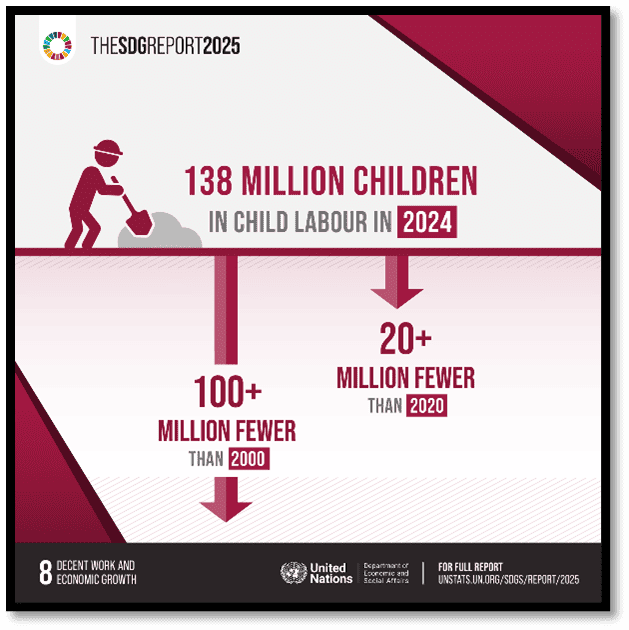
• Target 8.7- Put an end to Modern Slavery, Trafficking and Child Labour
Effective measures should be employed to eradicate forced labour, end modern slavery and human trafficking and initiate the prohibition and elimination of the worst forms of child labour, inclusive of recruitment and use of child soldiers. By 2025, this target was to be achieved, and we can definitely see a reduction in the same.
• Target 8.8- Promotion of Labour Rights and Safe Working Conditions
Protect labour rights and promote safe and secure working environments for all workers, including migrant workers, with special focus on women migrants, and those in precarious employment.
• Target 8.9- Promote Beneficial and Sustainable Tourism
Sustainable tourism should be promoted that creates jobs and promotes local culture and products. Under this, we also find sub-goals such as universal access to banking and other financial services, increase aid for trade support and develop global youth employment strategy.
What is Decent work?
The term ‘decent work’ is recurring and indeed signifies the dream of thousands. It means allocation of opportunities to get productive work and deliver a fair income.
However, a continued lack of decent work opportunities, insufficient investments and under-consumption lead to an erosion of the basic social contract underlying democratic societies: that all must share in progress.
The ILO report
The ILO reports states there are 160 million people openly unemployed in the world.” However, if underemployed people are taken into account, “the number reaches to at least 1 billion.” The report also says that “for every 100 workers worldwide, six are fully unemployed and another 16 are unable to earn enough to get their families over the most minimal poverty line of US$1 per day.”
ILO notes these three gaps in its report:
The rights gap primarily involves the denial of freedom of association, the incidence of forced and child labour, and discrimination. According to the ILO’s Director-General’s report, 250 million children worldwide are estimated to be working. It also found an increase in human trafficking, especially of women and children. Moreover, two countries out of every five have serious or severe problems with freedom of association.
Second in the report is the social protection gap, described as “truly alarming”, with an estimated 80 per cent of the workers globally experiencing a dearth in adequate social protection. In many low-income countries, formal protection for old age and invalidity, or for sickness and healthcare, reaches only a minimal proportion of the population. Additionally, the report also states that 3,000 people die in a day as a consequence of work-related accidents or disease.
The social dialogue gap reflects shortfalls in organisations and institutions, and often in attitudes that have resulted in a representational gap in the working sector. This is a consequence of the fact that workers and employers are not organised to make their voices heard. As a result, more than 27 million workers are still within the clutches of the informal economy.
Conclusion
The prediction for future unemployment rate is said to remain strong at 4.9% in the year 2026; however, a few problems remain unchanged, such as job vulnerability among youth, lingering gender inequality, uneven growth and potential areas leading to uncertainty in international trade, and lastly, there is a lack of coordinated and coherent responses from regional governments.
National leaders should take the lead here, first in their countries and then as world leaders for their other global partners.
References
[1] Goal 8: Decent work and economic growth. [Online]. Available:
https://globalgoals.org/goals/8-decent-work-and-economic-growth/
[2] Goal 8, Department of economic and social affairs. [Online]. Available:
https://sdgs.un.org/goals/goal8
[3] International Labour Conference to explore decent work deficit. [Online]. Available:
https://www.ilo.org/resource/news/international-labour-conference-explore-decent-work-deficit
[4] Global unemployment steady but decent work stagnates as AI and trade risks loom, warns ILO, article on People Matters. [Online]. Available:
https://me.peoplemattersglobal.com/news/economy-policy/global-unemployment-steady-but-decent-work-stagnates-as-ai-and-trade-risks-loom-warns-ilo-48038
Frequently Asked Questions
1. What is the core focus of Sustainable Development Goal 8?
The focus is to ensure that global economic growth is inclusive while promoting productivity and decent work for everyone.
2. How does this UN goal address the global job shortage?
It sets specific targets to reduce unemployment and encourage the formalization of micro-enterprises.
3. Why is labor productivity essential for economic stability?
Higher levels of productivity allow for better wages and more sustainable business models in the long run.
4. Can we achieve Sustainable Development Goal 8 by 2030?
While progress has been made, current trade tensions and geopolitical conflicts make reaching these targets challenging.
5. What is the UN’s GDP growth target under Sustainable Development Goal 8?
The goal is at least 7% annual growth in the least developed countries to ensure economic health.
6. How does diversification impact productivity?
By diversifying the economy into high-value sectors, a nation can significantly boost its overall labor productivity.
7. What is the “social protection gap” mentioned in the report?
It refers to the fact that 80% of workers lack the basic social security needed to maintain a decent standard of living.
8. How does technology influence Sustainable Development Goal 8?
Technological upgrades are a primary driver for increasing industrial productivity and creating modern job roles.
9. What does Sustainable Development Goal 8 say about modern slavery?
It calls for the immediate eradication of forced labor, human trafficking, and the worst forms of child labor.
10. Is productivity linked to environmental degradation?
Sustainable Development Goal 8 aims to decouple economic growth from environmental harm through resource efficiency and green productivity.
11. How many people are underemployed globally?
The ILO notes that if underemployed people are included, the number of people struggling for work reaches 1 billion.
12. Why is youth employment a priority for Sustainable Development Goal 8?
Youth are disproportionately affected by job shortages; hence, the framework focuses on education and training.
13. How do trade tensions affect progress?
Policy unpredictability hampers the investment needed to boost global productivity and job creation.
14. What is the goal for equal pay in Sustainable Development Goal 8?
The target is to achieve equal pay for work of equal value for all men and women by 2030.
15. How can small businesses contribute to Sustainable Development Goal 8?
By providing formal access to banking, these businesses can increase their productivity and hire more workers.
16. Does Sustainable Development Goal 8 cover migrant workers?
Yes, it specifically advocates for the protection of labor rights and safe environments for migrant workers.
17. What is the role of innovation in the current economy?
Innovation is the engine that drives high productivity, leading to more competitive and sustainable economies.
18. What is the 2026 outlook for Sustainable Development Goal 8?
While unemployment is steady at 4.9%, the quality of “decent work” remains a major hurdle for Sustainable Development Goal 8.
19. How does sustainable tourism help?
It creates local jobs and promotes culture, contributing directly to the growth targets of the UN.
20. How can leaders increase productivity in their countries?
By investing in human capital, infrastructure, and policies that align with Sustainable Development Goal 8.
Penned by Aarushi
Edited by Pranjali, Research Analyst
For any feedback mail us at [email protected]
Streamline Your Hiring with Eve Placement’s Custom Assessments
Eve Placement helps you engage, assess, and recruit top talent through tailored hiring challenges that go beyond resumes. From technical quizzes and real-world case studies to psychometric evaluations and audio/video submissions, our platform enables smarter, data-driven hiring decisions. Advanced security features ensure authenticity and eliminate fraud, giving you reliable results. Ready to hire better? Know More.
Mail us at [email protected]