
Social Engineering Defence: Defending the Digital Ecosystem of India
Introduction
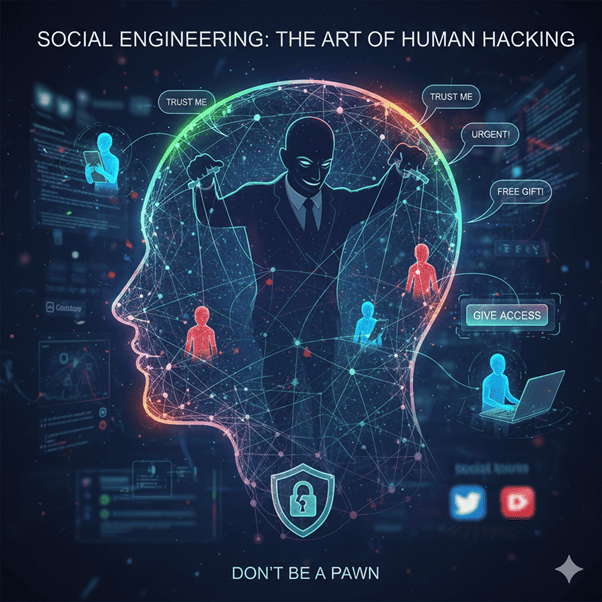
Social engineering is one of the most common and highest-risk cybersecurity threats to India today. Social engineering uses human psychology to overcome security barriers, unlike conventional cyberattacks, which use technical vulnerabilities to compromise human security. Social engineering has been aimed at the human element that is naturally vulnerable and cannot be overcome by most security mechanisms. These attacks have progressed and become more effective and harmful in the fast-digitizing environment in India, where banking, government services, and commerce have moved online.
The threat is particularly acute in India, which ranks as the third most vulnerable country globally to cyber threats, according to the Internet Security Threat Report provided by Symantec. The most important technique of the attack is to take advantage of human feelings to act according to the commands of the attacker. The recent cases reveal just how large this issue is, with call centre scams involving hundreds of operators defrauding foreign citizens of millions of dollars, mobile banking trojans targeting Indian users on WhatsApp and Telegram platforms.
The Indian Situation: An Increasing Menace
Digital transformation in India has provided unprecedented opportunities and even threats. Financial institutions are the perfect targets since the personal and transactional data of customers are electronically stored in the servers within the bank’s data centres. The banking industry is constantly under attack, with fraud schemes including phishing efforts attempting to impersonate reputable shopping websites, as well as fake KYC apps that intercept and steal sensitive information from their users.
Indian Computer Emergency Response Team (CERT-In) is the nodal agency that is set up in response to cyber incidents and is under the Information Technology Act 2000, Section 70B. According to CERT-In, there has been an alarming increase in social engineering attacks, especially those that are directed against the banking, government services and utilities sectors. Attackers are sending messages that are aimed at deceiving users into downloading a malicious application on their mobile device in the guise of trusted organisations by playing on the trust of known institutions.
Widespread Social Engineering Vehicles
Some of the attack vectors have worked especially well in the Indian context:
1. Phishing Attacks:
In 2021, a viral campaign was launched, targeting Indian users, which posed as well-known e-commerce platforms and gave them special deals by clicking on suspicious links. This type of attack is the most popular form of social engineering and most scalable.
2. Pretexting:
This is a type of attack where hackers build up elaborate stories, impersonating bank officials, IT support staff, or government authorities. The stories about defaulting on taxes, defaulting on payments, etc. and tempting people to give up their money/confidential information are a widespread tactic that plays on the fear of the governmental representatives in citizens.
3. Mobile Banking Trojans:
Microsoft Security has recently discovered continued activity of new fraudulent apps posing as a legitimate banking or government KYC application and leeching sensitive data such as banking data, payment cards, and account information.
4. Honey Traps:
The attackers use false online relationships to obtain intelligence about people in high positions, especially those in the defence, intelligence, or security services.
Countermeasures and Defense Techniques
Social engineering cannot be successfully defended against without a multi-layered people, process and technology approach:
1. Employee Learning and Information
Institutions ought to use intensive employee education to improve the level of awareness and the strategies of social engineering. Constant training should address identifying phishing attacks, learning about pretexting, and suspicious solicitation of sensitive data. Under CERT-In, the Information Security Education and Awareness (ISEA) program by the government is trying to spread mass awareness of cyber hygiene in India.
2. Technical Controls
Organisations are required to implement high security technologies such as:
Multi-Factor Authentication (MFA):
MFA can be considered a major mitigation since it will minimise the chances of unauthorised access significantly, even in cases where credentials are stolen.Email Filtering:
Sophisticated filters can be used to block malicious messages before they get to the inboxes of users.Endpoint Protection:
Multifaceted security products on the system of individual devices offer supplementary levels of protection.Security Audits Frequently:
This is a continuous process where vulnerabilities are identified before the attackers can exploit them.
3. Policy and Procedural Measures
Organisational tough access control and multi-factor authentication should be employed, and security policies should be frequently revised. All organisational policies must consider possible vectors of social engineering and should give particular advice about the protective measures. This involves checking protocols when receiving or sending funds, procedures in response to sensitive information requests, and the provision of clear reporting procedures regarding suspicious acts.
4. Culture of Skepticism
There is an added protection of keeping a culture of skepticism, i.e. checking requests, reporting suspicious events early to provide effective protection. Consultation should be encouraged to employees to see through the odd requests, particularly the ones that cause a sense of urgency or fear, and it should provide a safe reporting mechanism that does not result in revenge.
5. Preparation of Incident Response
Organisations have to plan and prepare for successful attacks despite the prevention strategy. This will involve documented incident response protocols, frequent drills that mimic social engineering attacks, and post-incident analysis to determine areas of weakness and put in corrective measures.
Government Initiatives
The Indian government has made a number of steps to fight against the social engineering threats. CERT-In operates the Cyber Swachhta Kendra (Botnet Cleaning and Malware Analysis Centre) and observes National Cyber Security Awareness Month annually. The National Cyber Crime Reporting Portal allows citizens to report directly via the portal, and the matter will be automatically routed to the relevant law enforcement.
Conclusion
Since India is still on the digital change path, it takes vigilance and adaptability to combat social engineering attacks. Companies should understand that security cannot be entirely about controls, but it is all about individuals. Through a unified awareness, technical defence mechanism and supportive organisational culture, India can become resilient to such manipulative methods and ensure that all citizens are safe in their digital ecosystem.
References
[1] Symantec, “Internet Security Threat Report,” Symantec Corporation, 2023. [Online].
Available: https://www.broadcom.com/company/newsroom/press-releases
[2] Indian Computer Emergency Response Team (CERT-In), “Annual Report on Cyber Security Incidents,” Government of India, 2023. [Online].
Available: https://www.cert-in.org.in
[3] Ministry of Electronics and Information Technology (MeitY), “Information Technology Act, 2000 – Section 70B (CERT-In),” Government of India. [Online].
Available: https://www.meity.gov.in
[4] Microsoft Security Intelligence, “Mobile Banking Trojans Targeting Indian Users,” Microsoft, 2023. [Online].
Available: https://www.microsoft.com/security/blog
[5] Reserve Bank of India (RBI), “Awareness on Digital Payment Security and Fraud Prevention,” RBI, 2022. [Online].
Available: https://www.rbi.org.in
Navigating Social Engineering: Frequently Asked Questions
- What is the primary goal of these psychological attacks?
The goal is to manipulate individuals into divulging confidential information or performing actions that compromise security protocols. - Why is the human element considered the weakest link?
Technical barriers are often robust, but human emotions like fear, urgency, or curiosity can be exploited to bypass even the strongest firewalls. - How does phishing differ from other manipulative tactics?
Phishing specifically uses digital communications, like emails or texts, to trick users, whereas other tactics might involve physical or phone-based deception. - What defines “Pretexting” in a security context?
It involves creating a fabricated scenario—such as an IT audit or a tax issue—to convince a target to share sensitive data. - Is social engineering common in the Indian banking sector?
Yes, it is highly prevalent, often involving fake KYC updates or fraudulent links sent via messaging apps. - What is a “Honey Trap” in the context of intelligence?
It is a tactic where attackers create fake online personas to build romantic or personal connections to extract sensitive defense or government information. - How does Multi-Factor Authentication (MFA) help?
Even if an attacker steals a password through deception, MFA provides a second layer of defense that is much harder to bypass. - What role does CERT-In play in India’s defense?
CERT-In serves as the national nodal agency for responding to cyber incidents and spreading awareness about online hygiene. - Can a “culture of skepticism” actually prevent data breaches?
Yes. Encouraging employees to verify unusual requests significantly reduces the success rate of psychological manipulation. - What is the “Cyber Swachhta Kendra”?
It is a government initiative for botnet cleaning and malware analysis to help citizens secure their personal devices. - How can I report a digital fraud in India?
Citizens can use the National Cyber Crime Reporting Portal to log complaints that are then routed to relevant law enforcement. - Why are mobile banking trojans so dangerous?
These apps mimic legitimate software to intercept SMS codes, payment data, and account credentials directly from a smartphone. - What is the “Information Security Education and Awareness” (ISEA) program?
It is a government-backed program aimed at educating the general public and students about staying safe online. - How do attackers use urgency to their advantage?
By creating a sense of panic (e.g., “Your account will be deleted in 1 hour”), they force the victim to act before thinking logically. - What should an incident response plan include?
It should include clear protocols for reporting, containing the breach, and analyzing how the deception was successful. - Are small businesses at risk from these threats?
Absolutely. Smaller entities often have fewer technical controls, making them prime targets for credential theft. - What is “Email Filtering”?
It is a technical control that scans incoming mail for suspicious links or language patterns typical of fraudulent outreach. - Does the IT Act 2000 cover these types of crimes?
Yes, Section 70B and other provisions provide the legal framework for addressing digital crimes in India. - How can regular security audits protect an organization?
Audits identify where human processes might be vulnerable to exploitation before a real attacker finds them. - Why is vigilance necessary for the future?
As more services move online, the risk of social engineering increases, requiring a resilient and informed digital ecosystem to maintain national security.
Penned by Arya
Edited by Anuj Kumar, Research Analyst
For any feedback mail us at [email protected]
Streamline Your Hiring with Eve Placement’s Custom Assessments
Eve Placement helps you engage, assess, and recruit top talent through tailored hiring challenges that go beyond resumes. From technical quizzes and real-world case studies to psychometric evaluations and audio/video submissions, our platform enables smarter, data-driven hiring decisions. Advanced security features ensure authenticity and eliminate fraud, giving you reliable results. Ready to hire better? Know More.
Mail us at [email protected]