
Why Skill-Based Hiring Outpaces Marks-Based Selection
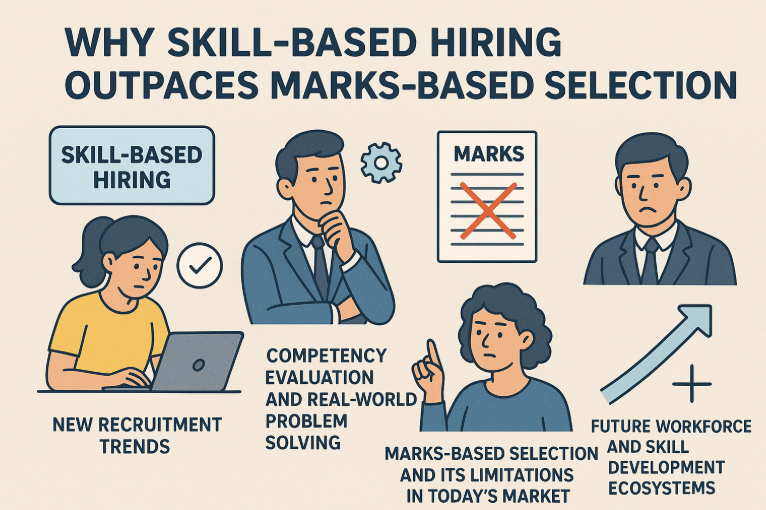
Shifting from Marks to Mastery: The Rise of Skill-Based Hiring
Are you sensing the enormous wave of change that is coming? What used to be the norm of judging the selection of an employee on the basis of marks scored is now becoming invalid, with a human capital flaw that is becoming too big just to be ignored or sidestepped. A few companies around the world, including some in India, are still relying on traditional ways in choosing their employees, whereas many companies are turning the tables towards the skill-based hiring approach, which concentrates more on what candidates are able to do rather than just telling them something. This change has certified talent straight away employable, which can be observed in companies like Google and Infosys that are giving more weight to practical tests than to degrees.
Skill-Based Hiring Takes Center Stage
Today, employers are eager to find workers who possess practical skills such as programming, data analysis, and marketing skills in order to have a workforce that is in line with the future challenges. In India, for instance, by organizing direct entry programs, Infosys and TCS are testing freshers on their ability to work on live projects rather than their academic performance, thus their talent pool becomes huge as they don’t limit themselves to only top colleges. On the other hand, HDFC and ICICI Insurance open up vacancies for the candidates who are best at selling policies, which indicates that skills are the main driver for business growth at a much quicker rate than through the use of an MBA degree.
This phenomenon has the effect of cutting the cost of training, and the company becomes more diverse since they get to choose from a pool of candidates coming from the Tier-2 towns such as Pune and Lucknow, where there is a rise of employable talent, and yet they may not be aware of their potential. It could happen that a software company chooses a developer who has taught himself to create apps and has a good portfolio rather than a top-IIT graduate who has no hands-on experience, and as a result, the company will be able to onboard faster and have more new ideas.
Evaluating True Competency Through Real Tasks
Firms now have in-depth interviews, and instead, they use task-based assessments for the evaluation of critical thinking skills and the ability to adjust to new situations, which are also characteristics of the workplace. Candidates can be given a task to prepare a digital campaign within a certain time limit when applying for a marketing role, thus it helps to uncover the problem-solving skills of a candidate beyond what the textbooks provide. The behavioral question, such as “tell us about a time when you faced a roadblock in a project,” helps understand the previous actions, which are a good indication of future actions.
India is using artificial intelligence-powered recruiting tools that are able to differentiate logic and emotional intelligence in the response to diminish bias and to spot talent at an early stage. The combination of campus drives with aptitude tests and communication simulation is now the way of hiring that provides immediate performance enhancement from the very first day, as recruiting time is cut in half by multi-competency platforms like iMocha.
Why Mark-Based Selection Falls Short
Most of the time, academic scores do nothing but spotlight a huge theory-practice gap, and they also have the issue of not being able to grade consistently, which in turn leads to the inflation of resumes but not to readiness. The Central Board of Secondary Education (CBSE) announced that there were significant differences in the theoretical marks and practical ones in 500 schools, which could be a sign that students are more prepared to do rote learning than to show their real abilities. For example, a student who excels at exams may become speechless when given the task of addressing a client, while the low achiever may be excellent when it comes to teamwork, thus revealing that marks only limit talent to those who are good at following a script.
The old school method of selecting employees is the cause of the crisis in employability; less than half of the Indian graduates (42-55%) are capable of being employed due to a lack of soft skills, such as teamwork. On the other hand, the IT sector is giving up on degree-holders only, as skills portfolios become more trustworthy than scores, which are not stable.
Building Tomorrow’s Workforce Through Upskilling
The future work necessitates a continuous learning environment that includes digital skills, AI fluency, and green initiatives that will eventually close all gaps. The India Skills Report 2025 reveals that the small towns are leading the way when it comes to employability through bootcamps, and 45% of the bosses are putting tech proficiency first in sectors such as BFSI and manufacturing. Women and gig workers are benefiting from platforms like Skill India Digital, which is promoting their adaptability.
Employers who are alongside the upskillers for certification rather than degrees are forecasting a 40% reduction in credential-focused hiring by 2025. An out-of-the-box commerce graduate who is upskilling in data analytics via online courses will be able to jump into BFSI roles in no time and thus become a perfect example of the ongoing shift to performance-driven careers.
Reference
Bone, E. Ehlinger, F. Stephany, “Skills or Degree? The Rise of Skill-Based Hiring for AI and Green Jobs,” arXiv preprint, Dec. 2023.
https://arxiv.org/abs/2312.11942.
FAQs :-
1. What is skill-based hiring and why is it becoming essential today?
Skill-based hiring is a modern recruitment method where employers select candidates based on real abilities rather than degrees or marks. This shift is essential because companies want job-ready talent who can perform from day one. Skill-based hiring ensures stronger productivity, reduces training time, and closes the theory–practice gap that traditional hiring often fails to address.
2. How does skill-based hiring benefit companies in terms of efficiency?
Skill-based hiring boosts efficiency by helping organizations pick candidates who already have hands-on experience, whether in coding, marketing, analytics, or design. Instead of relying on paper qualifications, employers evaluate a candidate’s real performance, which cuts onboarding time and improves early productivity. This direct skills evaluation is why many global firms now prefer skill-based hiring.
3. Does skill-based hiring help in reducing hiring bias?
Yes, skill-based hiring reduces hiring bias because candidates are judged on their capabilities, not where they studied, what grades they earned, or their background. Skills tests, simulations, and practical tasks make the process more fair and structured. Companies using skill-based hiring are able to build more diverse teams because talent is recognized purely based on ability.
4. How is skill-based hiring different from traditional marks-based recruitment?
Traditional hiring focuses on marks, degrees, and academic standing. Skill-based hiring shifts attention to practical knowledge, real-world problem solving, and portfolio strength. While marks show theoretical understanding, skill-based hiring reveals how effectively a candidate can apply knowledge, communicate, and adapt—qualities that matter far more in the workplace.
5. What industries are adopting skill-based hiring the fastest?
IT, BFSI, marketing, e-commerce, manufacturing, and design industries are adopting skill-based hiring quickly. These industries rely heavily on critical thinking, creativity, and technical abilities that cannot be measured through marks alone. Companies like Google, Infosys, TCS, and many startups now prioritize skill-based hiring for most of their roles, especially tech and analytics.
6. How does skill-based hiring support freshers from non-top colleges?
Skill-based hiring opens equal opportunities for students from Tier-2 and Tier-3 cities, community colleges, and non-IIT or non-IIM backgrounds. Instead of rejecting candidates based on college reputation, employers focus on skills, portfolios, and practical tasks. This gives freshers with real abilities a fair chance to prove their potential through skill-based hiring assessments.
7. What types of assessments are used in skill-based hiring?
Skill-based hiring uses coding tests, case studies, simulations, portfolio reviews, communication exercises, and task-based challenges. For example, marketers may create a campaign, programmers may solve real bugs, and analysts may interpret data. These assessments reveal true talent and are a core part of effective skill-based hiring.
8. How does skill-based hiring help reduce training costs?
When companies hire candidates who already have the necessary skills, they spend less on training programs and onboarding. Skill-based hiring helps employers build teams that are ready to work immediately, saving both time and money. This approach allows companies to invest resources in innovation rather than basic upskilling.
9. Does skill-based hiring improve employee retention?
Yes, skill-based hiring improves retention because employees who match the role’s practical demands tend to perform better and stay longer. When people are hired based on what they can actually do, they feel more confident and aligned with the job. This makes skill-based hiring a long-term strategy for building committed, high-performing teams.
10. How can candidates prepare for skill-based hiring tests?
Candidates can prepare by building real projects, improving communication skills, practicing case studies, and completing internships or online courses. Creating a strong portfolio and refining practical knowledge is key. Since skill-based hiring rewards genuine ability, candidates must focus on hands-on learning rather than memorizing theory.
Penned by Khusboo
Edited by Jinal Kapadia, Research Analyst
For any feedback mail us at [email protected]
Streamline Your Hiring with Eve Placement’s Custom Assessments
Eve Placement helps you engage, assess, and recruit top talent through tailored hiring challenges that go beyond resumes. From technical quizzes and real-world case studies to psychometric evaluations and audio/video submissions, our platform enables smarter, data-driven hiring decisions. Advanced security features ensure authenticity and eliminate fraud, giving you reliable results. Ready to hire better? Know More.
Mail us at [email protected]