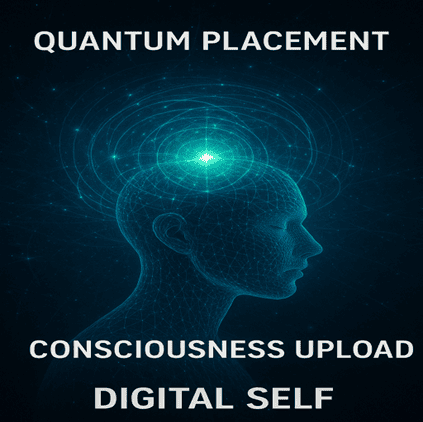
Quantum Placement Consciousness Upload
Introduction
The idea of storing the human mind on a computer seems to be a science fiction fantasy. Replicating thoughts, memories, and personality in a digital world in which nothing fades and nobody dies becomes an interesting idea for people. This daydream is becoming a serious topic as scientists investigate quantum technology.
Quantum Placement Consciousness Upload is a fresh concept gaining popularity that could transfer human consciousness to a digital world powered by quantum technology. Though this seems futuristic, let us try to understand it.
What is a Consciousness Upload?
The concept of transferring everything that makes you “unique”, your memories, feelings, routines, decisions, and even your style of thinking into a digital system is known as consciousness upload. As simple as copying your entire mind onto another device, just like copying a file from one device to another.
Due to the complexity of the human brain, it is still not known how this is actually done. As the capabilities of quantum computers are growing, scientists are optimistic about the near future.
Where regular computers process information in steps, a quantum computer uses qubits: the base unit of information in quantum computing, which can hold many states at once. This allows them to analyse huge amounts of data from the brain quickly and accurately.
With this speed and ability, one day, quantum technology can be used to map the tiny details of the human mind, making a consciousness upload more achievable.
What is Quantum Placement?
Quantum placement is an idea of the digital world, where the uploaded consciousness could exist. Consider a virtual home constructed with quantum computing principles, where the uploaded consciousness would not be locked or stuck in this area, as compared to a simple computer file. It might keep evolving, learning, and responding almost like a living mind.
Quantum placement would create an environment that is open to change and growth. After that, the uploaded consciousness would be able to behave more like a real person. The concept of a digital self becomes important in this situation.
Your Digital Self
Your “digital self” refers to a version of you that exists in a digital space, rather than in a physical environment. It can store your thoughts, memories, and even personality. To simplify this, the digital self is an immortalised copy of yourself.
Imagine being able to work on different projects and solve problems, study faster, or continue working even when you sleep. The idea of the digital self offers several interesting opportunities. Let us assume a space where,
It is possible for your digital self to take examinations or attend interviews.
It picks up new abilities more quickly than your human brain.
It saves your memories indefinitely, even when your biological body cannot.
The Potential Impact of Quantum Placement Consciousness Upload on Careers
One of the key impacts of consciousness upload is in the workplace. A quantum placement digital self could be helpful in a lot of ways.
It could master hard topics faster.
It might use simulation to review career paths.
It could fast analyse employment roles.
It could rehearse interview questions repeatedly.
Some people may even collaborate with their digital selves in the future. The computer self would do data-intensive jobs at quantum speed, while humans devote themselves to creative thinking or communicating. The way we work, learn, and grow could be drastically changed by this fusion of human intuition and quantum-level processing.
The Emotional Aspect of Consciousness Uploading
Although the concept sounds amazing, it may also seem weird or frightening. By uploading your mind, you can create a version of yourself that might survive the death of your physical body. It also raises some emotional questions.
Would the digital self still feel like “you”?
Will it be able to make a connection?
Would it be entitled to rights?
Over time, could it evolve into another form?
These questions show that uploading may be both a very personal and a scientific problem. Regarding the question of whether they want or do not want a digital persona, individuals’ views can be very different.
Safety Risks and Ethical Issues
With great technology comes great responsibility. Your entire individual memories and emotions may be stored in a consciousness upload. This information, if used in the wrong way, can be very dangerous. The enforcement of strict regulations and moral standards is required here.
Key Considerations Include:
Protecting the digital self against hacking.
Making sure that someone’s consciousness cannot be replicated.
Ensuring a respectful and safe environment for the uploaded mind.
Determining the legal and human rights of a digital self.
The technology could be hazardous if it is not properly controlled.
A Future Worth Investigating
The first steps toward consciousness upload are slowly taking shape. As quantum computing advances, it may be possible to partially upload memories, personality traits, or emotional patterns.
Whether this becomes common or remains an uncommon experiment, it is an idea forcing us to reconsider what life and identity mean. It takes us to a world in which the human intellect is able to exist beyond human limits.
With the bloom of consciousness upload, humanity enters a new phase in which identity and technology merge in unimaginable ways.
Reference
[1] Can You Upload a Human Mind Into a Computer? A Neuroscientist Ponders What’s Possible. [Online].
Available: https://news.gatech.edu/news/2025/05/23/can-you-upload-human-mind-computer-neuroscientist-ponders-whats-possible
[2] The Quantum Mind: How Consciousness Shapes Reality. [Online].
Available: https://medium.com/@freeasabird7774/the-quantum-mind-how-consciousness-shapes-reality-9c60299459fd
[3] Scott Aaronson On The Relevance Of Quantum Mechanics To Brain Preservation, Uploading, And Identity. [Online].
Available: https://www.brainpreservation.org/scott-aaronson-on-the-relevance-of-quantum-mechanics-to-brain-preservation-uploading-and-identity
Quantum Minds FAQs
- What is Consciousness Upload (or Mind Uploading)?
Consciousness upload involves transferring everything that makes a person unique—their memories, emotions, personality, habits, and thought patterns—into a digital system. It is often likened to copying the entire mind like a computer file. - What role does quantum technology play?
Quantum computing enables the process by using qubits to rapidly and accurately analyze and map the brain’s vast data, which is essential for a complete consciousness transfer. - What is “Quantum Placement”?
Quantum Placement is the conceptual digital environment or “virtual home” for the uploaded consciousness. Built on quantum computing principles, it allows the mind to evolve, learn, and respond dynamically, rather than remaining a static file. - How does a quantum computer differ from a classical one here?
Classical computers process data linearly using bits (0 or 1). Quantum computers use qubits in superposition to represent multiple states simultaneously, enabling faster, more accurate handling of the brain’s massive data for precise mapping. - What is the “Digital Self”?
The Digital Self is the immortalized digital version of a person in this space—a functional copy preserving thoughts, memories, and personality that persists after the biological body dies. - What is the ultimate goal?
Digital immortality: preserving the mind and identity indefinitely, unbound by biological limits. - How could this impact careers and workplaces?
The Digital Self could master subjects, analyze roles, and rehearse interviews far faster than a human. It would collaborate with the human self, tackling data-heavy tasks at quantum speeds while humans focus on creativity and communication. - Can the Digital Self learn skills faster?
Yes, due to quantum processing speeds and simulation capabilities. - Could it perform tasks while the human sleeps?
Yes, enabling continuous productivity on projects, problem-solving, or learning beyond biological constraints. - How does it aid memory preservation?
It stores memories perfectly and indefinitely, overcoming the biological brain’s fading and limits. - Would the Digital Self be “me”?
This core philosophical debate questions whether the copy retains subjective continuity or becomes a separate entity. - What legal and human rights issues arise?
Key concerns include granting human rights to a Digital Self, property ownership, and societal legal status. - What is the primary safety risk?
Protecting sensitive personal data (memories, emotions, personality) from hacking, manipulation, or misuse. - What ethical issues involve replication?
Strict regulations are needed to prevent unauthorized cloning, addressing identity, ownership, and uniqueness. - Could the Digital Self evolve differently?
Yes, the dynamic quantum environment allows potential divergence from the original personality over time. - Is it possible today?
No—it’s a theoretical, science-fiction concept gaining traction as quantum tech advances, but not yet real. - What is the main scientific hurdle?
Mapping the brain’s trillions of connections and minute details, which exceeds current capabilities. - What “first steps” are underway?
Partial uploads of elements like specific memories, traits, or emotions, as quantum computing progresses. - How should the technology be controlled?
Through strict regulations and ethical standards to safeguard against hacking, replication, and ensure a secure environment. - Will it be accessible to all?
Ethical concerns highlight potential inequality, with access possibly limited to the wealthy.
Penned by Tanuja
Edited by Pranjali, Research Analyst
For any feedback mail us at [email protected]
Streamline Your Hiring with Eve Placement’s Custom Assessments
Eve Placement helps you engage, assess, and recruit top talent through tailored hiring challenges that go beyond resumes. From technical quizzes and real-world case studies to psychometric evaluations and audio/video submissions, our platform enables smarter, data-driven hiring decisions. Advanced security features ensure authenticity and eliminate fraud, giving you reliable results. Ready to hire better? Know More.
Mail us at [email protected]