
Online Skill Challenges: Placement Gamification and Modern Assessment
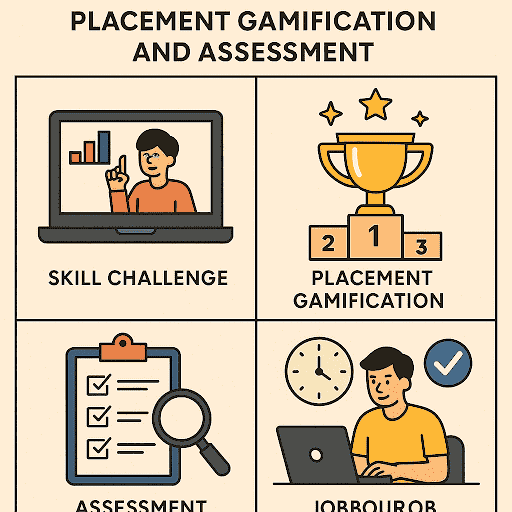
Topics: Skill challenge, assessment
Introduction
The traditional hiring process, which is mostly based on résumés and subjective interviews, is going to change dramatically in the near future. Companies are on the lookout for computerized, cost-efficient, and innovative methods that can effectively measure a candidate’s true potential. As a result, the online skill challenges are the new winners. They use gamification concepts to turn the dull placement process into a fascinating and motivating experience. Embedding game elements like points, badges, leaderboards, and instant feedback into either technical or soft skill assessment activities, companies not only make the applicants’ journey more enjoyable but also they get deeper and more reliable insights into future job performance. This piece of writing discovers how gamified online skill challenges are instrumental in talent acquisition and the establishment of a more equitable, efficient hiring ecosystem.
The Rise of Skill Challenge Gamification
Gamification means borrowing specific features of game playing (e.g., point scoring, competition, rules of play) and using them in some other non-game areas such as the recruitment and hiring process in our case. Formation of this personality attribute of a game for online skill challenges results in upliftment of candidate engagement and completion rates to a high degree as compared to the standard non-interactive tests without gamification. For applicants, a practical evaluation is no longer a boring task but an interesting, immersive, and transparent manner of proving one’s proficiency.
Key Elements of Placement Gamification are:
Progressive Challenges:
Activities that progressively become more challenging, mirroring the level of difficulty in a project at work and allowing the applicants to demonstrate their continuous learning and adaptability.
Immediate Feedback and Scoring:
Delivering instant validation or less praise, which is very energizing, and allowing responders to change their directions/strategies on the spot.
Ranking and Acknowledgement:
Using competitive and social recognition psychological needs by presenting the best performers. This competitive component is the reason for the highest effort and engagement.
What this way does is it completely changes the whole of the applicant’s path, thus the employer benefits by modernizing their brand and becoming more innovative and candidate-centric.
Skill Challenge as the Core Assessment Tool
Basically, the practical evaluation is better than other assessments mechanisms. Unlike a résumé, which is just a brief of someone’s past experience, an online practical evaluation can be a dynamic, direct, and objective way of measuring a candidate’s abilities.
Objective and Predictive Evaluation
The big advantage of using practical evaluation as an assessments tool is the shift towards objectivity. These challenges measure candidates based on performance standards that can be easily quantified – for instance, efficiency of code, time taken for problem-solving, logical reasoning scores, or the quality of the design solution – rather than relying on the subjective impressions of the interviewer or the educational background of the candidate. Studies have shown that these performance-based assessments can be four to six times more predictive of future job performance than traditional methods such as years of experience.
Assessing a Broad Range of Skills
Today’s online skill challenges are not only limited to technical hard skills. For example, gamified simulations can be used to create situational judgment tests (SJTs) that put candidates in relevant virtual work scenarios to assess highly important soft skills like teamwork, adaptability, decision-making under pressure, and emotional intelligence.This comprehensive method protects the company by ensuring the candidates are technically competent for the job and socially suitable for the company’s culture and teamwork environment.
Operational Benefits and Challenges
The hiring organization will enjoy great operational benefits through the use of online skill challenges. It allows large-scale evaluations to be conducted at the same time and the results to be generated automatically. Thus the time-to-hire can be shortened by up to 50% while the HR team’s workload is reduced (Source 2.2). This efficient system opens up the recruiter’s most valuable time for the interview of the most qualified candidates as identified by the assessment.
Nevertheless, setting up the system is not without difficulties. The major challenge is to guarantee that the skill challenging test is psychometrically valid and reliable. An ill-prepared task might only assess surface knowledge or might be open to cheating, thereby weakening the whole process. In addition, although the aim of gamified elements is to lessen bias, it is necessary to ensure the platform and tasks are accessible and fair for a diverse pool of applicants so as to reduce the likelihood of any algorithmic or design bias.
Conclusion
Online skill challenges through successful gamification are absolutely altering the face of talent acquisition. By changing the assessments phase from a boring task to an engaging competition, the companies can get a wider pool of talents, raise their employer brand, and most importantly, take data-driven hiring decisions based on the real and measurable potential. With the increasing demand for the best talents, gamified practical evaluation will not remain stagnant but will keep on developing, thus becoming the most efficient and objective instrument in forecasting success as well as ensuring a better role match for both candidates and organizations.
FAQs
What is an online skill challenges?
It is a digital activity that lets candidates demonstrate their abilities in realistic scenarios, providing a clear view of practical performance beyond a résumé.How does gamification improve these exercises?
Incorporating points, badges, and interactive features makes the experience engaging, motivating participants to complete tasks effectively.What types of skills can be evaluated?
Employers can measure technical expertise, logical thinking, teamwork, communication, and problem-solving skills.Why are companies using digital evaluations?
They reduce hiring time, provide consistent results, and allow recruiters to focus on candidates who perform best in practical exercises.Are these exercises fair for all applicants?
When carefully designed, tasks ensure equal opportunity. Clear instructions, accessible platforms, and standardized scoring promote fairness.Can these tasks predict future job performance?
Yes. Hands-on exercises often provide a more accurate view of how candidates will perform in real work situations than traditional interviews or CV reviews.How do companies prevent cheating during these exercises?
Randomized questions, time limits, and monitoring features help maintain integrity and ensure results reflect genuine skills.Are these digital exercises suitable for all roles?
Most positions benefit from practical online activities. Technical jobs may include coding or data challenges, while managerial or creative roles may use scenario-based simulations.How do these exercises differ from traditional tests?
They focus on applied performance rather than theoretical knowledge, showing how candidates think, adapt, and respond in real-world scenarios.What role do digital evaluations play in modern hiring?
They allow objective comparisons, support data-driven decisions, and reduce reliance on subjective impressions, helping recruiters make fairer selections
References
[1] Smiderle, R., Rigo, S. J., Marques, L., Coelho, J. A. P. de M. (2020). The impact of gamification on students’ learning, engagement and behavior based on their personality traits. Smart Learning Environments. [Online].
Available: SpringerOpen
[2] Legaki, N. Z. (2020). The effect of challenge-based gamification on learning. Computers & Education. [Online].
Available: ScienceDirect
[3] ASC, “Gamification in Learning & Assessment.” Assess.com. (2023). [Online].
Available: Assessment Systems (ASC)
[4] Assessment Day, “Gamified Assessments | Game-based & gamification in hiring.” AssessmentDay.co.uk. (2024). [Online].
Available: Assessment Day
Penned by Tushar Sharma
Edited by Preksha Khatod, Research Analyst
For any feedback mail us at [email protected]
Streamline Your Hiring with Eve Placement’s Custom Assessments
Eve Placement helps you engage, assess, and recruit top talent through tailored hiring challenges that go beyond resumes. From technical quizzes and real-world case studies to psychometric evaluations and audio/video submissions, our platform enables smarter, data-driven hiring decisions. Advanced security features ensure authenticity and eliminate fraud, giving you reliable results. Ready to hire better? Know More.
Mail us at [email protected]