The Importance of Upskilling for Non-Tech Talent
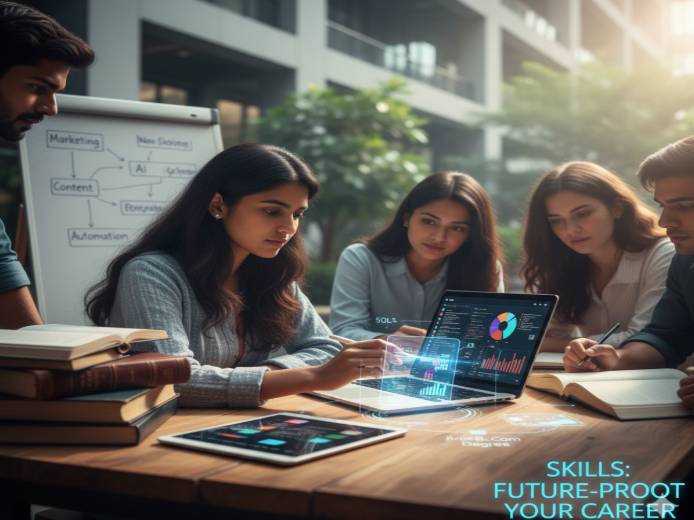
Let’s be honest, if you’re a B.A., B.Com., or BBA student, it’s easy to feel detached from the ongoing tech revolution. You might think, “I’m in a people-oriented role; I don’t need to code.” That assumption is not just outdated, it’s dangerous. In 2025, every company operates as a tech company, and the job market has evolved beyond traditional boundaries [1]. Non-tech upskilling, essentially adding technical knowledge to a non-technical background, is no longer a bonus skill. It has become a survival requirement, distinguishing those who secure high-value roles from those who struggle to stay relevant.
Non-Tech Upskilling for Students is essential for today’s digital-first job market, and the following FAQs explain why it matters, how it works, and how students can use it to build stronger careers.
3 Reasons Why “Non-Tech” Is a Myth Today
Marketing Has Become Data-Driven
A marketing manager without the skill to analytically look through and understand the data represented in the dashboards is almost like a manager who is blind. Modern marketing trends grab the skills of the marketer from two different sides — analytical and creative; hence, skills in tools like Google Analytics, SEO/SEM, and CRM systems (for example, HubSpot) are considered necessary skills nowadays. There is no creative venture that, in its essence, will be without measurable data that tests and gives evidence of success in terms of business results.
Finance Has Turned into FinTech
The financial sector is not going to function only via spreadsheets anymore. Nowadays, the whole thing has been flipped and turned into a major automated industry where the use of automation, predictive analytics, and algorithmic decision-making is the main tool strictly employed. Data analysis professionals must be skilled in the use of at least one highly sophisticated data visualization tool like Tableau or Power BI, and it would be great if they were also able to write a simple Python script that can be used for automating the execution of repetitive tasks. Using Excel alone is insufficient in today’s world.
HR Utilizing People Analytics
The Human Resource department has converted its role from being merely an administrative function into one that is strategic, data-oriented, and driven by analytics. HR teams nowadays analyze employee trends, monitor employee engagement, and predict attrition through the use of analytics. The skill of understanding data and employing it for talent and growth management has become the very core of the HR department.
3 Essential Skills for Modern Non-Tech Professionals
Data Fluency (Excel, SQL, Tableau)
Being a data scientist is not your job, but you still have to be able to handle and make sense of data. Proficiency in advanced Excel functions (PivotTables, VLOOKUP), having a basic knowledge of SQL to be able to write queries for databases, and also being capable of creating simple dashboards with Tableau or Power BI has become a minimum standard nowadays. These are the modern equivalents of knowing Word and PowerPoint — universal professional tools [3].
AI and Automation (No-Code Tools)
Artificial intelligence and automation are technologies that used to be the domain of only engineers, but now they are accessible to anyone. For instance, you could use ChatGPT to speed up your writing process or to assist you in organising your ideas. In addition, there are no-code tools such as Zapier, Notion, or Airtable that can enable you or your team to automate monotonous tasks.. Even just a little organization around some of your workload will save your team time; the net value should make it worth the time investment for a person taking care of everything manually.
Understanding Digital Marketing 101
Even if you’re not a marketer, you should at least understand how marketing works. Knowing how SEO works, social media SEO ads, and content marketing work gives you some insight into how businesses can create and retain customers. Involving thinking about how these marketing practices work makes you a more valuable asset in any role – whether finance, HR, operations, etc.
3 Smart Ways to Upskill Before You Graduate
1. Take Online Courses (The Obvious Route)
Platforms like Coursera and Udemy offer industry-recognized certificates — such as Google Data Analytics and Meta Social Media Marketing. These programs require effort and investment, but they send a strong message to recruiters: you are serious about your career and ready to contribute from day one .
2. Attend University Workshops (The Free Route)
Most colleges conduct workshops on Excel, Python, and visualization tools. Yet, attendance is often low. Participate actively — it’s an easy, cost-free way to enhance your skills and demonstrate initiative to potential employers.
3. Build Small Projects (The Smartest Route)
Real-world application is the best validation of your learning. Instead of merely listing “SEO” on your résumé, start a blog and track its growth with Google Analytics. Manage social media for a college event and measure engagement data. Create a simple business dashboard for a local shop using a no-code tool. A small, hands-on project carries more weight than a dozen certificates.
Conclusion
Technology and non-technology professionals are interconnected in the job market of today. Businesses want employees who are business-minded, creative, and tech-savvy because such workers will use technology to make better decisions and get more efficient results. Enhancing your skills in non-technology areas is what creates the link between your academic degree and your career. People who develop this link will be the leaders in the digital economy, while the rest will be left behind. Therefore, do not wait any longer. Learning, developing, and enhancing your skills is what will ensure your professional future.
References
[1] Harvard business review 2023 – why all your employees need digital skills. [online].
Available: https://hbr.org/2023/02/why-all-your-employees-need-digital-skills
[2] hubspot 2024 – the top marketing skills you need to get a job. [online].
Available: https://blog.hubspot.com/marketing/marketing-skills
[3] Coursera 2024 – Most in-Demand Skills for 2024. [online].
Available: https://www.coursera.org/in-demand-skills
[4] forbes 2023 – the importance of upskilling and reskilling for the future of work. [online].
Available: https://www.forbes.com/sites/forbesbusinesscouncil/2023/07/11/the-importance-of-upskilling-and-reskilling-for-the-future-of-work/
FAQs :-
1. What is Non-Tech Upskilling for Students?
Non-Tech Upskilling for Students means helping non-technical learners gain digital skills like analytics, automation, Excel, AI tools, and dashboards so they can perform confidently in today’s technology-driven workplaces.
2. Why is Non-Tech Upskilling for Students important today?
Non-Tech Upskilling for Students is important because modern jobs require digital awareness. Marketing, HR, finance, and operations all depend on data and tools, so students without tech skills face difficulty keeping up in the job market.
3. How does Non-Tech Upskilling for Students support non-tech graduates?
Non-Tech Upskilling for Students supports B.A., B.Com., and BBA graduates by giving them an edge through digital literacy. They can handle data, understand dashboards, run basic automation, and communicate insights more effectively.
4. What skills are included under Non-Tech Upskilling for Students?
Non-Tech Upskilling for Students includes Excel, SQL basics, Power BI, Tableau, SEO, social media analytics, Canva, ChatGPT, and no-code tools like Notion or Zapier. These skills help students complete real workplace tasks with ease.
5. Can beginners start Non-Tech Upskilling for Students easily?
Yes, beginners can start Non-Tech Upskilling for Students easily using free YouTube tutorials, college workshops, introductory courses, and small practice projects that build confidence without requiring technical backgrounds.
6. Does Non-Tech Upskilling for Students improve job opportunities?
Non-Tech Upskilling for Students improves job opportunities because companies prefer candidates who understand digital tools. Students with these skills perform better in interviews and prove useful from day one in internships or jobs.
7. Is Non-Tech Upskilling for Students expensive or difficult?
Non-Tech Upskilling for Students is not expensive or difficult. Many tools like Canva, Google Analytics, Excel basics, and ChatGPT are free or affordable, allowing students to practice without financial pressure or complicated learning steps.
8. How does Non-Tech Upskilling for Students help in internships?
Non-Tech Upskilling for Students helps interns complete meaningful tasks such as creating reports, analyzing engagement data, building dashboards, or automating repetitive work, making them more valuable and confident in real job settings.
9. Can Non-Tech Upskilling for Students help students build real projects?
Yes, Non-Tech Upskilling for Students encourages students to build real projects like blogs, mini dashboards, SEO reports, or automated workflows. These projects add practical value to resumes and show real skill, not just certificates.
10. What long-term benefits come from Non-Tech Upskilling for Students?
The long-term benefits of Non-Tech Upskilling for Students include better adaptability, career stability, faster growth, and the skill to stay relevant as technology evolves. Students who upskill continue to succeed in the digital future.
Penned by Yug
Edited by Disha Thakral, Research Analyst
For any feedback mail us at [email protected]
Streamline Your Hiring with Eve Placement’s Custom Assessments
Eve Placement helps you engage, assess, and recruit top talent through tailored hiring challenges that go beyond resumes. From technical quizzes and real-world case studies to psychometric evaluations and audio/video submissions, our platform enables smarter, data-driven hiring decisions. Advanced security features ensure authenticity and eliminate fraud, giving you reliable results. Ready to hire better? Know More.
Mail us at [email protected]