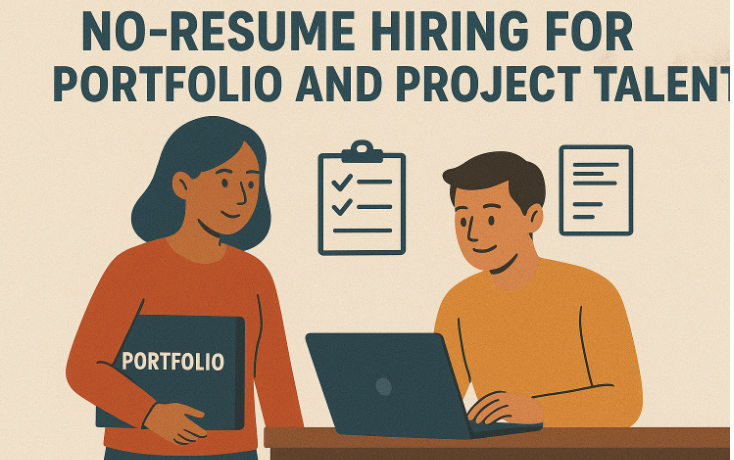
Resumes ruled the job market for decades. A piece of paper (or PDF) made an individual qualified to interview with someone or not. But with the modern evolution of industries and offices requiring more concrete proof of promise, the ubiquitous resume receives its comeuppance. A new employment model is on its way to us—a no-resume hiring campus approach—based on portfolios, projects, and practical competence, often referred to as project-first placement.
Going Beyond the Resume
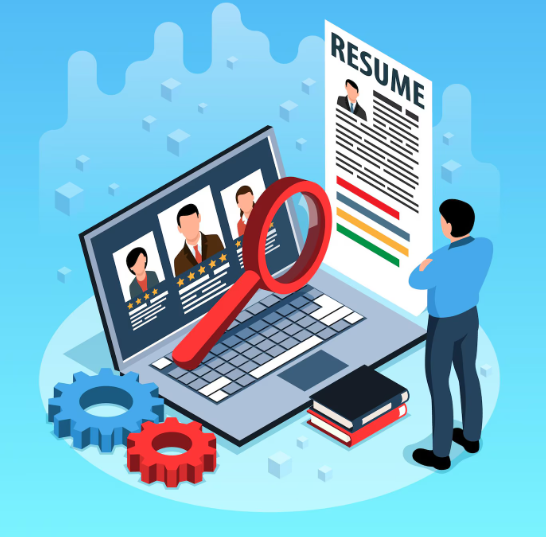
A resume can summarize years of practice, learning, and imagination in bullet points. While it is achievement-driven, it never quite conveys the subtlety of what one is capable of. Resumes can especially make students and young graduates feel constricted. Many are asking themselves: How do I demonstrate my capability when I don’t have experience?
This is where no-resume hiring campus recruitment is pushing the boundaries. Rather than asking for neat and organized CVs, recruiters now review student portfolios, GitHub repositories, design prototypes, or hackathon projects. These concrete deliverables reflect problem-solving ability, creative ability, and work habits in a way that no bullet point ever could.
 Project-First Placement: A Paradigm Shift
The project before placement is taking hold. Companies don’t give a whit whether you went to school somewhere or whether you’ve got multiple internships listed on your resume. They care about what you can create, produce, code, or write.
A computer science major who coded up a bus tracking application for himself is showing initiative, problem-solving, and technical ability. A web designer with a portfolio of branding ideas is obviously showing their sense of design. A blogger author is showing consistency and communication ability.
These projects yell louder than grades or degrees because they are showing applied knowledge—the kind that is worth something in real-world work situations.
Humanising the Hiring Process
What is most compelling about no-resume hiring is that it is human. Rather than the computer scanning of applicants on keyword-matching software, employers are actually working with real samples of talent. Recruiters don’t hear merely what a candidate says he or she has experience in; they get to witness what the candidate has actually done.
This movement is also good for other students who do not get to learn in the best institutions or cool internships. A strong portfolio can make things even, so everyone gets an opportunity.
Picture a student from a small town developing an AI project for language translation. Their resume may be awful, but their project speaks of promise to the universe. No-resume hiring guarantees that those types of people are not weeded out for lack of normal credentials.
The Campus Role in Fostering Change
Universities and colleges have a primary role in the revolution. Portfolio development is being incorporated into the curriculum of most campuses, and students are being encouraged to record their work and post it on the web.
No-resume hiring campus programs also collaborate with businesses to develop project challenges, hackathons, and case-study competitions. These give students the ability to develop skills against real problems and provide employers with an insider view of their potential. For students, it means that the initial impression of an organization is not created by a CV but by displayed skills.
Benefits of No-Resume Hiring
- Transparency: Employers are able to view actual skills being used, not merely assertions.
- Fairness: Less discrimination towards quality institutions and merit-based rewards.
- Skill Development: Enables students to focus on quality work projects instead of grades only.
- Confidence Boost: Students feel more confident when their quality work, and not just academic qualifications, is appreciated.
- Future-Proofing: Triggers a culture of ongoing learning and portfolio development.
Challenges Ahead
Of course, this method is not without defects. Not everyone has the same availability of materials to use, so portfolio-building isn’t the same either. And then there’s always the danger of being too focused on gimcrack projects and not steady learning. Managers must be taught how to manage portfolios just as objectively and equally across sectors as well.
But these are hidden problems. Campuses may offer platforms and facilities to enable all students to develop portfolios. Organizations can establish standardized project assessment in order to promote equity.
The Future of Recruitment
Project-before-placement reflects a wider trend: the future of work is skill-based, not credential-based. As industries are changing, flexibility, innovation, and problem-solving will be more important than where you graduated from or how well you’ve performed.
We are heading towards a career universe in which the query no longer remains “What’s on your resume?” but instead “What have you made or contributed?” For scholars, it’s emancipating—what they’ve accomplished is used to read beyond their paper, highlighting the importance of project-first placement.
Conclusion
No-resume hiring is not only a recruitment trend but a revolution in inclusiveness, equity, and appreciation of talent. With no-resume hiring campus initiatives and project-first placement, students are no longer stymied by the constraints of the one-page resume. Rather, they are encouraged to realize their full potential through projects, portfolios, and passion. This is a twofer for employees and students. The hiring future is not resumes—it’s results, creativity, and human potential.
Commonly Asked FAQs:
1. What is no-resume hiring campus recruitment and how does it work?
No-resume hiring campus recruitment is a modern approach where employers skip traditional CVs and focus on student portfolios, projects, and skills.
Instead of reading bullet points on a document, recruiters review GitHub repositories, design prototypes, hackathon projects, or creative deliverables to assess real capability. This process highlights practical skills and ensures hiring is based on merit rather than where someone studied or how polished their resume is.
2. Why is the no-resume hiring campus trend growing?
The rise of no-resume hiring campus programs reflects a shift toward skills-first recruitment. Companies today want candidates who can demonstrate problem-solving ability, creativity, and teamwork rather than just list qualifications.
With industries evolving rapidly, degrees alone no longer guarantee job readiness. Employers prefer real evidence of competence, and students benefit by showing what they can actually do through projects and portfolios.
3. How does no-resume hiring campus recruitment benefit students?
Students gain a level playing field through this approach. Even if someone does not attend a top-tier university or have multiple internships, they can still stand out with a strong project portfolio.
This method rewards creativity, applied learning, and initiative, giving equal opportunities to all. It also builds confidence because students know they are being judged on their work rather than their background or connections.
4. What role do portfolios play in no-resume hiring campus recruitment?
Portfolios are the heart of the no-resume hiring campus process. They showcase code samples, design mockups, research projects, or case study solutions that prove a candidate’s abilities.
Recruiters can see the quality of work, attention to detail, and problem-solving approach directly. Portfolios can be hosted on personal websites, Behance, GitHub, or even as PDF compilations, making them accessible during campus hiring events.
5. Can project-first placement replace resumes completely?
For some industries, yes. In tech, design, content creation, and product roles, project-first placement is becoming the norm. Recruiters care less about what school you attended and more about what you can create under real conditions.
However, in highly regulated fields like medicine or law, resumes and certifications are still necessary. Over time, we may see hybrid models where resumes are used only as formal documentation, while hiring decisions rely on portfolios.
6. How are colleges supporting no-resume hiring campus programs?
Forward-thinking colleges are integrating portfolio development into their curriculum. They encourage students to document projects from first year itself, participate in hackathons, and contribute to open-source communities.
Many institutions also collaborate with companies to create live project challenges, where students solve real problems and present results. These initiatives help students graduate with strong portfolios and hands-on experience.
7. Can this replace resumes entirely?
In many creative and technical fields, yes. In regulated fields, resumes still matter.
8. How should students prepare?
Start building projects early, document them well, and host them online for easy access.
9. Do colleges support this hiring style?
Yes, many now include portfolio-building in coursework and host hackathons for skill display.
10. What are the benefits for employers?
They get faster hiring, better culture fit, and proof of practical ability before onboarding.
11. What if a student has no big projects?
Even small, well-executed projects count. Quality matters more than quantity.
12. Does this encourage continuous learning?
Absolutely. Students keep improving skills and updating portfolios to stay relevant.
13. Is this approach more transparent?
Yes — recruiters see actual work rather than keywords filtered by ATS systems.
14. Can no-resume hiring be done online?
Yes, virtual project showcases and hackathons make it fully remote-friendly.
15. What are the main challenges?
Unequal access to tools, inconsistent project quality, and subjective evaluation.
16. How can these challenges be fixed?
Campuses can provide labs/resources, and companies can use standard scoring rubrics.
17. Does this method boost student confidence?
Yes, because their work — not just grades — is recognized and appreciated.
18. Are startups using this model?
Many startups rely on project-first hiring since they need proven doers, not just degree-holders.
19. How do recruiters judge projects fairly?
They assess clarity, innovation, execution quality, and real-world problem-solving.
20. Is this the future of recruitment?
Yes — hiring is shifting from credentials to capabilities, and portfolios are the new resumes.
21. What tools help in no-resume hiring campus programs?
Platforms like GitHub, Behance, and Dribbble help students showcase projects easily.
22. How do employers track performance in project-first placement?
They use analytics, scoring rubrics, and live challenge reviews for fairness.
23. Can no-resume hiring campus be gamified?
Yes — coding contests, hackathons, and case challenges make it engaging.
24. How does no-resume hiring campus improve employer branding?
It shows companies value skills and fairness, attracting more top talent.
25. Do students need mentorship for project-first placement?
Yes, guidance helps them pick impactful projects and present them well.
26. How does no-resume hiring campus promote diversity?
It removes bias by focusing only on skills, not background or college.
27. Can rural students benefit from project-first placement?
Yes — online submissions make it accessible regardless of location.
28. How do recruiters check originality in no-resume hiring campus drives?
They use plagiarism checks and live demo rounds to verify authenticity.
29. Can small startups use project-first placement programs?
Absolutely — it’s cost-effective and reveals real contributors fast.
30. Are academic grades still important in no-resume hiring campus?
Grades may be noted, but projects usually weigh more in final selection.
31. How can students prove teamwork ability?
Showcase group hackathons, collaborations, and open-source contributions.
32. What if a project fails during project-first placement?
Even failed projects display creativity, persistence, and problem-solving skills.
33. Can video portfolios be used for no-resume hiring campus?
Yes, video demos add clarity and make portfolios more engaging.
34. Are companies using AI in project-first placement drives?
Yes, AI scores portfolios, detects originality, and ranks high-potential candidates.
35. Is project-first placement useful for experienced candidates?
Yes, professionals use it to prove skills when switching roles or industries.
36. How does no-resume hiring campus evaluate communication skills?
Live presentations and Q&A sessions reveal clarity and confidence.
37. Can students add freelance work to their portfolio?
Yes — client work strengthens credibility in no-resume hiring campus drives.
38. How are no-resume hiring campus drives announced?
Usually through college placement cells, job portals, and LinkedIn posts.
39. What metrics show success in project-first placement programs?
Quality of hires, lower attrition, and improved candidate experience scores.
40. Is no-resume hiring campus the future of recruitment?
Yes — it’s becoming the global standard for fair, skill-based hiring.
References
[1] “Hire for Skills, Not for Resumes,” Harvard Business Review. [Online]. Available: https://hbr.org/
[2] “The Future of Hiring: Portfolios Over Resumes,” Forbes. [Online]. Available: https://www.forbes.com/
[3] “Why Project-Based Hiring Is Gaining Popularity,” LinkedIn Talent Blog. [Online]. Available: https://business.linkedin.com/talent-solutions
[4] “No-Resume Hiring on Campuses Gains Momentum,” Times of India. [Online]. Available: https://timesofindia.indiatimes.com/