
7 Alarming Signals of Cautious Hiring and Global Slow Job Growth in the Post-Pandemic Era
Introduction
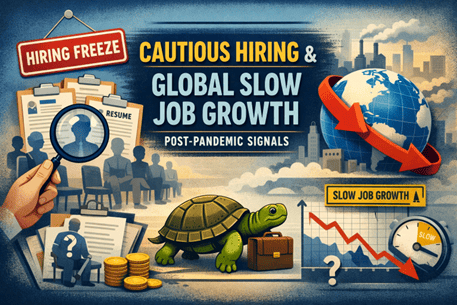
A sudden rush of new positions arrived after the worst days passed, but lately a different picture shows up – recruitment is slowing sharply. As uncertainty settles over markets, businesses favor caution rather than expansion moves. People looking for work notice shifts happening around them, nations prepare for possible turns ahead. Hidden causes shaping this shift come into view below, paired with likely paths unfolding soon.
Post-Pandemic Hiring Shifts
Midway through 2021, jobs began rising across the globe, but gains slowed sharply just three years later as payrolls shrank by about eighty thousand each month at times. Still, close to fifty percent of employers surveyed by ManpowerGroup in 42 countries plan to keep team sizes unchanged – highest level since early 2022 – even if net hiring sentiment dropped to 23%, below prior-year figures. While digital trends dominate headlines, stricter financial conditions and uncertain economic paths press more firmly on employment in advanced economies, where recruitment remains anywhere from twenty to thirty-five percent beneath pre-crisis levels.
Why Hiring Takes More Time Now
Fear about cash pushes most concerns. A full thirty-three percent of firms shrink staff since future clarity fades when costs climb, import fees shift, plus border rules keep changing. Hires take longer these days. Arrivals from overseas drop off, deportations rise, while homegrown workers sign up at lower rates – this pulled immigrant numbers from close to 120,000 added monthly into negative territory, losing six thousand by the start of 2025. Most jobs now appear in classrooms and health centers. Yet factories lose roughly twenty-one thousand roles each month, while India’s technology companies provide just one hundred three thousand openings – nowhere near past numbers.
Regional Differences in Tight Labor Markets
Highest in Asia Pacific is Outlook, holding 30%, with India rising to 40% thanks to tech focus – though fresh jobs mostly appear elsewhere. At 18%, Europe trails, dragged by continued financial stress – the UK and France each fall below 13%. In Indian tech, hiring for senior posts dropped fast, sliding 22% from last year’s figure, hitting the weakest mark in half a decade.
Workers and businesses face changes
A longer wait marks hiring today – a surge of 93% since just two years ago – as competition for talent bites harder. Growth may have cooled, yet close to fifty percent of employers still struggle to fill openings. Selection methods shift slowly: skills in digital tools now open doors to twenty-five out of every hundred positions, pushing degrees further behind. Workers stay put more often than in pre-pandemic times, possibly doubting another role would truly improve their situation.
Looking Ahead With Uncertain Outcomes
Halfway into 2026 may see slow growth rather than steep falls – central banks could lower interest rates to keep conditions stable, even as trade restrictions continue to loom. Hiring intentions in India point to about 11% more jobs on the rise, yet growing demand is pushing systems close to their limits. With changes happening at different speeds, groups gain ground by aligning skills precisely with work, adding support exactly where pressure builds.
Conclusion
Right now, jobs are still hard to fill – small signs in how people work suggest big shifts after the crisis passed. Anyone ignoring these clues may get stuck waiting longer than expected. Speeding up training offers another path, where progress grows steady without fanfare.
References
[1] ManpowerGroup, “Global Hiring Plans Cautious in Q4 with 45% of Employers Expecting to Maintain Headcount,” 2025. [Online]. Available:
https://go.manpowergroup.com/hubfs/MEOS%20Q4%202025/Press%20Release%20-%202025%20Q4%20MEOS-1.pdf
[2] L. Bengali et al., “The Recent Slowdown in Labor Supply and Demand,” FRBSF Economic Letter, Jan. 2026. [Online]. Available:
https://www.frbsf.org/research-and-insights/publications/economic-letter/2026/01/recent-slowdown-in-labor-supply-and-demand/
[3] LinkedIn, “A New World of Work: Global Labor Market Rotates, Not Recedes,” Jan. 2026. [Online]. Available:
https://news.linkedin.com/2026/2026-Davos-Press-Release
[4] K. Dennison, “A Look Back On The 2025 Job Market And How To Prepare For 2026,” Forbes, Dec. 2025. [Online]. Available:
https://www.forbes.com/sites/karadennison/2025/12/16/a-look-back-on-the-2025-job-market-and-how-to-prepare-for-2026/
Frequently Asked Questions
1. What is the current state of the international job scene?
Recruitment has shifted from a post-pandemic surge to a period of high caution and restricted expansion.
2. Why are companies hesitant to expand their teams right now?
Financial instability and a lack of future clarity are forcing firms to prioritize stability over growth.
3. What did the ManpowerGroup survey reveal about employer intent?
Nearly half of the surveyed companies plan to maintain their current staff levels rather than adding new roles.
4. How does current recruitment compare to pre-crisis levels?
In advanced economies, new job openings are down by 20% to 35% compared to the era before the global health crisis.
5. Is the current dip in payrolls significant?
Yes, some months have seen contractions of approximately eighty thousand positions globally.
6. How do rising costs impact the workplace?
Higher expenses and shifting import fees make businesses wary of the long-term commitment of new staff.
7. What role does immigration play in the current labor landscape?
Decreased arrivals and higher exit rates have turned a previously positive influx of talent into a net loss.
8. Which industries are currently seeing the most activity?
Education and healthcare remain the primary drivers of new opportunities.
9. How is the technology sector performing in India?
While still active, the volume of new openings in Indian tech is significantly lower than in previous peak years.
10. Why are labor markets behaving differently now?
Specific markets are reacting to localized financial stress and changing trade regulations.
11. Which region has the most optimistic outlook for 2026?
The Asia Pacific region leads with a 30% positive outlook, largely driven by India’s specific focus areas.
12. Why is Europe trailing in recruitment activity?
Ongoing financial pressures in major nations like France and the UK have kept their outlook below 13%.
13. Are senior-level roles being affected?
Yes, senior-level recruitment in certain tech hubs has seen a 22% drop, the lowest in five years.
14. How long does it take to get a job offer now?
The time-to-hire has increased by 93% over the last two years due to more rigorous selection processes.
15. Why are workers staying in their current roles longer?
Many employees doubt that moving to a new organization will significantly improve their professional or financial standing.
16. Is a major economic crash expected by mid-2026?
Current projections suggest a period of slow growth rather than a sharp, steep collapse.
17. How might central banks intervene?
There is a possibility of lowering interest rates to stabilize the environment if conditions remain weak.
18. Are university degrees still the primary requirement for jobs?
Degrees are becoming less critical as 25% of roles now prioritize specific digital competencies.
19. What defines the current slow pace of hiring?
This slow period is defined by a 93% surge in the time it takes to finalize a new hire.
20. How are global markets adjusting to these changes?
International markets are pivoting toward skills-based hiring to fill roles that remain difficult to staff.
Penned by Ridhima
Edited by Aradhiti, Research Analyst
For any feedback mail us at [email protected]
Streamline Your Hiring with Eve Placement’s Custom Assessments
Eve Placement helps you engage, assess, and recruit top talent through tailored hiring challenges that go beyond resumes. From technical quizzes and real-world case studies to psychometric evaluations and audio/video submissions, our platform enables smarter, data-driven hiring decisions. Advanced security features ensure authenticity and eliminate fraud, giving you reliable results. Ready to hire better? Know More.
Mail us at [email protected]