
4 ways Using Mind Mapping Apps for Exam Prep
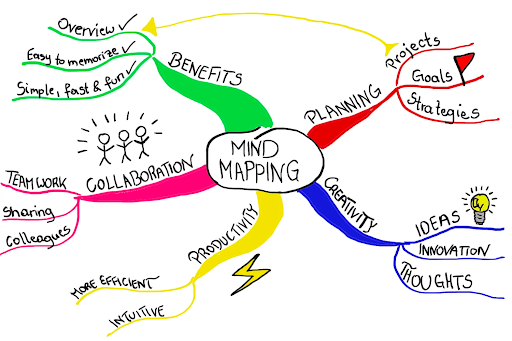
Table of Contents
Introduction
What is Mind Mapping?
Why You Should Use Apps Instead of Paper?
How Mind Mapping Helps in Exam Prep?
Choosing the Right App for You
Steps to Use Mind Mapping Apps for Study
Making Mind Maps More Effective
Common Mistakes to Avoid
Research Methodology
Conclusion
- FAQs
References
Studying for exams could be a huge hassle sometimes — after all, there’s a lot to go through, and notes might leave you in a spiral. Mind mapping would be a revolution to exemplify your thoughts. It’s basically a format of visualizing the details of the content so that readers get links between the topics, retain the information faster, and study in a more manageable way. In addition, the usage of mind mapping apps for exam prep allows one to do summary work just anywhere, and it is always going to be presentable and fuss-free.
Exam prep will become a piece of cake with the aid of mind mapping applications, and the technique will also give you more vitality while studying for the exam.
What is Mind Mapping?
Mind mapping is organizing ideas visually. In a LAN, you replace straight lines of notes with one central theme in the middle with radiations of related bullet points and sub-points. You display your thoughts “mapped,” implying the syntax where different ideas become linked.
Imagine you were assigned to research “Marketing Strategies.” Your first level might then be “Social Media,” “SEO,” “Email Marketing,” and “Content Creation,” with each of them having its subsequent branches and sub-branches intertwined with the first-level terms.
Why You Should Use Apps Instead of Paper?
Pen-and-paper mind maps are still a classic; in contrast, mind mapping apps bring you the following perks to consider:
Easy edits – The part that you want to edit becomes editable without interrupting the flow of the mind map.
Portability – Your hand-drawn mind maps on paper couldn’t go with you; however, if you use apps on your devices, namely phones, tablets, and laptops, you can carry them anywhere.
Collaboration – You can have others edit the same map along with you when you are meeting physically or virtually in real time.
Extra features – Every time you add a link, an image, or a video, your notes become more elaborate and comprehensive.
Fast and efficient map generation with popular apps like XMind, MindMeister, and Coggle is possible right in front of your eyes and takes a matter of minutes.
How Mind Mapping Helps in Exam Prep?
Mind mapping doesn’t merely consist of beautiful diagrams — it taps into the very essence of how human memory operates.
Better Memory – Since most brains are very visual, mnemonics help one to retain data at a much higher rate than taking write-ups only.
Clear Structure – Thus, no important detail will vanish in a sea of information.
Active Learning – Map-making takes you to mentally process the info further by finding links, and this phase is the actual understanding phase.
Faster Revision – You don’t have to flip through the pages of your notebooks anymore if you have your revision all coalesced into one place.
Choosing the Right App for You
Every single app differs from one another, and the “topmost” one among them is contingent on your profile. Key factors to look for include:
User-friendly design – It is okay if the app has a lot of features, but it does not make sense when a newcomer is struggling for an hour to figure out how to use it.
Cross-device sync – That way, you will never really be far from your work, no matter which device you use at the moment.
Export options – Long-time studies leading to a variety of copies for safekeeping and sharing purposes.
Free vs. paid – Students benefit from a lot of apps that offer free subscriptions with good enough features for their needs.
If your goal is to get done with work in no time, Coggle is the perfect place to start. If your work requires more complex tools, then XMind might be a more appropriate companion.
Steps to Use Mind Mapping Apps for Study
Try out this easy guide to start your creative journey:
Pick your topic – For example, “Indian Economy.”
Introduce the main branches – GDP, Inflation, Trade, Agriculture, and so on.
Get into the details and break every branch into sub-points – For GDP: Definition, Components, Recent Trends.
Insert the pictures – Icons, images, or color codes to make it memorable.
Continue improving – Don’t stop enhancing as learning indulges.
Making Mind Maps More Effective
To make your mind mapping as effective as possible:
Employ a color-coding system to visually segregate different chapters or subjects.
Abbreviate your keywords to 2-5 words and avoid long sentences.
One can add examples or mnemonics that serve as a cue for instant memory recall.
Establish a link between the related and the unlinked branches so that you can see not only the connections but also the gaps between subjects.
A mind map is more like a quick-reference guide than it is a complete textbook.
Common Mistakes to Avoid
While the mind mapping apps are of great help, students still often commit these errors:
Overloading the map with text – The excessive information in this case will make the map useless.
Failure to organize logically – The random branches will only add confusion to the map instead of clarifying.
Not reviewing – Mind maps are quite useless if you don’t go over your notes regularly as a matter of revision.
Always remember to keep it simple and make sure it is updated and neat.
Research Methodology
This article presents a descriptive research study, which included the following methods:
Secondary Research – Studying education blogs, neuroscience studies on visual learning, and app comparison articles.
Practicing Testing – Trying out the different mind mapping apps (MindMeister, XMind, Coggle) during study sessions.
Monitoring – Studying how mind mapping affected the recall speed and exam confidence of students in real-life situations.
Input – Students were asked about their experience, and the tips were changed according to what was effective.
The mixture of theory and practical testing assures that these tips are practical and not simply idealistic.
Conclusion
Mind mapping apps are not just digital note-taking tools; they are a more efficient way to learn, which is very useful for visual organization.
They can break down a complex topic into easily understandable and visual small chunks that help a person remember,<br> and revise it later on.
If you are consistent in using them, you will realize that preparing for exams is less stressful and more productive.
A powerful mind map can transform your notes into a wonderful and accessible path to success.
FAQs
1. What is a mind map?
A mind map is a visual diagram that organizes ideas around a central theme with branches and sub-branches.
2. How do mind mapping apps help in exam prep?
They simplify complex topics, improve memory retention, and make revision faster.
3. Why use an app instead of pen and paper for mind maps?
Apps offer easy edits, portability, collaboration, and multimedia features.
4. Which are the best mind mapping apps for students?
Popular choices include XMind, MindMeister, and Coggle.
5. Can mind mapping apps improve memory?
Yes, visual learning enhances memory recall compared to text-only notes.
6. Are mind mapping apps good for group study?
Absolutely — many apps support real-time collaboration.
7. Do I need to pay for mind mapping apps?
Not always. Many apps offer free versions with enough features for students.
8. How can mind maps make revision faster?
They consolidate key points into a single visual structure, reducing page-flipping.
9. What features should I look for in a mind mapping app?
User-friendly design, cross-device sync, export options, and collaboration tools.
10. Can I use mind maps for all subjects?
Yes, they work for any subject, from science to humanities.
11. How do I start creating a mind map for exams?
Begin with a central topic, add main branches, then expand with sub-points.
12. Should I use colors and images in mind maps?
Yes, color-coding and visuals improve retention and make maps engaging.
13. What mistakes should I avoid when mind mapping?
Overloading with text, poor organization, and skipping regular review.
14. Do mind mapping apps save time?
Yes, they allow quick edits and automatic layouts that save hours.
15. Can I export my mind maps into other formats?
Most apps let you export to PDF, images, or even Word documents.
16. How often should I review my mind maps?
Regularly — frequent revision reinforces memory before exams.
17. Can mind maps replace traditional notes?
They complement notes, acting as a summary and quick reference tool.
18. Are mind maps helpful for essay writing?
Yes, they help structure ideas and arguments logically.
19. Can teachers also use mind mapping apps?
Definitely, for lesson planning, presentations, and student collaboration.
20. Do mind maps actually reduce exam stress?
Yes, by making study sessions clearer, more organized, and less overwhelming.
21. Are mind mapping apps suitable for last-minute exam prep?
Yes, they allow you to summarize key points quickly and revise efficiently.
22. Can I use mind mapping apps offline?
Many apps like XMind offer offline access, though some require internet for syncing.
23. Do mind mapping apps support multimedia content?
Yes, most apps let you add images, links, icons, and even videos to enrich notes.
24. Which mind mapping app is best for beginners?
Coggle is great for beginners due to its simple, intuitive interface.
25. What are the main benefits of using mind mapping apps for exam prep?
They help students organize topics visually, improve memory retention, and speed up revision.
26. Which mind mapping apps for exam prep work best across devices?
Apps like MindMeister and XMind offer smooth cross-device sync on mobile, tablet, and desktop.
27. How do mind mapping apps for exam prep reduce stress before exams?
By simplifying complex topics into clear visuals, they make study sessions more manageable and less overwhelming.
28. Are mind mapping apps for exam prep better than traditional note-taking?
Yes, because they allow visual connections, faster edits, and interactive features that standard notes lack.
29. Can teachers recommend mind mapping apps for exam prep to students?
Definitely, many educators encourage their use to enhance classroom learning and independent study.
References:
Penned by Shivangi
Edited by Hamid Ali, Research Analyst
For any feedback mail us at [email protected]
Streamline Your Hiring with Eve Placement’s Custom Assessments
Eve Placement helps you engage, assess, and recruit top talent through tailored hiring challenges that go beyond resumes. From technical quizzes and real-world case studies to psychometric evaluations and audio/video submissions, our platform enables smarter, data-driven hiring decisions. Advanced security features ensure authenticity and eliminate fraud, giving you reliable results. Ready to hire better? Know More.
Mail us at [email protected]