
5 Silent Battles Faced by Gig Workers in the Digital Economy
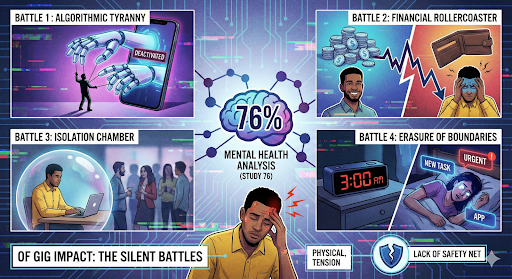
Topics: Mental Health Analysis, of Gig Impact
The gig economy seems appealing. You can work your way to financial freedom with just a smartphone and a strong drive.
However, for millions worldwide—from ride-sharing drivers in big cities to freelancers like graphic artists working from home—this represents an entirely new way of working.
Yet, if you look closer at this well-marketed freedom, another truth emerges. Beneath the convenience of our on-demand economy lies a significant crisis. This is a crisis of mental well-being.
To understand the cost of this digital revolution, we need to look beyond user interfaces and focus on those who operate behind them. We should examine “Study 76” to “Study 8767.” These studies illustrate that three-quarters of gig workers experience ongoing financial uncertainty, which significantly impacts their mental health.
The silent battles that this workforce faces, as shown by the mental health analysis, will be discussed below.
Understanding the “Study 76” Framework
It serves as a viewpoint for understanding the broader issues affecting the majority of gig workers, who consistently report stability levels well below 76%. Many feel financially insecure, anxious about their next paycheck, and lack a crucial safety net.
The mental health analysis of this sector shows that the very aspects promoted as advantages—flexibility and autonomy—are often the main sources of stress. The digital economy has destroyed the job framework that typically includes a steady paycheck, sick leave, and support from a human resources department.
Battle 1: The Tyranny of the Algorithm
In a traditional workplace, alongside colleagues, there is a human boss. They might be difficult, but you can speak to them, negotiate, argue, and build a relationship.
In the gig economy, millions of workers receive their tasks from an “algorithm” that makes all the critical choices: whether they will get work, the amount of work and pay, and whether they will continue or be terminated.
The mental strain of this “algorithmic management” is severe. Workers feel they are always on edge, living under the constant threat of an unexpected “deactivation” email—being terminated by a machine, with no clear way to appeal. A complaint from an unhappy customer, regardless of its validity, can reduce their visibility in the system.
Battle 2: The Financial Roller Coaster
One of the most significant stressors in this environment is financial insecurity.
The fluctuating income can wreak havoc on mental health. Sometimes, freelancers find themselves in high demand and earning a lot, feeling on top of the world, and then suddenly, nothing.
Battle 3: The Isolation Chamber
Humans are social beings. Traditional office settings, despite their flaws, offered built-in social networks through “watercooler talk,” shared frustrations about deadlines, and a sense of corporate belonging.
Working in the gig economy, especially in digital roles, can be a lonely experience. A freelance coder might go several days without direct human contact. A food delivery rider interacts briefly with many people, but these encounters are fleeting.
Isolation fuels depression. Without anyone to share experiences with or shoulder burdens, workers can internalize challenges, believing their struggles are personal failures rather than systemic issues.
Battle 4: Removal of Borders
Income is directly linked to effort; there is a strong temptation to remain available at all times. A smartphone can become a burden. Responding to notifications at 10 PM on a Saturday night can lead to trouble. If you’re not working, you’re not earning.
This lack of separation keeps the brain constantly active. The “always-on” culture causes chronic sleep deprivation and damages personal relationships, which are vital safeguards against mental illness.
Battle 5: The Physical Aftermath of Mental Stress
It’s clear that mind and body are connected. Researchers note that long-term gig economy workers suffer from stress-related health issues: high blood pressure, gastrointestinal problems, and chronic pain. The effects of the gig economy manifest physically, as mental insecurity takes a toll on the body. Additionally, the lack of health insurance among most gig workers creates immense stress, leading them to seek treatment only during emergencies.
Moving Forward: Rehumanizing Work
It may be difficult, but it’s not hopeless. The gig economy is here to stay, but the current model isn’t sustainable for the people behind these jobs. We should push for platforms to improve algorithms for the benefit of workers—ensuring transparency in processes and genuine paths for appeal.
We advocate for a policy shift that separates safety nets from traditional employment models. “Portable benefits,” no matter the platform used, should follow workers wherever they go. We need to confront the reality that efficiency gained through anxiety is not progress. A healthy digital economy must measure transaction speed as well as overall well-being.
FAQ’s
What is the purpose of mental health analysis in the gig economy?
Mental health analysis helps explain how unstable income, platform control, and uncertainty influence workers’ emotional well-being.How does the of gig impact differ from traditional employment stress?
The of gig impact is unique because workers face irregular pay, weak protections, and limited support systems.Why are gig workers more vulnerable to anxiety and burnout?
Mental health analysis shows that constant availability and performance ratings increase psychological pressure.Does income volatility play a role in mental strain?
Yes, the of gig impact includes unpredictable earnings, which creates ongoing financial and emotional stress.How does algorithm-based work affect worker confidence?
Mental health analysis indicates that lack of transparency in algorithms leads to fear of sudden work loss.Is social isolation a serious issue for gig workers?
The of gig impact often includes loneliness, as many workers lack stable peer interaction or workplace belonging.Can long working hours harm mental well-being?
Mental health analysis links extended screen time and irregular schedules with fatigue and emotional exhaustion.Are physical health problems connected to mental stress in gig work?
Yes, the of gig impact extends to physical symptoms such as sleep disorders and chronic stress-related pain.Why do many gig workers avoid seeking mental health support?
Mental health analysis points to cost concerns, lack of insurance, and fear of income interruption.How can policy changes reduce negative outcomes for gig workers?
Addressing the of gig impact through social security, transparency, and benefits can improve long-term well-being.
References
[1] Mental Health Foundation, “Mental health in the gig economy,” Mental Health Foundation, London, U.K., Rep., 2024. [Online].
Available: https://www.mentalhealth.org.uk/.
[2] S. Wang et al., “National survey of mental health and life satisfaction of gig workers: the role of loneliness and financial precarity,” BMJ Open, vol. 12, no. 12, p. e066389, Dec. 2022. [Online].
Available: https://bmjopen.bmj.com/content/12/12/e066389.
[3] Economic Policy Institute, “National survey of gig workers paints a picture of poor working conditions, low pay,” Economic Policy Institute, Washington, D.C., USA, Rep., Jun. 2022. [Online].
Available: https://www.epi.org/publication/gig-worker-survey/.
[4] International Labour Organization, “World Employment and Social Outlook 2023: The value of essential work,” ILO, Geneva, Switzerland, Rep., Jan. 2023. [Online].
Available: https://www.ilo.org/weso-2023.
[5] Fairwork, “Fairwork Cloudwork Ratings 2023: Work in the Planetary Labour Market,” Oxford Internet Institute, Oxford, U.K., Rep., 2023. [Online].
Available: https://fairwork.medialab.sciences-po.fr/ratings/cloudwork.
Penned by Sanskriti
Edited by Pranjali, Research Analyst
For any feedback mail us at [email protected]
Streamline Your Hiring with Eve Placement’s Custom Assessments
Eve Placement helps you engage, assess, and recruit top talent through tailored hiring challenges that go beyond resumes. From technical quizzes and real-world case studies to psychometric evaluations and audio/video submissions, our platform enables smarter, data-driven hiring decisions. Advanced security features ensure authenticity and eliminate fraud, giving you reliable results. Ready to hire better? Know More.
Mail us at [email protected]