
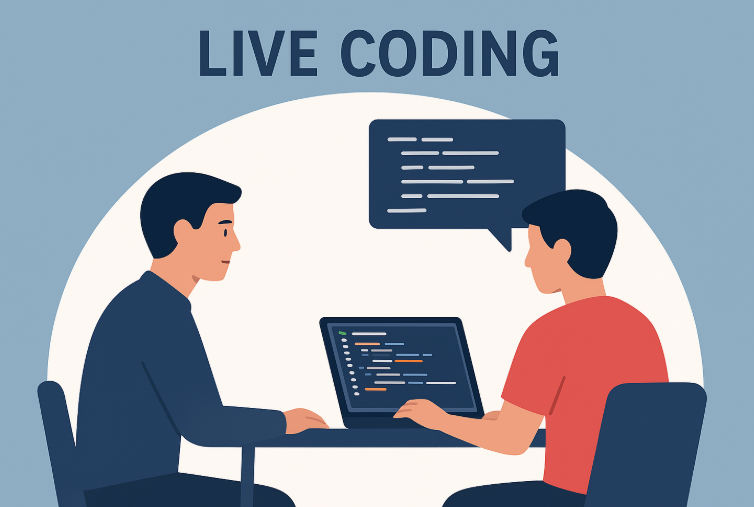
Entering a software development placement is a dream for many students. But live coding hiring is considered the most difficult stage for applicants during the recruitment process. Nowadays, many firms prefer hiring candidates through live coding instead of using old methods such as the use of question banks in interviews. It is quick, straight and quite real. But what exactly does it mean to code live in an interview?
3 Essential Insights into Live Coding and Placement Success
What Is Live Coding? The Art of Programming on Stage
Live coding is where the candidate writes a functioning code in real time in the presence of an interviewer. The candidate types into a shared editor instead of solving a puzzle on paper. The challenge may comprise as few as five minutes or up to one hour assignments.
It is important because employers prefer to view the way a student thinks. Do they break problems into stages? Do they make test Questionnaires? Are they able to adjust to debugging something when it breaks? Live coding provides an interviewer with insight into the workings of a developer. It is not so much about the resultant code but how they arrive at that code.
Live coding hiring is both an opportunity and a fear among the students who enter the software development placement. It is an opportunity since they can demonstrate actual abilities, and a fear since even simple logic may be jammed through pressure.
Challenges during Live Coding Hiring
Live coding hiring appears just on the surface because it reflects capabilities in action, but there are a lot of risks. A lot of students freeze when they are being observed by a person. The reason that could be tackled easily in practice goes away. A user of Reddit admitted that he has difficulties with live coding. “I understand the reasoning, but my head freezes in the presence of someone.” This shows that the test is not only about coding, but handling stress
The other issue is time pressure. Some companies provide tasks lasting five minutes. They desire fast solutions. However, short tests are not always signs of actual talent. A student might require more time to solve, but still he/she might be a great developer. The mismatch between speed and ability makes live coding stressful.
The fear of judgment is another challenge faced by candidates during live coding. Interviewers stay silent while observing. To many students, this silence is more intriguing than inquiries, and candidates start feeling anxious. A single misplaced bracket can break focus. The candidate suddenly loses confidence in his/her knowledge.
Gaps between practices and real life are also highlighted by live coding. Homework is a common way many students solve problems very well at home with the use of Google or notes. However, in the interview, no external assistance is permitted. This change leaves them in a situation of feeling underprepared despite studying hard.
Preparing for Software Development Placement
What can the students do about these challenges? The initial step is practice in real conditions. Have a friend or a mentor sit and observe as you go about solving a problem. This develops ease in being watched.
Next, spot fundamentals. Have clarity on the knowledge of loops, arrays and data structures, as it will reduce panic. Similarly, reasoning can get you through pressure.
On a conversational basis, talking out loud also helps. Type out how you can fix your problem as you explain it. In case you forget something, the interviewer is still able to see that your thinking is clear. Many recruiters like to see how a person processes his/her thoughts more than the correct grammar.
Lastly, perform mock interviews. Sites like GeeksforGeeks and many others provide coding challenges where you have a time limit. Routine training will develop the composure required in a software development placement.
Conclusion
Hiring via live coding is not all about the theoretical knowledge of code. It includes concentration, nerves and confidence in oneself. Students tend to wonder: What happens in case I fail when the pressure is on? The solution is very straightforward: you plan, you rehearse, and you demonstrate your best process irrespective of whether the code is perfect or not. On your placement day, ay think of live coding not as a trap but as a challenge. Face circumstances with logic. Show that you can think on your feet. That is what it takes to be a good developer. Interviews do not involve perfection. They are about demonstrating how one thinks in the face of a new problem.
Commonly Asked FAQs:
1. What is live coding hiring in technical placements?
Live coding hiring is a process where candidates are asked to solve programming challenges in real time while being observed by interviewers. Unlike traditional written tests, it focuses not only on whether the solution works but also on the candidate’s thought process, debugging approach, and ability to communicate logic under pressure. This format allows recruiters to assess how a developer thinks, reacts, and problem-solves in realistic scenarios.
2. Why do companies prefer live coding hiring over traditional interviews?
Companies prefer live coding hiring because it provides a clear, authentic picture of a candidate’s real-world skills. Traditional question banks or take-home tests may allow memorization or outside assistance, but live coding ensures that interviewers see
the candidate’s raw ability to reason, implement, and adapt. It also reflects how someone might work under real workplace stress and time constraints.
3. What skills do interviewers evaluate during live coding hiring?
Interviewers look for problem decomposition, coding fluency, data structure knowledge, and debugging strategy. They also assess communication skills — how well the candidate explains their reasoning.
Live coding hiring is not always about writing flawless code but rather about demonstrating a structured thought process, logical problem-solving, and resilience when faced with unexpected issues.
4. Why do many students feel anxious about live coding hiring?
Live coding hiring can be stressful because candidates are coding under observation, often in silence. This pressure can lead to mental blocks, even when solving simple problems. Anxiety increases when tasks are timed, creating a mismatch between
speed and actual ability. The fear of judgment and lack of external resources also make students feel more vulnerable compared to practicing at home.
5. How can students overcome performance anxiety during live coding hiring?
The best way to reduce anxiety is to simulate real interview conditions. Practicing with peers, mentors, or online mock interview platforms helps students get comfortable with being observed.
Speaking thoughts aloud while coding reassures interviewers of your logical process, even if you hit a roadblock. Deep breathing, time-boxing solutions, and focusing on problem-solving steps rather than perfection also ease nerves.
6. How important is speed in live coding hiring?
Speed is a factor, but clarity is more important. Interviewers want to see progress, but they are more impressed by well-structured, readable code and clear reasoning than by rushed, buggy solutions.
A candidate who explains their approach, writes maintainable code, and fixes errors systematically often performs better than someone who simply finishes quickly but cannot explain their decisions.
7. What are the most common mistakes candidates make during live coding hiring?
Common mistakes include not asking clarifying questions, rushing without planning, ignoring edge cases, and staying silent during the process.
Some candidates freeze under pressure and forget basic syntax, while others overcomplicate solutions. Another mistake is failing to test code after writing it, which shows a lack of debugging discipline — something interviewers actively look for.
8. How should one prepare technically for live coding hiring?
Preparation should start with mastering core computer science fundamentals: loops, arrays, strings, recursion, data structures, and algorithms. Practicing on platforms like LeetCode, HackerRank, or GeeksforGeeks under timed conditions mimics the
real interview environment. Reviewing common interview questions such as sorting, searching, and dynamic programming helps build confidence before the placement day.
9. What role does communication play in live coding hiring?
Communication is crucial. Explaining your plan before typing shows interviewers that you can break problems into steps. Narrating as you code keeps them engaged and allows them to follow your thought process.
Even if you make a mistake, communicating how you intend to fix it demonstrates composure and problem-solving ability, which can impress interviewers more than just the final answer.
10. How can students practice for live coding hiring without feeling overwhelmed?
Start small by practicing coding in front of a friend or recording yourself while solving problems. Gradually build up to mock interviews under timed settings.
Break problems into clear steps, and practice writing code without external help to mimic interview restrictions. Building this habit reduces reliance on search engines and develops real-time problem-solving confidence.
11. Are online coding challenges enough to prepare for live coding hiring?
Online coding challenges are helpful but should be combined with real interview practice. Many candidates solve problems perfectly at home but struggle under observation. Pair programming sessions, group study, and mock interviews
provide a more realistic rehearsal. Combining online practice with live simulations builds both technical skills and emotional readiness.
12. What should candidates do if they get stuck during live coding hiring?
If stuck, stay calm and explain your thought process. Interviewers often guide candidates who communicate well. You can also outline a pseudo-code approach,
which demonstrates problem-solving ability even if you cannot complete the entire solution. Showing perseverance and adaptability is valued more than silently panicking.
13. How do interviewers view partial solutions in live coding hiring?
Partial solutions are not necessarily a failure. If you clearly explain what you were attempting and what you would do next with more time, it shows structured
thinking. Interviewers prefer an incomplete but well-thought-out solution over a rushed, incorrect one. They want to see how you approach problems rather than just the final result.
14. What tools are used in live coding hiring?
Common tools include online code editors such as CoderPad, HackerRank Interview, or shared IDEs in Zoom/Teams. Some companies may use whiteboards for pseudo-code or algorithm design.
Candidates should familiarize themselves with at least one collaborative coding platform before interview day to avoid wasting time adjusting to new interfaces.
15. Can practicing soft skills improve live coding hiring performance?
Yes. Building confidence through public speaking, presentation practice, or even casual group discussions can reduce fear of being observed. Soft skills like clear articulation, active listening, and confidence building contribute significantly to performance
during live coding hiring. Recruiters value candidates who can explain ideas simply and professionally.
16. What role does time management play in live coding hiring?
Time management is critical. Divide your time into planning, coding, and testing phases. Spending a minute or two outlining the approach before coding helps
avoid backtracking. Always reserve time for testing and debugging so you can present a working solution, even if not fully optimized.
17. How do live coding hiring sessions prepare students for real jobs?
They replicate real work scenarios where developers must solve problems while collaborating with teammates or under deadlines. The ability to think under pressure, communicate ideas, and debug effectively is part of daily work.
Live coding hiring bridges the gap between academic knowledge and workplace expectations, making students job-ready.
18. Are live coding hiring sessions fair to all candidates?
While some argue they favor fast thinkers, well-designed live coding hiring sessions aim to evaluate problem-solving approach, not just speed.
Good recruiters consider partial solutions, communication, and overall reasoning rather than requiring flawless code. Preparation and practice can level the playing field for most candidates.
19. How can students build confidence before placement day?
Confidence grows with preparation and simulation. Regular practice under time limits, rehearsing in front of peers, and solving problems out loud build comfort.
Positive visualization techniques — imagining yourself solving calmly and successfully — can also reduce anxiety before the big day.
20. What mindset should students have going into live coding hiring?
Treat it as a chance to showcase thinking rather than a trap. Interviewers are not trying to trick you but to see how you approach challenges.
Focus on process over perfection. Entering with curiosity, confidence, and a willingness to explain your ideas increases your chances of making a strong impression.
Reference
[1] Jugglenutz, “Five-minute coding challenges for technical interviewers,” Medium, Apr. 18, 2017. [Online]. Available: https://medium.com/@jugglenutz/five-minute-coding-challenges-for-technical-interviewers-cab516f9af62
[2] Reddit, “Advice for someone who struggles in live coding,” r/ExperiencedDevs, Aug. 2024. [Online]. Available: https://www.reddit.com/r/ExperiencedDevs/comments/1loeqle/advice_for_someone_who_struggles_in_live_coding/
[3] A. Nikishaev, “Effectiveness of live coding interviews in technical hiring,” LinkedIn Pulse, Jun. 2021. [Online]. Available: https://www.linkedin.com/pulse/effectiveness-live-coding-interviews-technical-hiring-nikishaev-ua-rvsze
[4] “Interview preparation for a software developer,” GeeksforGeeks. [Online]. Available: https://www.geeksforgeeks.org/software-engineering/interview-preparation-for-software-developer/