
7 Major Benefits of Improving Real-Time KPI Dashboards for Placement Cells
Topics: KPI dashboard placement analytics, data-driven recruiting
In the aggressive landscape of better schooling, placement cells play a pivotal role in bridging the distance between students and employers. These departments, frequently observed in universities and faculties, manage activity placements, internships, and professional development programs. Key Performance Indicators (KPIs) such as placement prices, recruiter engagement, student utility volumes, and offer recognition ratios are vital for measuring success. However, conventional static reporting regularly falls short in a quick-paced job market. Improving actual-time KPI dashboards—digital equipment that offers interactive, live visualizations of these metrics—can revolutionize how placement cells function. By leveraging automated fact streams and analytics, those more desirable dashboards allow proactive control, fostering higher outcomes for students, establishments, and recruiters.
Instant Visibility into Placement Performance
One of the number one advantages of upgraded real-time KPI dashboards is the ability to monitor placement sports as they unfold. Unlike previous spreadsheets that require guide updates, those dashboards pull information from incorporated systems like applicant monitoring software or campus portals, showing metrics that include stay utility counts and interview schedules, and provide rollouts in a centralized view. This immediacy lets placement officers spot traits early, consisting of an unexpected dip in packages for a selected quarter, allowing speedy changes.
Enhanced Data-Driven Decision Making
For instance, if data exhibits low engagement from top-tier groups, placement heads can prioritize outreach efforts, mainly to more focused and powerful recruitment drives. Overall, this advantage transforms placement operations right into a strategic asset for the group.
Timely Interventions for Student Success
Improved dashboards allow placement cells to pick out at-risk college students early through real-time tracking of individual KPIs, including application submission prices or interview guidance scores. By integrating instructional and extracurricular records, advisors can flag troubles like declining GPAs or missed career events, triggering personalized aid. This may want to contain automated signals for counselling periods or ability-constructing resources, directly impacting placement effects. In better education settings, such interventions have been shown to improve academic and professional trajectories, reducing dropout rates in placement processes.
Increased Transparency and Accountability
Placement cells can proportion live metrics with college students, schools, and directors through consumer-friendly interfaces, selling accountability in all respects. For recruiters, this indicates getting admission to accurate, updated information on candidate pipelines, lowering miscommunications, and building trust. Internally, dashboards with drill-down functions allow groups to hint at performance variances, including why certain departments underperform in placements.
Reduced Administrative Burden and Efficiency Gains
This efficiency extends to error discounts, as stay data minimizes inaccuracies from outdated records. In university contexts, such streamlining has led to faster response times to opportunities, like capitalizing on emerging job tendencies, ultimately scaling operations without extra assets.
Better Collaboration and Communication
Enhanced dashboards enhance collaboration by presenting a single supply of facts for all concerned parties. Placement teams can use interactive factors, which include shared views or alerts, to discuss performance insights across departments.
Competitive Advantage for Institutions
Ultimately, investing in real-time KPI dashboards provides universities with a competitive edge in attracting top talent and employers. By demonstrating fact-savvy operations, institutions can showcase high placement achievement fees in advertising materials, appealing to potential students. In a technology where employability ratings count, such enhancements at once make a contribution to institutional reputation and long-term growth.
Conclusion:
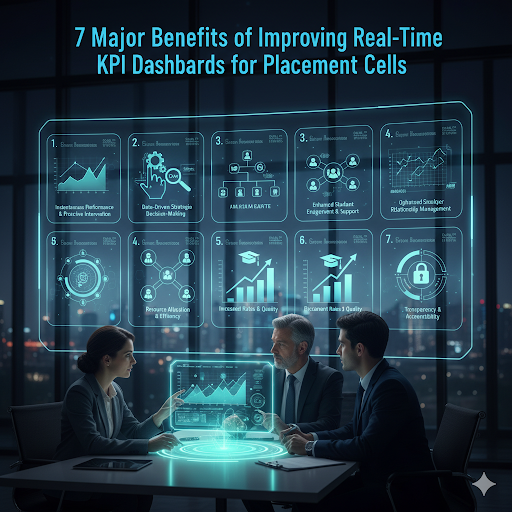
The seven major benefits—ranging from instant performance monitoring and proactive intervention strategies to enhanced stakeholder communication and data-driven curriculum feedback—converge to create a placement operation that is not merely reactive but strategically predictive and highly efficient.
FAQ’s
1. What is a KPI dashboard for placement cells?
A KPI dashboard placement analytics tool tracks student placements, recruiter engagement, and overall placement performance.
2. How do these dashboards improve placement outcomes?
By using KPI dashboard placement analytics, placement teams can monitor live data and make data-driven recruiting decisions for better results.
3. Can real-time dashboards support data-driven recruiting?
Yes, data-driven recruiting is enhanced when dashboards show which strategies work and which need adjustment.
4. What are the main benefits of using a dashboard for placements?
Real-time KPI dashboard placement analytics offers instant visibility, improved decision-making, student support, transparency, and institutional advantages.
5. How does real-time information help in placement tracking?
Live dashboards provide insights on student progress, recruiter activity, and KPI dashboard placement analytics, making recruitment more efficient.
6. Are dashboards suitable for all institutions?
Yes, universities and colleges can implement data-driven recruiting dashboards to optimize placement success and track KPIs effectively.
7. How do dashboards reduce administrative workload?
By centralizing KPI dashboard placement analytics, teams reduce errors, automate updates, and save time for strategic placement activities.
8. Can students benefit from using these dashboards?
Students gain a better experience as KPI dashboard placement analytics offer instant feedback, placement insights, and visibility into recruitment opportunities.
9. What features should an effective placement dashboard include?
Essential features for data-driven recruiting dashboards include interactive charts, live metrics, alerts, and the ability to track student-recruiter engagement.
10. How do dashboards enhance transparency in placements?
Sharing KPI dashboard placement analytics and recruitment metrics with students and recruiters fosters trust and accountability.
References
[1] Superset, “Real-Time Updates: Transforming Placement Portals,” Superset Blog, 2025. [Online]. Available: https://joinsuperset.com/blogs/real-time-updates-real-results-how-placement-portals-keep-universities-ahead-in-recruitment/. [Accessed: Sept. 23, 2025].
[2] Domo, “What Is a KPI Dashboard? Benefits, Best Practices, and Examples,” Domo Blog, 2025. [Online]. Available: https://www.domo.com/learn/article/kpi-dashboards. [Accessed: Sept. 23, 2025].
[3] ResearchGate, “Performance Dashboards for Universities,” ResearchGate. [Online]. Available: https://www.researchgate.net/publication/228979138_Performance_Dashboards_for_Universities. [Accessed: Sept. 23, 2025].
Penned by Shrutt
Edited by Seema Acharya, Research Analyst
For any feedback mail us at [email protected]
Streamline Your Hiring with Eve Placement’s Custom Assessments
Eve Placement helps you engage, assess, and recruit top talent through tailored hiring challenges that go beyond resumes. From technical quizzes and real-world case studies to psychometric evaluations and audio/video submissions, our platform enables smarter, data-driven hiring decisions. Advanced security features ensure authenticity and eliminate fraud, giving you reliable results. Ready to hire better? Know More.
Mail us at [email protected]