How to Prepare for College Job Fairs: A Hands-On Guide
Introduction
Do some college job fair attendees feel confident leaving their booth with minimal business cards or promotional items? Or do they have no business card at all? Is this typical behaviour? How do you make sure recruiters remember everything about you? Thinking about every possible angle like this ensures that you leave an impression and get one step closer to your career aspirations. When you put your mind to preparing and planning the best networking strategies at the right college job fair, you stand a long way ahead as soon as you enter.
Why College Job Fairs Matter More Than You Think
If you are unsure or uneasy at a job fair, it can be easier to avoid it. Why? The tour can provide more than just a job or internship.”. Developing professional relationships is possible at these fairs.? The scenario creates an opportunity on campus where you can meet various recruiters without leaving campus when needed. Before applying for jobs on portals, job and career fairs are great for introductions, professional settings, and the ability to see how you would present yourself and communicate. Finally, you get insider information. Asking the companies directly which skills or qualities they value can prevent you from guessing.
Whether you’re in search of a position or not, the experiences of attending such fairs are valuable down the line. You’ll have the networking experience with company culture and expectations down the line, years later.
Get Your Materials in Order Before You Arrive
Your materials are the key to a successful preparation for college job fairs. You must do it right, as recruiters will give you the first impression. So, do your homework carefully.
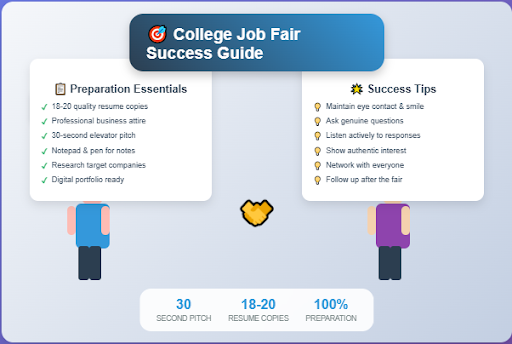
Print out 18-20 copies on good-quality paper. The need for a paper resume that is both professional and clean persists in the current age of technology. Place them neatly into a folder.’ Don’t go business casual without a professional face to speak. Steer clear of abrupt occurrences or fragrances that could lead to distraction.
Lastly, pack a small kit. Stay hydrated during extended fairs by using a notepad and pen to write important information, taking calming breath mints, or drinking water from bottled sources. Drink lots of fluids throughout the day as well. Carry along a ‘hard-copy’ digital portfolio of your creative work or artistic skills.
The Elevator Pitch and Networking: Your Brand in 30 Seconds
It may be difficult to know a recruiter early on, but creating good elevator pitches is very important. Do not panic. The purpose of your presentation is to give them a profile of yourself with your strong points and types that would best fit your interests.
Building a network is all about smiling, looking people in the eye and establishing trust.
The recruiter’s company, work atmosphere, or hiring season can be inquired about to demonstrate genuine interest. Remember to listen attentively. Speaking to someone you know is a different matter since it’s purely an informal chat. “. Additionally, take into account the function of recruiters.’ Engaging in conversations with peers and meeting new people can result in hands-on learning or innovative career paths.
What Not to Do: Avoid These Common Mistakes
Take measures to avoid the fair. Examine companies before entering. Avoid taking chances. It’s evident that if you’re not prepared, the recruiters are going to call you out on it. Your dishevelled outfit reveals how much you want this opportunity. People are in line, be short and courteous, but don’t ramble in front of your recruiter.
Be respectful. Moreover, neglecting questions can cause boredom, so ask some questions beforehand.
It is important to avoid using keywords like college job fair preparation or networking tips in your speech and resume. Despite its use in everyday language, forced repetition appears robotic to both humans and tracking software. Why? A lot of students fail to prioritise follow-up. Why?
Conclusion
Likely, you have already started your first trade show experience. By utilising networking techniques and getting ready for college job fairs, one can overcome nervousness and feel more confident. Your individualised resume, authentic elevator skills, and genuine interest can transform a busy fair into endless career opportunities. Just keep in mind that with every handshake, conversation, and follow-up email you send, you are one step closer toward achieving your goals.
Any successful trip begins with proper college job fair preparation, and your networking plans will be what makes you stand out, not just during your career search but also beyond in the future. It is strong networking strategies and emphasis on the prep at college job fairs that will make you memorable in front of recruiters. Accept the invitation to take on a new challenge and demonstrate your identity to potential employers.
FAQs
Q1. What is the purpose of attending career events on campus?
They give students the chance to meet recruiters, explore industries, and build connections.
Q2. How do you prepare your resume for recruiters?
Keep it concise, professional, and tailored to highlight relevant skills and experience.
Q3. Why is an elevator pitch important?
It introduces who you are, what you do, and what you’re looking for in under 30 seconds.
Q4. What kind of outfit is best for professional events?
Choose formal or business attire that reflects seriousness and respect.
Q5. How can you overcome nervousness while networking?
Practice, prepare questions in advance, and remind yourself recruiters are there to help.
Q6. Should you bring physical copies of your resume?
Yes, always carry multiple copies on quality paper to share with potential employers.
Q7. How do you leave a strong impression on recruiters?
Be polite, attentive, ask thoughtful questions, and show enthusiasm for their company.
Q8. Why is research important before attending?
It helps you focus on relevant employers and ask informed, engaging questions.
Q9. What mistakes should be avoided during networking?
Avoid rambling, poor preparation, and neglecting to follow up with contacts afterward.
Q10. How can you stay memorable after the event?
Send thank-you emails, connect on LinkedIn, and remind recruiters of your conversation.
References
- Indeed. (2025, June 9). How To Prepare for a Job Fair (With Video).
- U.S. Department of Labor. (2025, July). Job Fair Networking and Strategies: Participant Guide.
- Massachusetts Institute of Technology Career Services. (2025, January 8). Tips for career fair success for candidates.
- Cornell University ILR School. (n.d.). General Tips for Preparing and Navigating Career Fairs.
- University of Texas at Austin, College of Education. (2024, August 23). Career Fair Preparation.
- Affordable Colleges Online. (2025, June 17). College Career Fairs: Resources and Tips.
- Florida State University Career Center. (n.d.). Preparing for a Career Fair.
- Southwestern Community College. (n.d.). Preparing for a Job Fair
- Interstride. (n.d.). Career fair preparation for international students.
- Brooklyn College. (2022, March 1). What do I do before, during and after a job fair?
Penned by Ansh Aggarwal
Edited by Sneha Seth, Research Analyst
For any feedback mail us at [email protected]
Streamline Your Hiring with Eve Placement’s Custom Assessments
Eve Placement helps you engage, assess, and recruit top talent through tailored hiring challenges that go beyond resumes. From technical quizzes and real-world case studies to psychometric evaluations and audio/video submissions, our platform enables smarter, data-driven hiring decisions. Advanced security features ensure authenticity and eliminate fraud, giving you reliable results. Ready to hire better? Know More.
Mail us at [email protected]