
“The Invisible Manager”: 5 Hidden Ways AI Controls Your Gigs (Study 75 Analysis)
Introduction
“If you ever ordered an Uber, booked an Airbnb, or hired a freelancer on Upwork, you participated in what I call the modern magic trick,” he said.
But behind this smooth operation lies a complex logistical system. There is no person overseeing everything from a big room, directing drivers over a radio. There is no manager checking every freelancer’s portfolio for every single fifty-dollar logo project.
Instead, there is an algorithm—an Artificial Intelligence (AI).
Recent studies on algorithmic management, particularly the “Study 75” framework, demonstrate that it is a highly effective system that generates considerable discussion.
What is ‘Study 75’? (The 75% Threshold)
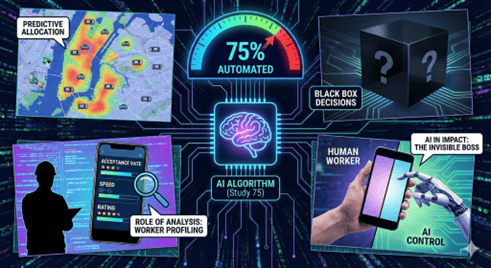
To better understand what AI control means, it’s necessary to look at the concept of “Study 75.” So, what’s “Study 75”? This term is often used in labor analytics to highlight a point seen in established large platforms: when more than 75% of tasks are fully automated and predictive, no longer relying on human input for matching.
In the early days of the gig economy, people had more choices. A person could decide to drive. A person could choose which ride to take. Today, according to findings in “Study 75,” in most gigs, the “choice” is just an illusion. The algorithm decides this beforehand and filters it before it’s shown to the user.
This shift changes the nature of employment. It moves us from a “marketplace” to a “managed network,” changing from “a meeting of buyers and sellers” to “an AI matching people to each other.”
Here’s a straightforward description of how the “Invisible Manager” operates and its impact on workers.
1. The Death of the Dispatcher: Speed Over Choice
In the past, taxi dispatching involved loud, manual operations. A call would come in, and the dispatcher would look at a map to find the car that was nearest and call them over the radio.
Now, services like DoorDash or Lyft manage millions of requests simultaneously. The aim of AI in this situation is to achieve speed.
“When you ask for a ride,” he says, “there is a huge simulation. It doesn’t just look at who is closest ‘as the crow flies.’ It considers current traffic and what direction a driver is headed. It even calculates the likelihood of a driver accepting a short or long trip.”
To clarify how this operates and to paint a clearer picture of what just happened at your house and what is happening at that moment.
The “Study 75” Impact
It gives you options. Because it tries to optimize the whole system at 75% efficiency, it may pair you with a ride that is less profitable for you but better for overall system optimization. You are just a small part of a large machine where all the choices are automated.
2. The Central “Role of Analysis”: You Are Data
How does the system decide that you are the right person to make this delivery at 6:03 PM on a Tuesday?
This is where the “data crunching” takes place. The role of analysis in these systems is crucial, as it powers all of them and makes decisions based on data, which is quickly acted upon.
It evaluates thousands of data points for each worker to create a “Worker Profile.” It tracks:
Your Acceptance Rate:
Do you decline short trips? The AI keeps track of this.
Your Reliability:
Do you cancel after accepting a job?
Your Speed:
Are your driving skills above average?
Your Habits:
Do you usually log off after you’ve earned $50?
On freelance sites like Upwork, analysis determines how many views your profile gets. When you hunt for work by searching “Web Developer,” the AI ensures you appear on Page 1 while others land on Page 50. It considers previous keywords you used, how quickly you responded to messages, and your “Job Success Score.” You might be a “75% match,” while others are “90% matches,” meaning you may never see certain job ads.
3. Predictive Allocation: Crystal Ball
Platforms don’t wait for a consumer to place an order for food; they want to be ready before the consumer even thinks about it.
The AI system analyzes past data. It knows that demand spikes every Friday at 5 PM in the central business district. It also recognizes that it often rains in April.
With this level of analysis, the AI starts to “nudge” workers before a demand actually appears. The AI may show a “Surge Zone” (meaning higher pay) in an area with little activity, aiming to get drivers there before the expected rush in 20 minutes. Workers are being moved around a chessboard controlled by an intelligence anticipating the future.
4. “Black Box” Frustration
The toughest part of this system is the lack of transparency.
With an AI manager, there is no office to visit.
Employees feel like they are fighting against a ghost.
What about the orders? Why am I not getting any?
Why did my rating drop?
Which users got banned?
The reality of “Study 75” is that decisions are made within a “Black Box,” hiding the algorithm. It is corporate technology. A person might be penalized for driving too slowly or for taking a different route than the computer suggested and never learn why.
5. AI in Impact: The Social Consequence
Let’s look at the second part of our topic: ai in impact, which significantly affects society.
While these algorithms are very effective at moving people and packages, they can sometimes be unintentionally harsh. AI does not understand empathy. It does not recognize emotions such as happiness or sadness.
The Bias Problem:
If AI is trained on data showing that men receive better ratings than women for certain tasks, it could lead to the AI giving better jobs to men as a way to optimize. This increases biases and discrimination against women that already exist in society, using the guise of math and science.
Dehumanization:
Workers controlled by apps lose the human touch in their management. They become “units of supply.” When a bike courier gets a flat tire, the algorithm doesn’t care about the courier’s bad luck; it just knows that “the delivery time target has not been met.”
The Bottom Line: Who is in Control?
The “Study 75” model shows that we have crossed a threshold. We are no longer just using tools; the tools are using us. There are clear impacts from using AI for task allocation, leading to faster and cheaper services. This tool has created jobs for millions who might not have had opportunities otherwise. However, this efficiency comes with the role of analysis overshadowing human judgment.
Moving forward, policymakers and platforms must reintroduce “human” into “human capital.” We need algorithms to be more transparent and remember that “behind every unit of supply and every device and platform,” there is “a person with bills to pay and a life to live.” The future of work will be shaped by our choices to either empower or control workers through AI.
References
[1] Oxford Internet Institute, “The Fairwork Project: Labour Standards in the Platform Economy,” University of Oxford. [Online].
Available: https://fairwork.medialab.sciences-po.fr/.
[2] International Labour Organization, “World Employment and Social Outlook 2021: The role of digital labour platforms in transforming the world of work,” ILO, Feb. 2021. [Online].
Available: https://www.ilo.org/global/research/global-reports/weso/2021/lang–en/index.htm.
[3] A. Rosenblat and L. Stark, “Algorithmic Labor and Information Asymmetries: A Case Study of Uber’s Drivers,” International Journal of Communication, vol. 10, pp. 3758–3784, Oct. 2016. [Online].
Available: https://ijoc.org/index.php/ijoc/article/view/4892.
[4] M. Mateescu and A. Nguyen, “Algorithmic Management in the Workplace,” Data & Society, Feb. 2019. [Online].
Available: https://datasociety.net/library/algorithmic-management-in-the-workplace/.
The Invisible Manager & Study 75 FAQs
- What is the “Invisible Manager”?
It refers to the AI systems that supervise gig workers without human oversight. - What does “Study 75” signify?
It is the threshold where 75% of tasks are automated, shifting the platform’s control. - Is there a human supervisor?
No; in this model, a complex algorithm makes all the management decisions. - How has the gig economy changed?
It has evolved from a simple marketplace into a network run by an Invisible Manager. - What is a “managed network”?
A system where the matching of buyers and sellers is handled entirely by a computer. - How does dispatching work now?
High-speed simulations calculate the best matches based on traffic and worker habits. - What is the priority of the system?
The system prioritizes speed and efficiency over individual worker choice. - What data does the “Invisible Manager” track?
It monitors acceptance rates, speed, and reliability to build a “Worker Profile.” - How are freelancers on Upwork affected?
An automated system determines which profiles appear on the first page of search results. - What is a “Worker Profile”?
A data-driven identity that the algorithm uses to predict your future performance. - What is “Predictive Allocation”?
It is when the system anticipates a spike in demand before it actually happens. - How are workers “nudged”?
The Invisible Manager uses surge pricing to move workers into specific areas. - Why is this called a “Black Box”?
Because workers cannot see how the internal algorithm decides their pay or ratings. - Can a worker talk to a manager?
There is no office; workers often feel they are interacting with a “ghost.” - What happens if a worker deviates from a route?
The algorithm may penalize them for being “inefficient.” - Does the system understand human context?
No; it treats a flat tire or an emergency as a simple failure to meet a target. - What is the “Bias Problem”?
Automated systems can accidentally reinforce social discrimination found in past data. - How does this affect human dignity?
Workers can become “units of supply” rather than valued individuals. - Who is truly in control?
According to the article, the tools we created are now beginning to control the users. - What is the final goal for the future?
We must make the algorithm transparent to protect the people behind the devices.
Penned by Sanskriti
Edited by Pranjali, Research Analyst
For any feedback mail us at [email protected]
Streamline Your Hiring with Eve Placement’s Custom Assessments
Eve Placement helps you engage, assess, and recruit top talent through tailored hiring challenges that go beyond resumes. From technical quizzes and real-world case studies to psychometric evaluations and audio/video submissions, our platform enables smarter, data-driven hiring decisions. Advanced security features ensure authenticity and eliminate fraud, giving you reliable results. Ready to hire better? Know More.
Mail us at [email protected]