Introduction
Internship trends in 2026 show how student work has changed dramatically. If you ask anybody who did an internship ten years ago… what they can recall having done, the responses generally revolve around a few similar activities: making photocopies, arranging schedules, attending meetings without speaking, and perhaps preparing a research memo which no one read in any detail. By 2026, this kind of situation seems more and more out of date.
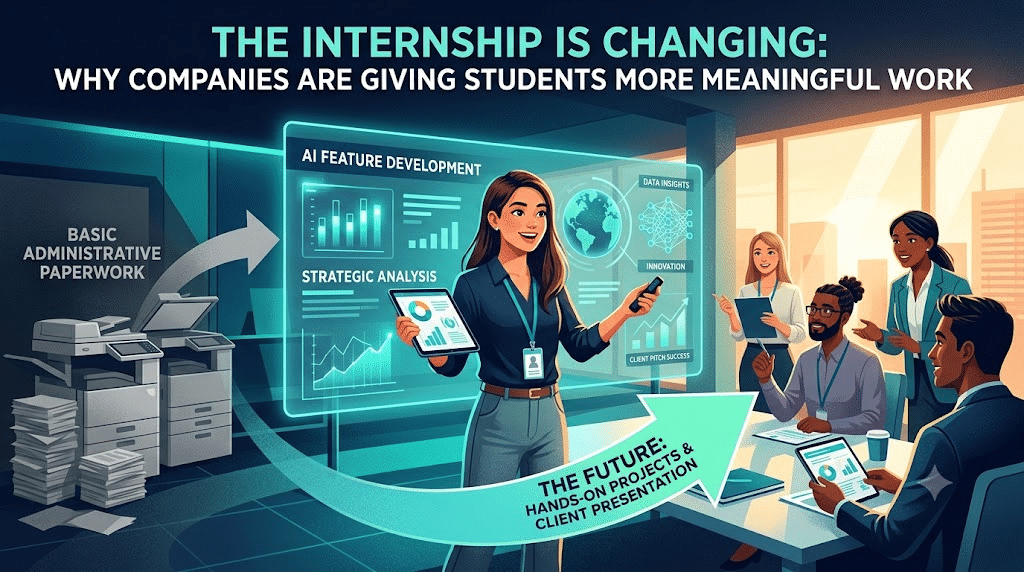
In all different areas, companies are reorganising their internship programmes to include real projects with real consequences—such as taking overall responsibility for specific features at technology companies, carrying out data-heavy strategic work at consulting firms, and providing direct hands-on engagement with clients at professional services firms.
Internship work is no longer seen as a side activity meant just to keep young people occupied; instead it is now being incorporated directly into the way the business carries out its operations.
This is not merely a cultural change involving treating young employees more nicely; it is mostly a result of the AI-driven transformation that is altering entry-level jobs.
Since AI tools have taken over the repetitive tasks which used to occupy an intern’s daily routine, such as data entry and scheduling and the initial formatting, companies now have to decide how to use up the time that has been freed.
More and more, the solution is to assign meaningful, higher-value work which was previously only given to junior full-time employees. The following article examines why this change is taking place, what it looks like in real terms, and what it means for both students and the organisations hiring them.
From Observation to Ownership
The list of the most prestigious internship programmes that Vault has produced in 2026 is a good indication of the current standard.
At NASA, which is consistently ranked as the leading destination for interns, students take part in actual mission activities together with scientists and engineers rather than just observing them, and in many cases the positions involve having responsibility for features in software engineering, product management, and UX.
In consulting and professional-services companies such as KPMG and PwC, the internship ‘projects’ are clearly described as data-intensive and analytical tasks focused on real business problems, in KPMG’s instance, they are designed to reflect what a full-time position actually entails, with interns working directly with business units on major initiatives.
This trend goes far beyond the case of the most well-known companies. At Deloitte, internships are organised around actual client projects and involve project work that leads to tangible business results, not simulated exercises.
Adobe also allows interns, whether or not they have a technical background, to take part in work covering generative AI, machine learning, computer vision, and product strategy right from the beginning of their internship, rather than starting them off with observational tasks.
In smaller companies and startups the change is often even more evident: in some instances an intern launches a feature that is made available to real users within their first two weeks at the company.
The common feature in all of these cases is ownership. In the past, the work carried out by interns would have to be double-checked, rewritten, or even discarded by a full-time employee; today, however, interns are increasingly producing work which is shipped, presented to senior management, or fed directly into a live product or client deliverable.
Why AI Is Driving This Shift
The internship has not suddenly become more meaningful. Instead, various factors which are directly related to the adoption of AI are causing companies to assign students more substantial work.
The “busywork” which used to make up an intern’s timetable has now been taken in by AI. Activities such as scheduling, simple data entry, producing the first draft of a document, and carrying out routine research summaries those traditional fundamentals of a beginner’s position are almost entirely capable of being automated.
Because of this, the time that was previously occupied by such tasks is now available, and managers have therefore had to find new things for interns to carry out, the usual choice being actual project work rather than artificial busywork.
Interns are usually more at ease with AI than the employees who would normally be in charge of them. Since AI tools have become a regular part of daily work, companies that have a high level of trust are now getting interns to take part in working meetings alongside vice presidents and senior leaders simply because the interns have a different and often more up-to-date view of how these tools can be used, a situation which has been noted in several of the Fortune 100 Best Companies to Work For in 2026. This change in the way the value of interns is seen naturally leads to them being given more substantial tasks.
Firms are employing internships as a way of testing out the wider AI-driven changes to their working methods. As has been noted across the industry in 2026, internships now show a more deliberate attitude towards early talent planning, with a purposeful balance between structure and flexibility that takes long-term hiring objectives into account rather than viewing the internship as something separate from the company’s main activities.
By giving interns responsibility for a specific and clearly defined part of a larger AI-related project, companies are able to trial new methods of working with minimal risk while at the same time generating useful results.
The expectations of students have changed, and as a result companies are making adjustments in order to stay competitive.
Nowadays, interns specifically seek out meaningful work, well-defined expectations, and genuine chances for professional development and those firms which are trying to secure their share of the increasingly small group of top early-career candidates have had to modify their programs as a result in order to remain appealing. There is a risk that programmes which do not provide substantial work will see candidates leave for competitors who do.
The Retention and Conversion Payoff
The change isn’t just motivated by a desire to do good, it has a clear impact on business results. According to Vault’s most recent survey of interns in its various programs, over 98% of them would recommend the internship to a friend, which is a clear indication that carrying out substantial work is linked to a generally positive experience.
This level of satisfaction leads to better hiring results: students who intern at companies with strong conversion pipelines perform significantly better than their peers when it comes to receiving full-time offers, and paid, formal internship programs in the fields of technology, finance, consulting, and government now achieve conversion rates that exceed the industry average of 62%.
Retention experts also refer to this aspect from the employer’s point of view. It is consistently mentioned as one of the most effective methods for keeping early-career employees engaged and for getting them to decide to stay with a company in the long term, especially when combined with real mentorship and a clear path for growth.
In the current tight labour market for early-career talent, having meaningful work has become not only a desirable feature but also a retention strategy.
The NACE data shows that this level of investment is still going ahead rather than decreasing: around 70% of companies intend to keep their intern hiring at the same level or to increase it in 2026, even though overall growth in the hiring of entry-level employees is only modest.
The fact is that businesses are not scaling back their internship programmes because of AI; instead they are reorganising the content of those programmes.
What This Means for Students
For those students who are considering internship opportunities in 2026, the practical conclusion is that “meaningful work” is now a reasonable and ever-more common expectation rather than something that occurs only at the most elite companies.
It is worthwhile when going through the interview process to find out what a typical project involves, whether the work done by previous interns has actually been shipped or put into use by the business, and how the position relates to the company’s wider AI-related initiatives. Internship programmes that are able to give concrete answers to these questions are the ones that tend to convert interns into full-time employees at above-average rates.
At the same time, students must understand that greater responsibility is involved in more meaningful work. An internship based on feature ownership or involving a actual client delivery demands a degree of accountability which a completely observational internship had never required.
This is exactly the kind of trade the present market is making: it gives students work that is important, on the condition that they treat it and the AI tools that are now increasingly incorporated into it — in the same serious way as a full-time employee would.
Conclusion
The internship in 2026 is very different from the one a decade earlier, and AI is the main reason for this change. Since AI has taken over a large amount of the repetitive tasks that used to make up entry-level positions, companies have been forced to reconsider what they expect of their interns and in all sectors, including technology, consulting, government, and professional services, the response has been to give interns real ownership of actual projects.
For companies, this change is resulting in higher levels of intern satisfaction, better conversion rates, and improved retention. For students, an internship no longer just serves as a item on their résumé; it is, more usually than not, an early and genuine insight into the kind of work they will be carrying out for the rest of their careers.
What are the biggest internship trends in 2026? Internship trends in 2026 show a shift toward meaningful student work, with interns handling real projects instead of busywork.
Why is student work more meaningful today than in the past?
AI has automated repetitive tasks, freeing interns to focus on higher‑value student work such as project ownership and client deliverables.
How are companies using internship trends to attract talent?
Companies highlight meaningful student work, mentorship, and career growth opportunities to compete for top early‑career candidates.
What role does AI play in internship trends?
AI tools handle scheduling, data entry, and drafts, allowing interns to contribute to strategic projects and innovative student work.
Which industries are leading in meaningful student work for interns?
Technology, consulting, finance, and professional services are at the forefront of internship trends, giving interns ownership of real outcomes.
How do internship trends affect conversion to full‑time jobs?
Programs that emphasize meaningful student work achieve higher conversion rates, often exceeding the industry average of 62%.
Why do companies see retention benefits from meaningful student work?
Internship trends show that interns who engage in substantial student work are more likely to stay long‑term and grow with the company.
What should students look for when evaluating internship offers?
Students should ask whether internship trends at the company include real student work, shipped projects, and AI‑related initiatives.
How do smaller companies reflect internship trends?
Startups often give interns immediate ownership, with student work like launching features for real users within weeks.
What does meaningful student work mean for career preparation?
Internship trends in 2026 ensure that student work mirrors full‑time responsibilities, giving interns a genuine preview of their future careers.
References
[1] College Works, “Best paid summer internships for 2026: Real-world projects and top pay,” Apr. 15, 2026. [Online]. Available: https://collegeworks.com/articles/best-paid-summer-internships-2026/
[2] GMAC, “The 25 best internships to kickstart your career | Vault ranking 2026,” Jul. 23, 2026. [Online]. Available: https://www.gmac.com/resources/learners/business-careers/employers-salaries/best-internships
[3] Internshala, “Best companies to intern for in 2026 for career growth,” Jul. 3, 2026. [Online]. Available: https://internshala.com/blog/best-companies-to-intern-for/
[4] CareerEnlightenment.com, “Best companies for internships in 2026: 25 programs worth your application,” May 17, 2026. [Online]. Available: https://careerenlightenment.com/best-internship-companies-2026
[5] Great Place To Work, “Fortune 100 Best Companies to Work For® 2026,” Jun. 18, 2026. [Online]. Available: https://www.greatplacetowork.com/best-workplaces/100-best/2026
[6] Atrium, “3 ways internships transformed in 2026,” May 4, 2026. [Online]. Available: https://www.atriumglobal.com/resources/3-ways-internships-transformed-in-2026/
[7] Poets&Quants for Undergrads, “‘Vault’ releases 2026 internship rankings: NASA, Google, Apple, Goldman Sachs among ‘most prestigious,'” Oct. 27, 2025. [Online]. Available: https://poetsandquantsforundergrads.com/first-jobs/vault-releases-2026-internship-rankings-nasa-google-apple-goldman-sachs-among-most-prestigious/
[8] CareerEnlightenment.com, “Best companies for internships in 2026: 25 programs worth your application” (conversion-rate data), May 17, 2026. [Online]. Available: https://careerenlightenment.com/best-internship-companies-2026
[9] Forbes Business Council, “19 ways companies can entice interns to stay long term,” Apr. 23, 2025. [Online]. Available: https://www.forbes.com/councils/forbesbusinesscouncil/2025/04/23/19-ways-companies-can-entice-interns-to-stay-long-term/
[10] CareerEnlightenment.com, “Best companies for internships in 2026: 25 programs worth your application” (citing NACE hiring-outlook data), May 17, 2026. [Online]. Available: https://careerenlightenment.com/best-internship-companies-2026