
Introduction
Group assessments, or cooperative assessment, is a form of cooperative edification where the students have been grouped to perform or work on a specific assessment. The group assessment work is designed to evaluate how students collaborate, communicate, and solve problems as a part of a team. Teamwork is fostered by this kind of assessment, with the evaluation of the work being done in a teamwork interview, both the assessment and the interview form part of the greater good of the team exercise. This article will highlight what group assessment is, common formats, and core skills required, along with excelling strategies, and will close with common mistakes to avoid while being part of the exercise.
Understanding Cooperative Assessments
Cooperative assessments are a type of assessment in which students’ team up in pairs or small groups, enabling learners to gain insights from their fellows’ expertise and receive feedback from the assessor during the same task. Effective teamwork can enhance student comprehension by encouraging them to clearly explain their reasoning, which in turn enhances their introspective abilities. And can introduce students to diverse viewpoints and ideas. Cooperative work fosters vital interpersonal skills that can help students in their transition to the workforce, despite the fact that it can be challenging to master. Similar to cooperative assessments, peer reviews are group activities where students assess one another, usually in addition to self-evaluation. This kind of assessment involves evaluation methods, judgments, and considerations. Like group collaborative assessment’s, these evaluations need to be carefully organized and conducted to ensure that every student has an equal opportunity to succeed. Students also need sufficient assistance in order to engage in this practice in an efficient manner.
Cooperative assessments cover real-world scenarios, such as group interviews or discussions, in addition to assignments and projects. Group interviews allow for the effective evaluation of numerous applicants by bringing several candidates together in front of one or more interviewers at the same time. They copy real team settings so that assessors can see how well someone fits in with the company’s culture, how well they communicate (both verbally and nonverbally), how well they work with others, and how well they handle stress to find the best team members.
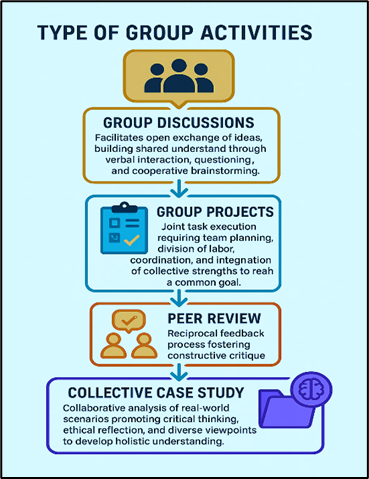
Other types of group activities:
Common features
- Process or product- Students are assessed on both the final product and the teamwork that went into creating it in the majority of group work assessments. When evaluating the process, students concentrate on how their group plans assignments, fixes issues, and increases productivity. Students are better prepared to acquire transferable teamwork skills for any cooperative setting when these methods, rather than just the final product, are evaluated.
- Peer Evaluation- Peer evaluation is an organized procedure where students evaluate the performance and contributions of others. By asking students to use predetermined standards—checklists—to evaluate the caliber and volume of peer contributions, it encourages responsibility, reflective practice, and fair workload distribution. The peer evaluation is conducted primarily under the assessor’s guidance by a team lead who has a direct line of communication with both the group and the assessor.
- Criteria for Assessment- When fellows have some say in the assessment criteria, groups perform best. One option is to create a list of criteria and ask students to add to it. Another option is to work with students to develop the criteria through open discussion. When creating assessment criteria, always start with the learning outcomes.
- Case study & project -based tasks- Case study-based tasks engage the learners with real-world scenarios that require research and strategic execution. Mostly case study-based tasks are elongated in nature, so they require contributions from all members at different stages.
- Problem based learnings- This type of activity requires stratifications of the main concern by problem interpretation, solution derivation, and outcome presentation; each level requires an intricate combination of reasoning, analytical thinking, and cooperative attitudes. Each of the stratifications requires teamwork and lucid communication.
- Observation’s- Observation helps to identify collaborative attitudes, diverse thoughts, conflict resolution, and engagement level. Discussions provide insight into individual accountability within celebrative tasks and support assessment evaluations.
Core Teamwork skills for Interview Successes with 3 A’s
Employees look for more than just job-related skills in assessing the suitability of a candidate; they look for the ability to work well with others during the interview. Behavioral and interpersonal traits are essential to show the cooperative attitude of candidates. Below are essential skills to thrive in team-oriented roles:
- Active Listening- Interviewers evaluate these traits by looking at instances of communication, cooperation, and feedback. Clearly expressing ideas and opinions while render close attention to others enhances understanding, reduces quarrels, and guarantees team alignment and solidarity.
- Adaptability- Being able to quickly adjust to a different of roles, responsibilities, team dynamics, and unforeseen obstacles demonstrates endurance and dexterity, these traits are which the interviewers looking for in applicants who must thrive in fast-paced, cooperative environments.
- Accountability- Interviewers seek candidates who balance responsibility with a cooperative, empathetic approach to group success. Taking the ownership of tasks while uplifting other show reliability in the interview process in situations like group discussions
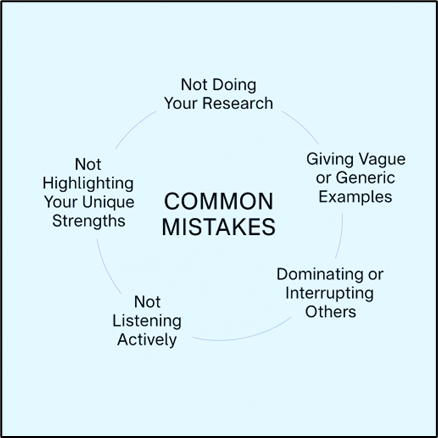
Common Mistake to avoid during Team collaboration and Interview
Conclusion
In conclusion, doing well in group assessments and group interviews takes more than just finishing tasks. It needs creative brainstorming, lucid communication, and understanding others’ perceptions. By mastering the 3 A’s (Active Listening, Adaptability, and Accountability) and steering clear of common mistakes, candidates can show they are ready to succeed in ass and add value to shared goals.
Group Assessment FAQs
- What is a group assessment in education?
A group assessment is a collaborative evaluation method where students work together on tasks to demonstrate teamwork, communication, and problem-solving skills. - Why is group assessment important for student development?
Group assessment fosters interpersonal skills, encourages diverse thinking, and prepares students for real-world teamwork scenarios. - How does group assessment differ from individual assessment?
Unlike individual assessment, group assessment evaluates both the final product and the collaborative process, including peer interaction and shared responsibility. - What are common formats of group assessment?
Group assessment formats include case studies, project-based tasks, problem-based learning, peer evaluations, and group interviews. - How is peer evaluation used in group assessment?
Peer evaluation in group assessment involves students assessing each other’s contributions using structured criteria to ensure fairness and accountability. - What skills are essential for succeeding in group assessment interviews?
Key skills for group assessment success include active listening, adaptability, and accountability—often referred to as the 3 A’s. - How can students prepare for a group assessment interview?
To prepare for a group assessment interview, students should practice clear communication, understand team dynamics, and reflect on collaborative experiences. - What are common mistakes to avoid in group assessment tasks?
Mistakes in group assessment include poor communication, lack of role clarity, ignoring feedback, and dominating or withdrawing from group discussions. - How does group assessment simulate workplace scenarios?
Group assessment mirrors workplace settings by evaluating teamwork, stress management, and cultural fit through collaborative tasks and interviews. - Can group assessment improve employability skills?
Yes, group assessment enhances employability by developing communication, problem-solving, and collaboration skills valued in professional environments.
References
- Group and peer assessment https://www.monash.edu/learning- teaching/TeachHQ/Assessment/group-and-peer-assessment
- How to Prepare for Group Activity of the Assessment Centre (July2024)
https://www.linkedin.com/pulse/how-prepare-group-activity-assessment-centre-tokam-maptue-av6ge/
- Collaborative Assessment (2024)
https://citt.ufl.edu/resources/assessing-student-learning/collaborative-assessment-/
- Group Learning Assessments as a Vital Consideration in the Implementation of New Peer Learning Pedagogies in the Basic Science Curriculum of Health Profession Programs (August 2016)
https://pmc.ncbi.nlm.nih.gov/articles/PMC5736269/#section5-JMECD.S18930
- Assessing by group projects
https://www.teaching.unsw.edu.au/assessing-group-work
- Team – Building Exercise: 5 pitfalls to avoid (December 2023)
https://smartpreneur.ng/team-building-exercise-5-pitfalls-to-avoid/
- A guide for group work (2018)
https://flexiblelearning.auckland.ac.nz/guide-to-group-work/