
Gig Economy Impact on Traditional Employment Models
Introduction
The gig economy has emerged as a transformative force in the global labour market, reshaping traditional employment relationships, workforce management practices, and regulatory systems. Driven by rapid technological advancements, digital platforms, and evolving worker preferences, gig work has gained widespread acceptance among both employers and workers. This employment model primarily involves short-term, task-based labour arrangements facilitated through online platforms, offering flexibility and efficiency. While the gig economy contributes to productivity and innovation, it also raises concerns related to worker rights, income stability, and legal protection. This article analyses the gig economy from business, human resource, and legal perspectives using the Resource-Based View (RBV) and Transaction Cost Economics (TCE) frameworks.
Evolution and Nature of the Gig Economy
Although temporary and freelance work has existed for centuries in sectors such as agriculture and construction, the modern gig economy took shape with the rise of digital marketplaces. Early platforms such as Craigslist and eBay enabled peer-to-peer service exchange, while later platforms including Uber, Upwork, Fiverr, and Amazon Mechanical Turk formalized gig work across industries. The 2010s marked a significant expansion of platform-based labour, allowing workers to access global opportunities and organizations to source talent on demand. The COVID-19 pandemic further accelerated this growth, as businesses increasingly relied on remote and flexible labour. However, the crisis also exposed structural weaknesses in gig work, particularly the lack of healthcare access, paid leave, and job security for workers.

Business Strategies in the Gig Economy
From a strategic standpoint, organizations adopt gig-based models to enhance operational flexibility and reduce fixed labour costs. The Resource-Based View emphasizes that human capital is a key source of competitive advantage, encouraging firms to access specialized freelance skills without long-term commitments. Transaction Cost Economics complements this approach by helping organizations assess whether outsourcing tasks to gig workers is more cost-effective than employing full-time staff. Platform-based and project-based models dominate gig employment, enabling rapid scaling and efficiency. However, excessive reliance on gig labour may lead to challenges in knowledge retention, organizational loyalty, and consistent service quality if not managed strategically.
Human Resource Management in Gig Work
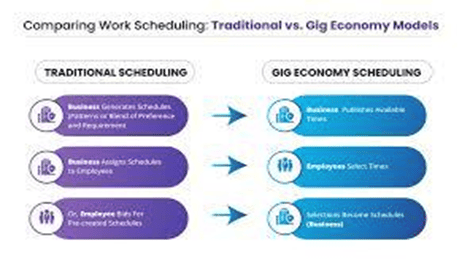
Human resource management in the gig economy differs significantly from traditional employment models. Recruitment processes are increasingly digital, relying on algorithm-driven platforms that match skills with short-term assignments. Performance evaluation is typically project-based, emphasizing output, client feedback, and task completion rather than continuous supervision. Retention strategies focus on maintaining long-term relationships through repeat engagements, skill development opportunities, and transparent communication. While gig workers value autonomy and flexibility, the absence of conventional benefits and career advancement pathways necessitates innovative HR policies that balance organizational efficiency with worker engagement and motivation.
Legal and Regulatory Considerations
Legal governance remains one of the most complex challenges in the gig economy. Worker classification—whether individuals are considered employees or independent contractors—has significant implications for labour rights, taxation, and social protection. Misclassification can allow organizations to bypass minimum wage laws and employee benefits, leading to ethical and legal disputes. Landmark rulings, such as the UK Supreme Court decision recognizing Uber drivers as workers, highlight global efforts to redefine labour protections. Nevertheless, regulatory frameworks remain fragmented and struggle to keep pace with evolving gig work models. Continuous legal reforms, compliance audits, and updated labour policies are essential to ensure fair treatment and accountability.
Implications for Workers and Policymakers
For workers, the gig economy offers flexibility, autonomy, and access to diverse income opportunities. However, it also introduces income uncertainty and limited access to social security benefits. Policymakers face the challenge of designing inclusive legal frameworks that protect workers without discouraging innovation. Addressing issues such as gender pay gaps, minimum income guarantees, healthcare access, and dispute resolution mechanisms is crucial for building a sustainable and equitable gig economy.
Conclusion
The gig economy represents a fundamental shift in employment dynamics, redefining how work is structured and managed in modern economies. While it enables organizations to remain agile and competitive, it also introduces challenges related to workforce stability, legal compliance, and worker welfare. Strategic integration of gig workers through adaptive business models, innovative HR practices, and robust legal frameworks is essential for long-term sustainability. As the gig economy continues to evolve, collaboration among businesses, policymakers, and labour institutions will be critical in ensuring a balanced system that promotes both economic growth and social protection.
References
[1] J. Horney, The Future of Work. New York, NY, USA: McGraw-Hill, 2016. [Online].
Available: https://www.mheducation.com
[2] T. Lepanjuuri, R. Wishart, and P. Cornick, “The characteristics of those in the gig economy,” UK Department for Business, Energy & Industrial Strategy, London, UK, 2019. [Online].
Available: https://www.gov.uk/government/publications
[3] A. Broughton et al., “Employment and working conditions of selected types of platform work,” European Foundation for the Improvement of Living and Working Conditions, Dublin, Ireland, 2018. [Online].
Available: https://www.eurofound.europa.eu
[4] A. Wood et al., “Good gig, bad gig: Autonomy and algorithmic control,” Work, Employment and Society, vol. 33, no. 1, pp. 56–75, 2019. [Online].
Available: https://journals.sagepub.com
[5] M. Schwellnus et al., “Gig economy platforms,” OECD Economics Department Working Papers, Paris, France, 2019. [Online].
Available: https://www.oecd.org
[6] S. Malik et al., “The rise of the gig economy,” Journal of Business Research, vol. 132, pp. 1–10, 2021. [Online].
Available: https://www.sciencedirect.com
[7] V. De Stefano, “The rise of the just-in-time workforce,” Comparative Labour Law & Policy Journal, vol. 37, no. 3, 2015. [Online].
Available: https://papers.ssrn.com
[8] A. Gupta, “UK Supreme Court ruling on Uber drivers,” Industrial Law Journal, vol. 53, no. 1, 2024. [Online].
Available: https://academic.oup.com
[9] R. Bogg and M. Buendia, “Worker classification in the gig economy,” International Labour Review, 2022. [Online].
Available: https://onlinelibrary.wiley.com
Navigating the Gig Economy FAQs
- What is the primary focus of this labor model?
It focuses on short-term, task-based labor facilitated through digital platforms rather than long-term contracts. - How does gig work differ from traditional employment?
Unlike traditional roles, gig work offers higher autonomy and flexibility but lacks consistent benefits and fixed schedules. - Which economic frameworks are used to analyze this model?
The article utilizes the Resource-Based View (RBV) and Transaction Cost Economics (TCE). - What role did the COVID-19 pandemic play?
It accelerated the adoption of flexible labor while highlighting the lack of security for non-traditional workers. - What are the strategic benefits for businesses?
Companies can access specialized skills on-demand and reduce fixed labor costs. - What are the potential downsides for organizations?
Over-reliance on gig labor can lead to issues with service quality and a loss of organizational knowledge. - How is recruitment handled in this sector?
Recruitment is largely digital, using algorithms to match worker skills with specific tasks. - How is worker performance evaluated?
Performance is judged based on specific outputs and client feedback rather than constant supervision. - What is the most significant regulatory challenge mentioned?
The classification of workers as either employees or independent contractors is a major legal hurdle. - Why is worker classification important?
It determines a company’s legal obligations regarding minimum wage, taxes, and social protections. - What was the impact of the UK Supreme Court’s Uber ruling?
It set a major legal precedent by recognizing gig drivers as workers entitled to specific rights. - Do gig workers have access to social security?
Currently, many lack access to healthcare, paid leave, and unemployment insurance. - What do policymakers need to address?
They must create legal frameworks that protect workers without stifling the innovation of the platform economy. - How does the gig economy impact income stability?
While it provides diverse opportunities, it often introduces significant income uncertainty. - What is the “Resource-Based View” in this context?
It suggests that human capital is a competitive advantage, even when sourced through non-traditional means. - How can HR departments improve gig worker engagement?
By using innovative policies that focus on transparent communication and repeat engagements. - Is platform work limited to specific sectors?
While it started in sectors like transport, it has expanded across almost all professional industries. - What is required for the long-term sustainability of this model?
A combination of adaptive business strategies and robust legal reforms is essential. - How do regulatory frameworks currently look?
They remain fragmented and often struggle to keep up with the pace of technological change. - Who must collaborate to ensure a fair system?
Businesses, policymakers, and labor institutions must work together to ensure social protection.
Penned by Swati
Edited by Nivedita, Research Analyst
For any feedback mail us at [email protected]
Streamline Your Hiring with Eve Placement’s Custom Assessments
Eve Placement helps you engage, assess, and recruit top talent through tailored hiring challenges that go beyond resumes. From technical quizzes and real-world case studies to psychometric evaluations and audio/video submissions, our platform enables smarter, data-driven hiring decisions. Advanced security features ensure authenticity and eliminate fraud, giving you reliable results. Ready to hire better? Know More.
Mail us at [email protected]