
Gamified Hiring Assessments to Engage Gen Z Applicants
Topics: Gamified assessment, Youth careers
One clear trend has emerged as companies are trying to get hold of the next generation of talent: traditionally used hiring methods have less and less charm for Gen Z candidates. This generation – the one with members born in the late 1990s and the early 2010s – has evolved in a digital world that is characterized by interactivity, instant feedback, and immersive experiences. In order to reach them in a proper way, firms are using more and more gamified assessments – a recruiting technique that evaluates while engaging, thus making the whole recruiting process something vibrant, fun, and data-driven in youth careers.
Understanding Gamified Hiring
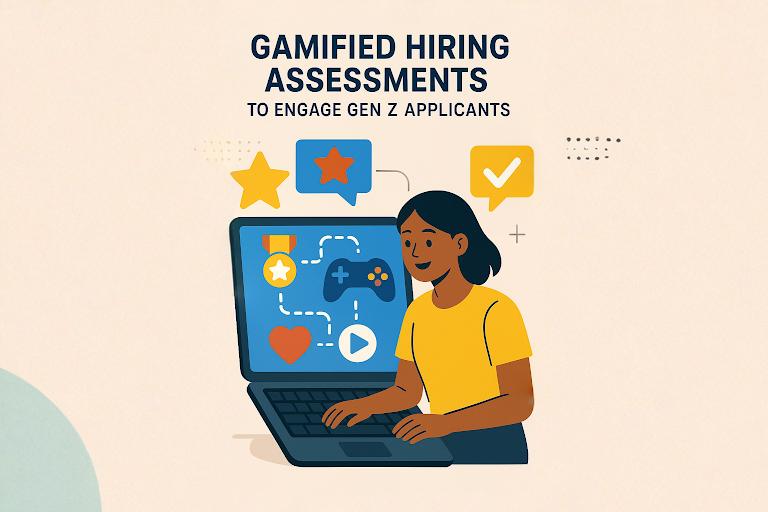
Gamified hiring is the use of recruitment assessment game design features, for example, challenges, levels, leaderboards, or rewards, to engage candidates. Instead of submitting candidates to the usual aptitude or personality tests, companies present them with interactive tasks that simulate a real workplace scenario. Such tests can evaluate the skills of the candidates through the use of a game, for instance, in this way, problem-solving, decision-making, teamwork, and adaptability can be mastered.
In order to exemplify, the logistics company might employ a supply chain simulation game to see how the applicants deal with unexpected delays or how they react when there is a shortage of supplies. In the same way, a marketing company might hold a storytelling contest in which competitors have to create a brief campaign within the given time. The main purpose is to make use of a production method that is both trustworthy and fun and that can disclose the real capacities of the person, which is beyond what can be derived from a traditional test or résumé.
Why Gamification Appeals to Gen Z
The main thing that Gen Z candidates desire is an experience that is interactive, transparent, and technology-driven. They want to be challenged in a way that they have to come up with the solution using their creative and critical thinking skills instead of just answering multiple-choice questions. If we analyze the gamified hiring process, one could say that it is the perfect match for this way of thinking since it altogether turns the candidate from a passive tester into an active participant, hence, recruitment is no more the narrowing down of the options but a dialog of possibilities.
Besides that, these tests offer real-time results, a quality that is in line with the expectations of a generation that is used to getting the results of whatever they do instantly via apps, games, or social media. Gamification is also instrumental in lowering test anxiety to such an extent that the test will soon be perceived as an engaging competition rather than a game.
Benefits for Recruiters and Organizations
On top of that, gamified hiring assessments are a source of insights that are much deeper and more accurate than the engagement of candidates can be. The employers, by observing and thus being able to track the way the candidates make decisions, are under stress, or cooperate, could spot those personalities that usually remain invisible even if they scrutinize the CVs very thoroughly.
The information obtained from such games can be put through AI and other analytical tools to paint the most complete candidate portraits. This way, recruiters transition from making hires based on their instincts to behavioral insights thus the occurrence of unconscious bias is reduced. Moreover, gamification has been proved to be effective in employer branding — organizations that adopt futuristic, candidate-friendly hiring approaches signal their innovativeness and attract the tech-savvy Gen Z applicants.
Creating Fair and Inclusive Assessments
Innovative gamified hiring solutions also contribute to the D&I agenda. They devise the game elements in such a way that they assess the players based on observable actions and not on their demographic data. As an example, the ability to think strategically under pressure will be gauged through specific indicators rather than the candidate’s background or appearance. On top of that, everyone, regardless of their location or educational background, if given a gamified task, would stand an equal chance of success, as the solution requires skills, logic, and creativity.
Challenges and Limitations
Though there are several benefits associated with gamified hiring, it also bears some drawbacks. Some poorly designed games may inadvertently test skills that are not relevant or favor certain learning styles. If the focus is too much on fun, then the assessment of the needed job skills may be neglected. Furthermore, tailor-made and scientifically accurate gamified tests might cost a considerable amount of money to smaller organizations.
Another issue at stake is data protection – since these devices normally record player behavior, time, and even biometric reactions, the companies need to be assured that they conform to privacy laws and follow moral data handling principles.
The Future of Recruitment
Gamification is likely to become one of the main features of recruitment strategies when the next generation of workers will be digital natives. The hiring of the future may look like an immersive experience where applicants “play” to show their skills if we consider the use of AI-driven analytics and virtual reality simulations together. Although the success will hinge upon companies’ ability to balance tech with fairness, transparency, and human insight.
In the following ten years, gamified hiring will probably transition from being an experimental tool to a widely used recruitment strategy. It is a chance for evaluation in a practical, interesting, and impartial manner that employers are offered through this tool. On the other hand, for Gen Z, it stands for a recruitment process that finally gets their point. Interactive, authentic, and full of opportunity is what they are.
Conclusion
As a result, companies aiming to attract Gen Z candidates and influence the future of youth careers in a trendy way can consider gamified hiring assessments as an effective instrument. Using game-style elements such as points, levels, and simulations, recruiters are able to develop engaging, data-rich, and brand-enhancing assessments that appeal to digitally native talents. They bring together technology, engagement, and recruitment results; thus, organizations can draw in and assess the younger generations in a manner consistent with their background and expectations when a gamified assessment is well thought-out and seamlessly implemented.
FAQs
Q1. What is a gamified assessment?
A. A gamified assessment is a recruitment tool that uses game-like elements such as challenges, levels, and rewards to evaluate candidates’ skills in an interactive way.
Q2. How does gamified hiring benefit youth careers?
A. It allows digitally native candidates to demonstrate problem-solving, creativity, and decision-making skills, helping them showcase abilities beyond traditional resumes.
Q3. Why is gamification appealing to Gen Z applicants?
A. Gen Z prefers interactive, transparent, and tech-driven experiences. Gamified assessments engage them actively and reduce test anxiety compared to conventional evaluations.
Q4. Can gamified assessments improve fairness in recruitment?
A. Yes. They focus on observable actions and skills, minimizing bias related to demographics, location, or educational background.
Q5. How do these assessments provide insights for recruiters?
A. They track candidate behavior, decision-making, and collaboration patterns, giving employers data-rich profiles for better hiring decisions.
Q6. Are gamified assessments effective for teamwork evaluation?
A. Absolutely. Multi-player simulations and collaborative challenges help assess communication, adaptability, and cooperation skills in realistic scenarios.
Q7. Can small companies implement gamified hiring for youth careers?
A. While effective, designing high-quality, scientifically valid gamified assessments may require investment, but scalable solutions are available for smaller firms.
Q8. How do gamified assessments align with modern recruitment trends?
A. They transform hiring from passive testing to active participation, blending engagement, skill evaluation, and employer branding for digitally savvy talent.
Q9. Do gamified assessments comply with data privacy standards?
A. Responsible gamified tools follow privacy regulations, ensuring candidate data, behavior, and biometric metrics are handled ethically and securely.
Q10. What is the future of gamified hiring for youth careers?
A. Gamification is expected to become a standard recruitment strategy, combining AI, analytics, and immersive experiences to assess skills practically and fairly.
References
[1] Prep AI, “Hiring Gen Z? Here’s why Gamified assessments are a must,” Prep AI, July 2025. [Online]. Available: https://www.prepai.io/blog/gamified-assessments/
[2] AB Academies, “Gamification in Recruitment: A Strategy for Engaging Millennial and Gen Z Talent,” Academy of Marketing Studies Journal, 2025. [Online]. Available: https://www.abacademies.org/articles/gamification-in-recruitment-a-strategy-for-engaging-millennial-and-gen-z-talent-17586.html
Penned by Tushar Sharma
Edited by Preksha Khatod, Research Analyst
For any feedback mail us at [email protected]
Streamline Your Hiring with Eve Placement’s Custom Assessments
Eve Placement helps you engage, assess, and recruit top talent through tailored hiring challenges that go beyond resumes. From technical quizzes and real-world case studies to psychometric evaluations and audio/video submissions, our platform enables smarter, data-driven hiring decisions. Advanced security features ensure authenticity and eliminate fraud, giving you reliable results. Ready to hire better? Know More.
Mail us at [email protected]