
Entrepreneurship vs Corporate Job: What’s Right for You?

Selecting between entrepreneurship and a corporate career is a defining choice. Each path offers distinct benefits and challenges, and the proper choice depends on your personal goals and risk appetite. In today’s dynamic process, understanding the differences between the two will enable you to make a more informed and satisfying choice.
What is Entrepreneurship? Understanding the Freedom and Responsibility
Entrepreneurship includes the beginning and going for a walk with your enterprise. It affords autonomy, creativity, and the danger of constructing something significant from scratch. You are your boss and get to make strategic decisions that form your business. On the other hand, company jobs provide shape, stability, and a clean career development. Those jobs offer a supportive environment with described roles and obligations within a long-term agency.
Risk vs Stability: Which Career Offers More Balance?
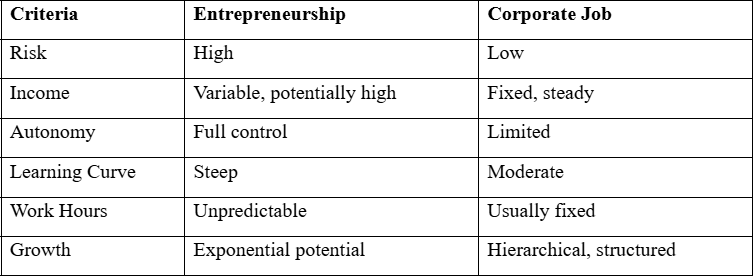
One of the foremost elements to keep in mind is threat and balance. Entrepreneurs face a high level of uncertainty, especially in the early stages. Earnings may be unpredictable, and disasters are common. However, additionally, they can analyse from the ones that screw up and pivot fast. In assessment, company jobs typically provide monetary safety with fixed monthly income, health benefits, and activity balance—an attractive element for many specialists.
Income Potential: Unlimited vs Predictable Earnings
With regards to earning capability, entrepreneurship gives unlimited opportunities, though they’ll take time to materialise. Entrepreneurs’ profits are carefully tied to their efforts, innovation, and market response. Company jobs, at the same time as having dependent salaries, additionally provide bonuses and promotions. But, profit growth in such roles is frequently linear and capped based on the organisational hierarchy.
Work-Life Balance in Startups vs Corporate Roles
Work-life balance is every other full-size consideration. Entrepreneurs generally experience erratic work schedules and lengthy hours, especially in the course of release levels or increase periods. Their groups regularly call for interest beyond typical painting hours. On the other hand, company personnel commonly enjoy constant schedules, which might also permit better balance, even though a few roles require working beyond regular time or tight closing dates.
Task pride can range extensively based on private dreams. Entrepreneurship tends to offer a deeper feel of success, whilst the commercial enterprise aligns with the founder’s passion. Every success feels private and impactful. Company jobs can also offer pride through accomplishing team dreams and climbing the organisational ladder. But some individuals may additionally find the recurring nature of company roles much less stimulating over the years.
Here is a quick comparison to help visualise the pros and cons:
Final Thoughts: Aligning Your Career with Your Purpose
So, who needs to pick out what? Select entrepreneurship in case you thrive in uncertainty, have an enterprise concept you’re captivated with, and are self-driven and resilient. It suits folks who are inclined to take risks and enjoy constructing something from the ground up. Then again, a corporate process is right for folks who value predictability, structure, and teamwork. It’s a sturdy preference for those seeking long-term financial and career security.
There may be no popular way to determine which course is better. The maximum critical thing is alignment—how well your career choice suits your values, strengths, and aspirations.
Whether or not you construct your assignment or climb the corporate ladder, fulfilment in the long run comes from determination and a clear sense of purpose.
Keywords Used: entrepreneurship vs company activity, career selection, startup vs activity, task security, income capability, work-lifestyle stability, career boom, enterprise achievement, corporate ladder, entrepreneurial attitude, structured profession course.
REFERENCES
- Rauch, A., & Frese, M. (2007). Let’s put the person back into entrepreneurship research: A meta-analysis on the relationship between business owners’ personality traits, business creation, and success. European Journal of Work and Organizational Psychology, 16(4), 353–385.
- McKinsey & Company. (2022). The Rise of the Hybrid Professional: Navigating Work and Entrepreneurship. Retrieved from https://www.mckinsey.com
- Image Source: https://www.pexels.com

FAQ: Entrepreneurship vs Corporate Jobs
1. What is the core difference between entrepreneurship and a corporate job?
The primary difference lies in ownership, control, and structure. Entrepreneurship involves starting and managing your own business, giving you autonomy to make strategic decisions and shape your vision. In contrast, corporate jobs operate within a structured system where roles, responsibilities, and decision-making are more hierarchical and predefined.
2. Is entrepreneurship better than a corporate job?
It depends on your personality, goals, and risk tolerance. Entrepreneurship is ideal for those who enjoy innovation, independence, and are comfortable with uncertainty. Corporate jobs, on the other hand, are well-suited for individuals seeking stability, career progression, and teamwork within an established system.
3. How do risk and stability compare in both paths?
Risk is a defining factor of entrepreneurship. Business owners face uncertain markets, fluctuating incomes, and potential failure. However, the ability to learn from mistakes and pivot quickly is a key advantage. Corporate roles offer a more stable environment with predictable income, benefits like healthcare, and job security—making them less risky overall.
4. What are the income potential differences?
In entrepreneurship, income potential is virtually unlimited but highly variable, especially in the early stages. Success often depends on innovation, market demand, and operational efficiency. Corporate jobs offer predictable salaries, structured promotions, and bonuses—but income growth is usually capped by company policies and position levels.
5. How does work-life balance compare in both career paths?
Entrepreneurship often demands long hours, especially during a company’s launch or growth phases. Work schedules can be unpredictable and intense. Conversely, corporate jobs usually have more consistent hours, which can allow better work-life balance though some roles may still require overtime or deadline-driven flexibility.
6. Which path offers better job satisfaction?
Job satisfaction is subjective. Many find entrepreneurship fulfilling because it allows them to pursue passions and see direct impacts of their work. Every achievement feels personal. Corporate professionals may find satisfaction in teamwork, achieving company goals, or climbing the corporate ladder—but some might find the structured environment less exciting over time.
7. Do corporate jobs offer more professional growth?
Corporate roles typically provide defined career paths, mentorship programs, and frequent training opportunities. This structured environment helps individuals steadily progress. Entrepreneurship, however, forces rapid self-development and continuous learning, especially in leadership, strategy, and resource management—making it an accelerated yet self-driven growth path.
8. Is entrepreneurship suitable for recent graduates?
While not impossible, jumping straight into entrepreneurship after graduation can be risky without prior work experience or industry knowledge. Gaining some exposure through internships or corporate roles can help build the skills and network necessary for entrepreneurial success. That said, if a graduate has a well-researched idea and strong support, they can still succeed.
9. Which career path provides more financial security?
Corporate jobs offer consistent paychecks, retirement plans, insurance, and other benefits contributing to long-term financial stability. In entrepreneurship, earnings may be inconsistent and benefits must be self-managed, especially in the beginning. Over time, however, a successful business can yield greater financial rewards.
10. How can I decide between entrepreneurship and a corporate career?
Start by evaluating your personal values, long-term goals, and comfort with risk. If you are self-driven, adaptable, and have a passion for creating something new, entrepreneurship may be the right fit. If you value routine, collaborative environments, and career stability, corporate life might be more suitable.
11. Can one switch from corporate to entrepreneurship later in life?
Yes, many professionals transition to entrepreneurship after gaining experience and financial stability in corporate roles. The skills, industry insights, and networks developed over time can be incredibly valuable when launching a business.
12. What personality traits are essential for entrepreneurship?
Key traits include resilience, self-motivation, adaptability, risk-taking, creativity, and leadership. Successful entrepreneurs are solution-oriented, quick learners, and able to remain persistent even when facing
13. Are there hybrid career options?
Yes, many pursue side hustles while working corporate jobs, eventually transitioning to full-time entrepreneurship once their ventures become sustainable. Others operate in roles that combine entrepreneurial thinking within companies, also known as “intrapreneurship.”
14. Which path leads to greater impact?
Both can be impactful in different ways. Entrepreneurship allows individuals to solve problems directly, create jobs, and bring innovation to market. Corporate roles enable professionals to drive change at scale, influence team dynamics, and contribute to large-scale operations.
15. What’s the final takeaway for choosing between the two?
There’s no universally “better” choice—it all boils down to alignment. Choose entrepreneurship if you’re passionate about innovation and ready to embrace risk. Choose the corporate route if you prefer structure, predictability, and gradual growth. Ultimately, success comes from pursuing what aligns with your strengths, purpose, and vision for the future.
Penned by Sukant Gupta
Edited by Ragi Gilani, Research Analyst
For any feedback mail us at [email protected]
Streamline Your Hiring with Eve Placement’s Custom Assessments
Eve Placement helps you engage, assess, and recruit top talent through tailored hiring challenges that go beyond resumes. From technical quizzes and real-world case studies to psychometric evaluations and audio/video submissions, our platform enables smarter, data-driven hiring decisions. Advanced security features ensure authenticity and eliminate fraud, giving you reliable results. Ready to hire better? Know More.
Mail us at [email protected]