
Master Voice-Enabled Placement Apps
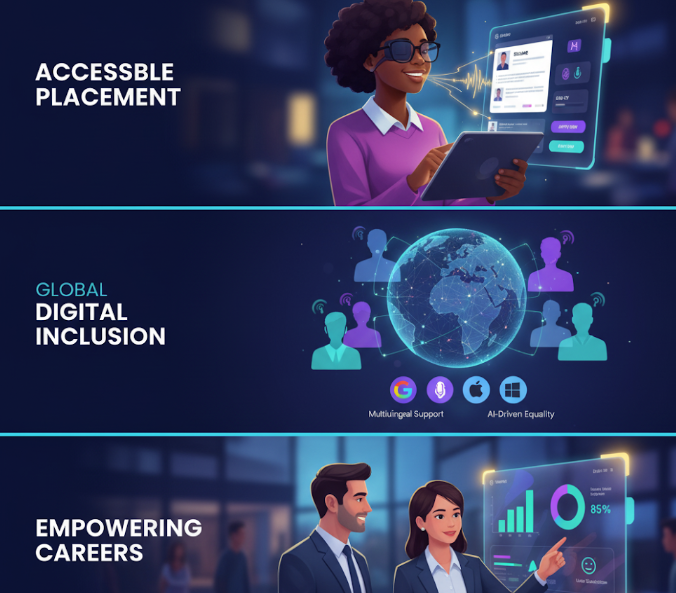
A voice-enabled placement app can do more than read schedules. It can guide users to do multi-step tasks such as registering for a drive, uploading documents or practicing interview questions, in order to attain Assistive Hiring Solutions through speech. By providing spoken prompts at each step, the voice-enabled placement app helps users to complete the complex placement processes without needing a screen to see.
Multilingual language support is also important for Digital Inclusion. The voice-enabled placement app should include language selection and training so that Speech Recognition performs well across different accents and dialects. Regular testing with diverse user groups helps the placement sites to identify the gaps and work on them in order to improve the accuracy of the Speech Recognition Technology.
Privacy and data protection must be an important feature to design for voice-enabled placement apps. Voice recordings and transcripts can contain sensitive personal information. Clear consent flows, secure storage, and the option to delete recordings give users control over their data and maintain the privacy of users during the placement process.
Developing a voice-enabled placement app also requires thoughtful cost planning. Institutions can start small with pilot programs focused on a single department. Partnerships with technology providers can spread costs and bring technical expertise to the placement campus.
Adoption will improve when staff and students receive training. Short demonstration sessions, quick start guides, and an accessible support channel make the voice-enabled placement app less intimidating. Feedback loops allow developers to refine voice commands and improve the user experience for greater Digital Inclusion.
Voice-enabled placement tools can also help recruiters. An accessible application channel widens the candidate pool and signals an employer’s commitment to Digital Inclusion. Recruiters can reach diverse talent and benefit from applications that might otherwise be missed. This enhances Assistive Hiring Solutions.
Metrics to monitor include adoption rate, successful completion of application tasks, and user satisfaction scores. Tracking these indicators helps institutions justify investments and plan next steps for expansion of Digital Inclusion in placement.
Major accessing Platforms and tools for Voice-Enabled Placement Accessibility:
Google Voice Access: Especially designed by Google to use voice for searching data, and placement opportunities and it also mnages tasks by making specific commands. This is an Assistive Hiring tool.
Apple VoiceOver: The IOS feature with voice help in finding job portals and Assistive Hiring Solution sites.
Microsoft Voice Access: The Windows in Microsoft also have voice-enabled placement features, which help users to navigate the sites and job portal through speech also.
Assistive Hiring Solutions:
Assistive Hiring Solutions is different from the traditional hiring, which takes a lot of time and effort. Assistive Hiring tools with advanced features and technologies will track the best talents worldwide, enhancing Digital Inclusion.
This feature uses a lot of automation, machine learning and artificial intelligence to help recruiters in hiring the best talents for particular positions.
Using Assistive Hiring Solutions will increase effectiveness, equality, and efficiency at the same time for Digital Inclusion in placement.
Conclusion
In conclusion, Voice-Enabled Placement Apps are a practical step toward inclusive hiring. With careful testing, attention to privacy, and clear training, these tools can help all students participate fully in Campus Placements and support employers in finding capable and diverse candidates. Voice-Enabled Placement Apps will significantly improve Digital Inclusion and empower the candidates applying for certain positions. Major platforms like (Google Assistant, Apple Siri, Alexa, and more) will help in enhancing Assistive Hiring areas using voice-enabled platforms for candidate placement and job search opportunities.
Commonly Asked Questions
1. What are Voice-Enabled Placement Apps?
Apps that allow users to interact with placement systems using natural speech rather than traditional web or mobile interfaces.
2. What is the main goal of Voice-Enabled Placement Apps? To create an accessible and smoother way for all students to interact with placement systems, promoting Digital Inclusion.
3. What role does Speech Recognition Technology play?
It allows users to ask questions and receive spoken answers or clear written responses through voice-assistance.
4. How do these apps benefit students with visual impairments?
Voice-driven navigation reduces dependence on keyboard and touch interactions, making placement sites easier to use.
5. How are Voice-Enabled Placement Apps different from traditional interfaces?
Traditional interfaces can be difficult for some users, while the voice-enabled approach uses speech for interaction.
6. What multi-step tasks can a voice-enabled placement app guide a user through?
Registering for a drive, uploading documents, or practicing interview questions are examples.
7. What is the benefit of spoken prompts at each step?
It allows users to complete complex processes without needing to view a screen.
8. What is Digital Inclusion in the context of Campus Placements?
It is the significant improvement in access that empowers all candidates to participate fully in the application process.
9. What common features do Voice-Enabled Placement Apps support?
Opening apps, navigating data, editing resumes, and submitting applications.
10. What is a key metric to justify investment in Voice-Enabled Placement Apps?
Tracking metrics like adoption rate, successful task completion, and user satisfaction scores.
11. Why is multilingual language support important for Speech Recognition Technology?
It ensures the technology performs well across different accents and dialects.
12 How can developers improve the accuracy of Speech Recognition Technology?
By conducting regular testing with diverse user groups to identify gaps and refine the technology.
13. What privacy measures must be included in the design of Voice-Enabled Placement Apps?
Clear consent flows, secure storage, and the option to delete recordings of voice data.
14. What is required for a successful Digital Inclusion expansion plan?
Tracking user satisfaction and adoption rate helps institutions plan next steps for expansion.
15. What is a cost-effective way for institutions to start development?
Starting small with pilot programs focused on a single department.
References
Penned by Shubham Gupta
Edited by Zainab, Research Analyst
For any feedback mail us at [email protected]
Streamline Your Hiring with Eve Placement’s Custom Assessments
Eve Placement helps you engage, assess, and recruit top talent through tailored hiring challenges that go beyond resumes. From technical quizzes and real-world case studies to psychometric evaluations and audio/video submissions, our platform enables smarter, data-driven hiring decisions. Advanced security features ensure authenticity and eliminate fraud, giving you reliable results. Ready to hire better? Know More.
Mail us at [email protected]