COMMUNICATION WORKSHOPS THAT WILL ELEVATE YOUR PROFESSIONALISM
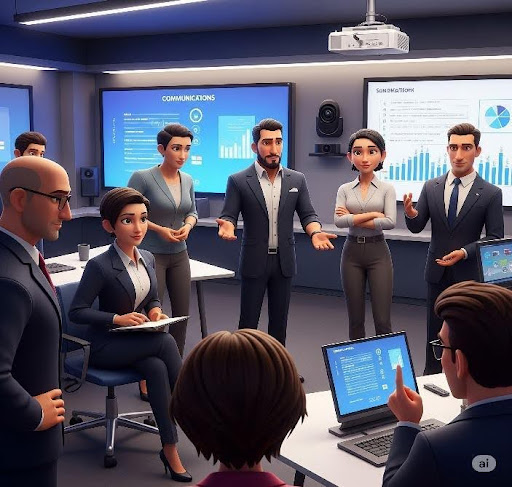
Article: Communication Skills Training for Professionals
In today’s fast-changing world of work, mastering communication and interpersonal skills is an essential toolkit. A truly gifted communicator is not only able to build relations but also to translate conflict into opportunity. When professionals with the capacity for great interpersonal skills, such as behavioral/personality diversity, possess a professional toolkit, they experience measurable gains in collaboration, leadership presence, conflict resolution, and overall self-efficacy levels. This article examines why such training makes a difference, what type of training and formats work best, and how to apply these training formats to further your career.
What Makes Great Interpersonal Communicators Different?
Great communicators in the workplace are like great teachers – they are individuals who help people understand and support so that the information they are sharing is not just communicated, it is understood. Whether it is communicating a strategy to their team, persuading a group of stakeholders to support their project, or providing positive feedback, great communicators use words that are clear, consistent, and caring. They are not just communicating; they are communicating information that is logically ordered, contains appropriate context, and is put into a frame that is aware of how their audience understands or interprets it. This is priceless in the workplace. Teams need clarity. Ill communication creates wasted time, distrust, and unnecessary conflict. When a great communicator is intentional with their words, they become a conduit between departments and between leadership and execution, and between a vision and its manifestation in action. More importantly, great communicators do not merely talk well; they listen well. They ask questions that evoke the root of problems, they interpret non-verbal situations with care in all settings, and they create psychological safety that encourages exchanges to occur openly. Their work pattern minimizes misunderstanding and creates a tone of mutual respect. Essentially, they create a clear difference between issuing an order and a direction. Between presenting data and telling a story with it. Between simply being heard and being understood. Strong professional communication is about putting your mind where your mouth is—expressing thoughts with intention, delivering messages with purpose, and ensuring every conversation moves people forward. When communication becomes a leadership tool rather than just a transactional activity, that’s when careers grow, teams align, and organizations succeed. Moreover, leadership programs from Bocconi, INSEAD, and ESCP business schools now embed behavioral skills training—many around communication and interpersonal skills—because recruiters increasingly prioritize “kindness, humility and managerial presence” alongside technical know-how.
Workshop formats that deliver:
- Short retreats and experiential simulations
In the health and counselling sector, there have been international initiatives to uphold the standards of good communication. One such initiative is the Calgary-Cambridge model. This has shown substantial improvement in self-efficacy and application of the new skills.
- Drama and roleplay intensives.
In the technical training of medical news, one factor that is often overlooked is sustaining empathy alongside the technicalities of the profession. In Montpellier, the students often engage in drama–based workshops to help them deliver difficult news.
- Online simulations
Another model combines AI-driven rehearsal with immediate expert-style feedback; this is possible because of the newest innovations in IMBUE. Using this, we have seen a boost of 27% in self-efficacy and 17% better skill mastery compared to control groups.
- Student-centered workshops
Curriculum at universities that integrates reflective practice, small group dynamics, and peer feedback in their courses helps bring about sustained improvements in the communication styles of the students. Students who engage in such courses often turn out to be more confident, listen carefully, and become less shy expressing their discipline-specific context.
What are the features of these workshops?
Experiential learning that closely imitates real life and utilizes role-play, simulation, and real feedback engenders higher awareness and confidence and behaviors with higher levels of rehearsal. Experiential learning activities that reflect empathy and active listening, and enhance trust and resilience in a work environment. Of particular benefit are structured frameworks like SACCIA (Sufficiency, Accuracy, Clarity, Contextualization, and Interpersonal Adaptation) can encourage participants to move towards more clarity and decrease misunderstanding. The hybrid model also promotes skill acquisition along with flexibility.
How to integrate these skills into your profession?
Communication workshops will offer you much more than the development of skills to present concepts. You will not only build your confidence in addressing difficult conversations, expressing your ideas clearly, and presenting yourself with confidence and credibility. For a young professional, this can look like developing confidence in showing up in meetings or interviews; for a mid-career individual, this can mean effectively delegating tasks, resolving conflict, and influencing other professionals in cross-functional teams. Communication becomes more than a skill set; it becomes your professional signature.
Conclusion
If you want to advance professionally—and maximize each connection—focus on developing your communication skills and interpersonal skills through excellent courses and workshops. Through research, we know that quality, structured, and feedback-oriented training doesn’t just teach us; it changes us, increasing self-efficacy, empathy, and effectiveness in complex conversations. When we know how to communicate skillfully as second nature, professionalism is not merely an aspirational value – it’s how we live every day. Such competence is the ultimate asset; develop it—your career will appreciate it!
❓ Frequently Asked Questions: Communication Skills Training for Professionals
- What is communication skills training for professionals?
Communication skills training for professionals is a structured program designed to enhance verbal, non-verbal, and written communication in workplace settings. It helps professionals express ideas clearly, listen actively, and collaborate effectively. - Who should enroll in communication skills training for professionals?
This training is ideal for early-career professionals, team leaders, managers, and anyone looking to improve workplace interactions, leadership presence, and conflict resolution abilities. - What topics are covered in communication skills training for professionals?
Topics typically include active listening, public speaking, non-verbal cues, business writing, emotional intelligence, and digital communication etiquette. - How does communication skills training for professionals improve career growth?
By mastering communication, professionals gain confidence, build stronger relationships, and become more persuasive—leading to better performance reviews, promotions, and leadership opportunities. - Is communication skills training for professionals available online?
Yes, many institutions offer online communication skills training for professionals through live sessions, self-paced modules, and AI-powered simulations for flexible learning. - How long does communication skills training for professionals usually take?
Programs range from short workshops (1–2 days) to extended courses (4–6 weeks), depending on the depth of content and delivery format. - What are the benefits of communication skills training for professionals in remote teams?
It helps remote professionals communicate with clarity, reduce misunderstandings, and foster trust across digital platforms and time zones. - Can communication skills training for professionals help with public speaking anxiety?
Absolutely. Many programs include role-play, feedback, and coaching to help professionals overcome fear and speak confidently in meetings or presentations. - What frameworks are used in communication skills training for professionals?
Models like SACCIA (Sufficiency, Accuracy, Clarity, Contextualization, Interpersonal Adaptation) and Calgary-Cambridge are often used to structure effective communication. - How do I choose the right communication skills training for professionals?
Look for programs with experiential learning, expert facilitators, personalized feedback, and alignment with your career goals and industry needs.
References:
- https://pollackpeacebuilding.com/effective-communication-skills-training/
- https://professional.dce.harvard.edu/blog/8-ways-you-can-improve-your-communication-skills/#1-Be-clear-and-concise
- https://www.rieti.go.jp/jp/publications/dp/19e045.pdf?utm_
- https://www.ft.com/content/ed3fb3f2-abb4-43fc-8031-843152dcfc4b?utm_
- https://www.sciencedirect.com/science/article/pii/S0738399120304596?utm_
- https://www.lemonde.fr/en/science/article/2024/05/27/how-do-you-deliver-a-cancer-diagnosis-medical-students-train-in-empathy-in-drama-workshops_6672766_10.html?utm_
Penned by Himangi Kapoor
Edited by Ragi Gilani, Research Analyst
For any feedback mail us at [email protected]
Streamline Your Hiring with Eve Placement’s Custom Assessments
Eve Placement helps you engage, assess, and recruit top talent through tailored hiring challenges that go beyond resumes. From technical quizzes and real-world case studies to psychometric evaluations and audio/video submissions, our platform enables smarter, data-driven hiring decisions. Advanced security features ensure authenticity and eliminate fraud, giving you reliable results. Ready to hire better? Know More.
Mail us at [email protected]