
Importance of Networking
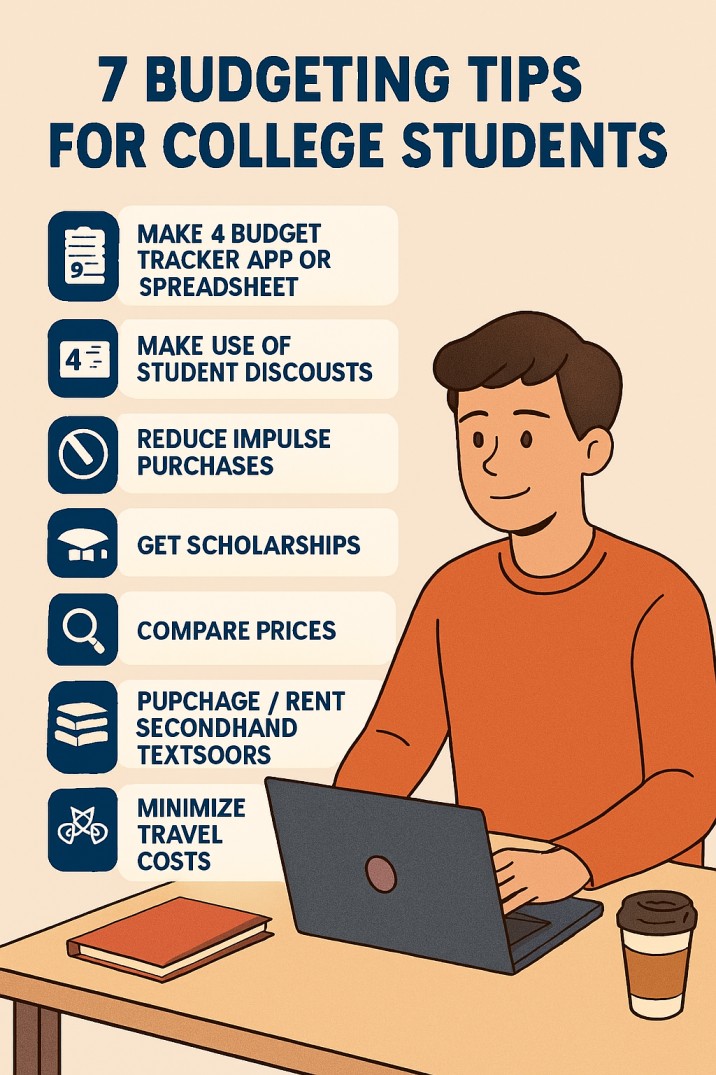
Article: college student budgeting tips
Budgeting is an important financial skill, college and university students in particular, have many expenses to cover and strain to meet more expenses using fewer sources of income. Luckily, budgeting may be worth it when you use tested and proved tips on saving, which are aimed at meeting the needs of students who concentrate on their post high school education.
This article explains the top seven financial plans to college students and how to work out a feasible budget during college life.
- Make A Budget Tracker App or Spreadsheet
In order to learn to spend less than you earn, the first and the best measure that you can take towards a budget is by developing the habit of monitoring your money in and out. This way, you will get to know more about your usual spending habits and on how you can utilize your money more efficiently. You will not spend excessively on what you want as opposed to what you need. There are two ways that you can track your income and expenses, a budget-tracking app or a traditional spreadsheet. In whichever you decide, the more vigilant you can be in tracking each dollar, the sooner you will see an upward shift in the health of your finances.
2.Make Use of Student Discounts
As a student, there are numerous financial commitments you will face, however; your student ID also has money saving benefits that positively impact your personal finance. As a student, you are able to get big discounts in retail stores, movie theatres and any other place that participates in the deal. When it comes to purchasing their products, most leading technological firms such as Apple and Microsoft also provide massive discounts when the purchase is being done as a student.
- Reduce on impulse purchase
The issue of impulse buying is a huge challenge to everyone considering how convenient it is to make purchases on the internet. As a student, however, you must exert extra caution when it comes to such impulse purchases because it may just end up chewing on the expenses of what you must have. One of the best saving money skills to use as a student is shopping and listing the items you believe that you want to buy and waiting 30 days. After a month check back on your list and provided that you still desire or need and have money to spend go ahead and purchase it.
Waiting gets out of your breast of decisions about spending your money and by doing so leads you towards making better choices.
- Get scholarships
India has a good scholarship system whereby students have the chance to economise on tuition in the country. It is as simple as that, filling out an application.
Besides that, there are numerous school-based scholarships that are available to any kind of student. You will have an opportunity to find opportunities in:
- adult learners,
- students in the middle of their careers,
- part time ones, and
- geographically located students.
Scholarships are able to operate in a variety of manners. Some will cover your school fees, others school transport and living cost, some covering technological necessities, etc.
- One should always compare and watch prices
Stop penny-pinching, and execute a comparison of the prices of products or services by use of websites such as Idealo and camelcamelcamel. They monitor prices and make you aware of good or bad price tags on the currents, or whether the price is going to fall.
Whereas camelcamelcamel only runs on the Amazon webpage, Idealo also contains prices of hundreds (probably thousands) of online shops. This implies that besides monitoring the price change over time you can also use Ideal to know where it is cheapest.
- Purchase / Rent secondhand Textbook
The cost of new textbooks may consume a lot of your school budget. Therefore, rather than buying them at the full price, think of some more economical ways of getting them such as acquiring or renting second hand versions. Contact upper year students or look online at sites where people or bookshops are selling used copies of the textbooks you require.
- Minimize travel costs
One of the highest costs students incur is travelling and although one may choose to ease the burden of travelling by being dependent on a car or public transport, he or she will accumulate the transport invoice faster than he or she can handle it unless he or she has a master plan. Therefore, it is prudent to have your accommodation depending on your proximity to your campus, and in the event that you can walk or ride a bicycle to university on a daily basis, you will save a lot of transport costs. Investigating student discounts on public transport including the 16-25 railcar should also be considered to help reduce costs when it comes to paying to attend university.
Conclusion: A Realistic Budget of a College Student
All college students do not have the same budget. There is no greater way of having one that is effective and manageable but by a tracking of the spending behaviour alerting you of the areas where you are overspending and then the allocation of funds to your established spending behaviour. This strategy will enable you to design a financial plan to suit your unique needs irrespective of whether your finances are not the same as those of other college students or not.
Penned by Priyanka Bhambhu
Edited by Shashank Khandelwal, Research Analyst
For any feedback mail us at [email protected]
Streamline Your Hiring with Eve Placement’s Custom Assessments
Eve Placement helps you engage, assess, and recruit top talent through tailored hiring challenges that go beyond resumes. From technical quizzes and real-world case studies to psychometric evaluations and audio/video submissions, our platform enables smarter, data-driven hiring decisions. Advanced security features ensure authenticity and eliminate fraud, giving you reliable results. Ready to hire better? Know More.
Mail us at [email protected]