
One Bowl, 6 Feelings: What Mango Pachadi Teaches Us About Life on Tamil New Year
Published: Jun 23, 2026
Key Points
- Tamil New Year wants you to accept all feelings, not just the good ones. Unlike New Year's plans that want everything to be perfect, Mango Pachadi shows you that you can feel sad, surprised and bitter along with happy.
- Neem flowers show that bitter things can make you strong. The same bad taste that makes you frown also helps clean your blood, reduces swelling and gets your body ready for times.
- You cannot remove the parts of life; you can only add enough good things to get through them. This is, like emotional intelligence. Understanding your pain, not ignoring it.
- Grandmothers are depicted as philosophical figures who use food to express acceptance rather than avoidance of life’s difficulties.
- The preparation blends ingredients like jaggery, raw mango, neem flowers, and spices, creating a dish that is both symbolic and nutritional.
- The story emphasizes that embracing contrasting flavors teaches resilience and balance, turning a festive meal into a reflective practice.
Introduction
Let me tell you a story. It is April, in a Tamil household. The sun shines very bright by 8 AM. The kitchen is full of activity. My grandma is carefully grating a block of jaggery. My mom is chopping mangoes that’re so sour they make your face scrunch up. On a plate there are some neem flowers. These neem flowers are bitter they are pale green. They smell like medicine.
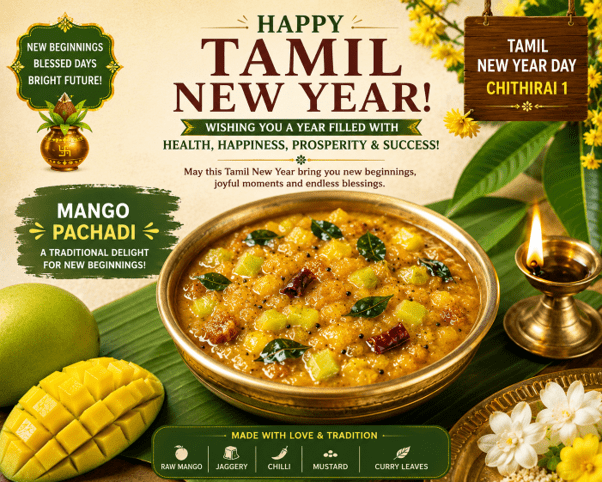
The star of the feast is not rice or crispy vadai. The star of the feast is Mango Pachadi. If you have never tasted Mango Pachadi imagine someone mixing lemonade, dark chocolate chilli flakes and cough syrup in a jar. This sounds very weird right? That is the point of Mango Pachadi. Mango Pachadi is special because it has different tastes.
The Day the Calendar Changes and So Does Your Plate
Here’s a backstory. Unlike New Years on January 1st the Tamil New Year happens in April. It is a harvest festival, a spring-cleaning day and a spiritual reset all in one. What makes Puthandu special is that you do not just celebrate you eat your destiny. Before eating payasam or spicy kuzhambu you have some of Mango Pachadi.
Puthandu is the Tamil New Year where people come together with family and friends to celebrate a new year. It is the season for payasam and kuzhambu. Mango Pachadi is a traditional dish that is eaten during the Puthandu festival. Mango Pachadi is a tangy dish made with mangoes, eaten for good luck and prosperity in the new year.
What’s Actually in That Bowl?
Let me break down what’s in Mango Pachadi. This is where the magic is. In the Siddha system of medicine, there are six tastes. Arusuvai. Each taste corresponds to elements that have effects on the body and mind.
Here’s how they show up in the bowl:
-
Sweet comes from melted jaggery and ripe mango. That’s your happiness, your promotion, your wedding day.
-
Sour comes from mango and tamarind. That’s the surprise layoff, the tyre, the friend who ghosts you.
-
Bitter is the neem flower.
-
Pungent is chilli and fresh ginger. That’s the argument with your sibling, the restless anger, the fire that clears the air.
-
Astringent comes from raw mango skin and turmeric. It dries your mouth like an unripe banana. That’s Tuesday, the routine, the days.
-
Salty is rock salt. That’s your breathing, waking-up baseline.
Now here’s the thing. Most dishes have one-star flavour. Mango Pachadi puts all six tastes together.
Why Tamil Grandmothers Are Secretly Philosophers
I watched my own grandmother make this dish & said, “You can’t take the bitter out, you can only add sweet to carry it.” That’s intelligence on a spoon. We spend most of our lives trying to engineer happiness. We curate our social media feeds to avoid posts we avoid conversations we numb the bitter with TV, shopping or wine.
Mango Pachadi refuses to lie. It says: you will taste sorrow this year, you will taste confusion, you will taste afternoons. That’s not a bug in the system, that’s the recipe. The Siddha principle of “Unavae Marunthu” says that food itself is medicine. The wildest part? When you eat the thing together. The jaggery coats the neem, the sour mango cutting through the pungent chilli. It actually tastes good, not fake-good, real-good.
Your Body Gets the Lesson Too
This isn’t fluff. There’s science in that pot. Raw mangoes have vitamin C and anti-inflammatory properties. The spices used in Pachadi, turmeric and mustard seeds have inflammatory compounds. Neem has bioactive potential. Studies have identified compounds in neem leaves. The same bitterness that teaches you resilience is also an agent. So the dish heals your body while preparing your mind. That’s what I call efficiency.
How to Make Your Bowl of Life
You do not have to be Tamil to try this recipe you do not have to wait until April to make it. Just try the mango recipe once. The mango recipe is really strange. To make this mango recipe, you add half a cup of jaggery and a little bit of rock salt, to the mango mixture. You have to stir the mango mixture until the jaggery is all melted.
In a pan you heat some coconut oil. Add mustard seeds and a chilli and asafoetida and curry leaves to the coconut oil. This is the part of the mango recipe: you have to add one tablespoon of dried neem flowers to the pan. The mango recipe needs these dried neem flowers. Let neem flowers crackle for ten seconds in the pan.
Pour this tempering into the mango mix simmer mango recipe for five minutes. Taste the mango recipe you might grimace at the mango recipe, then you might smile at the mango recipe. Taste the mango recipe again. The first bite of the mango recipe will confuse you. The second bite of the mango recipe will challenge you.
By the time you have the third bite of the mango recipe, you might understand something about the mango recipe that your brain could not put into words
Frequently Asked Questions
1. What is the significance of this traditional festival dish?
It represents the idea that life contains many contrasting experiences, all of which must be accepted together. The preparation symbolizes balance, where pleasant and challenging moments coexist rather than being separated or ignored.
2. Why are multiple tastes combined in one preparation?
The combination reflects an ancient wellness philosophy that associates different flavors with emotional and physical states. Bringing them together in one bowl illustrates the unity of joy, struggle, calmness, and intensity in human life.
3. What does the bitter element represent in the dish?
The bitterness symbolizes difficult or uncomfortable experiences. Instead of being removed, it is included to acknowledge that growth often comes through challenges that are not immediately pleasant but are meaningful.
4. How is this food connected to emotions?
Each flavor is linked to a feeling or life situation, turning eating into a reflective act. The experience encourages awareness that emotions shift constantly, much like the changing tastes on the palate.
5. Is this preparation considered nutritious?
Yes, it includes ingredients with beneficial properties such as raw fruit rich in vitamins, natural sweeteners, and spices known for digestive and anti-inflammatory qualities, making it both symbolic and health-supportive.
6. When is this dish traditionally consumed?
It is typically eaten at the start of the new calendar cycle in Tamil households. It serves as the first taste of the year, setting a tone of acceptance and mindfulness for the months ahead.
7. What are the essential ingredients used in it?
Key components include unripe fruit, jaggery, rock salt, neem flowers, mustard seeds, curry leaves, and spices. Each ingredient contributes a distinct flavor profile and symbolic meaning.
8. Can this preparation be made outside of festival time?
Yes, it can be prepared at any time of the year. Many people recreate it as a mindful dish to reflect on balance, emotional awareness, and seasonal cooking traditions beyond celebrations.
9. What is the cultural philosophy behind this food tradition?
It is rooted in the idea that food is not only nourishment but also a form of teaching. Eating becomes a way to understand acceptance, impermanence, and harmony between contrasting life experiences.
10. Where can one find a reference for this traditional preparation?
Detailed versions of this recipe and its variations are documented in traditional cooking archives such as community food blogs, including regional culinary resources that preserve South Indian festive dishes.
Citations & References
[1] Padhu, “Mango Pachadi-Tamil New Year Special,” Padhuskitchen, Apr. 10, 2011. [Online].
Available:
https://www.padhuskitchen.com/2011/04/mango-pachadi-tamil-new-year-special.html
[2] EvePlacement. [Online].
Available:
https://eveplacement.com/
Streamline Your Hiring with Eve Placement
Engage, assess, and recruit top talent through tailored AI hiring challenges that go beyond resumes. Ready to hire better? Contact our research team for a custom consultation.