
7 UNSTOPPABLE SHIFTS: International Talent Mobility and the Struggle for Global Hubs
Published: Apr 1, 2026
Key Points
- International talent mobility has become a primary driver of economic innovation and is forcing global cities to compete as magnets for specialized skills.
- Highly skilled migration is currently hindered by rigid visa regimes and a lack of international credential recognition which leads to significant brain waste.
- Successful global hubs must look beyond high salaries to offer inclusive cultures, family support systems, and clear pathways to permanent residency.
- Modern migration is shifting from a one-way brain drain to a fluid brain circulation where knowledge and networks flow across borders.
- In an era of remote work and digital transformation, the most successful hubs will be those that understand talent no longer just arrives but chooses where to stay.
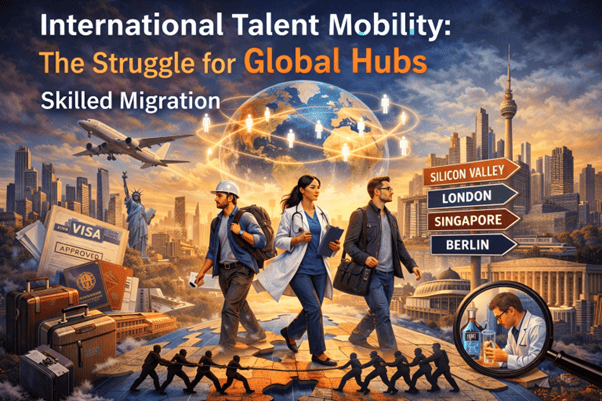
Introduction: A World on the Move
International talent mobility has subtly emerged as our generation’s defining narrative: professionals are bringing more than just luggage across the globe and continents. They are bringing talent, dreams and the hope for a better life. The phenomenon of talent migration is changing the economy and redefining what it means to be a global hub, whether it is engineers, physicians, researchers, designers, or entrepreneurs.
Yet, this movement falls quite short of being smooth. While world-class cities and countries are competing fiercely in order to hire the best talent from around the world, professionals are finding themselves caught up in visa restrictions, adjustment to culture, issues regarding professional recognition and emotional compromises.
The struggle for global hubs is not just about policies and pay packages-it is about people, belonging and long-term opportunity.
This article examines international talent mobility: The Struggle for Global Hubs, analysing the relevance of highly skilled migration, what is going well and what is going wrong in global hubs and ways to design systems for both migrants and the economy to thrive.
The Need for Understanding International Talent Mobility
Essentially, international talent mobility is the process of individuals travelling across the globe for employment, research, and even educational pursuits. In most cases, migration is driven by the need for survival. In the case of skilled migration, it is often for the purpose of opportunities presented by advances in infrastructure, innovation, and exposure.
Global centres such as Silicon Valley, London, Berlin, Singapore, Toronto, and Bengaluru succeed because these cities function as magnets for these talents. They provide a concentration of employers, investors, institutions, and ideas. However, with the growing demand for talent across the globe, there is stiffer competition to be among the global cities.
Why Global Hubs Are Fighting Harder Than Ever?
The competition for worldwide hubs is founded on one basic truth: Talent drives growth. What drives an economy is talent; countries with a high influx of talent are always going to be more innovative, more productive.
Several factors are propelling this struggle forward:
-
The portability of skills in digital transformation is of worldwide importance.
-
Demographic imbalances also imply that some nations have a greying population due to old-age problems when it comes to productivity and youth vs. experienced talent utilisation.
-
Shifts in post-pandemic mobility have changed how people evaluate work-life balance, stability, and purpose in their lives.
Consequently, international talent mobility has shifted from the sidelines to a prominent position in the strategy.
The Human Side of Highly Skilled Migration
Although the discourse on this topic may emphasise figures, visas and GDP, the situation of a professional moving across international borders involves a lot of excitement and a sense of uncertainty. There are professions rebuilt, skills recalculated, and even identity reconstituted.
For some people, it’s not an issue of capability; it’s an issue of recognition. Engineers driving cabs, scientists in junior research roles, doctors waiting for licenses,” the kinds of things that happen because the global hotspots haven’t been able to integrate their talent in a meaningful way.
A successful hub means more than bringing in talent, helping it belong, grow, and remain.
7 Ways to Enhance International Talent Mobility
In response to these challenges for global hubs, governments, institutions, and employers must turn good intentions into action for change. Below are seven action steps, using figures, which have a real impact:
-
Simplify and Humanise Visa Systems
Long and complex visa regimes remain a major obstacle for highly skilled migration. International hubs require a clear, predictable and time-bound migration process that balances the need for security with the need for urgency.
-
Recognise Global Credentials Faster
Credentials and work experience that are not recognised promptly can squander talent. Recognition of credentials and skills can assist professionals in contributing to a field more quickly.
-
Promote Inclusive Workplace Culture
It is rather pointless to attract talented staff worldwide if the working environments that they enter are not welcoming. Programs for mentorship, cross-cultural training, and diversified management are all those that make a sudden influx of migrants feel valued rather than tolerated.
-
Supporting Families, Not Just Workers
International talent mobility may go awry when families are facing a struggle. Education, medical, employment, and integration are essential to retain them.
-
Invest in Local-Global Skill Bridges
The global hubs should avoid transplanting the skills of local talents into the global hub. Rather, the global hubs should work as bridges of knowledge.
-
Promote Regional and Not Only Elite Centres
Crowded megapolises have lost their appeal. The emergence of secondary cities as global hubs will spread opportunities and alleviate demand related to housing, infrastructure, and cost of living.
-
Provide Clear Paths to Stabilisation
“Temporary visas are temporary,” says one report, “and their residents are permanent.” Permanent anxiety is thus generated by temporary visas. Permanent pathways for residency or citizenship stand as a backbone of confidence for skilled migrants wanting to emotionally and economically commit to their new homes.
The Uneven Geography of Opportunity
Not all nations start the competition for the role of global hubs on an equal playing field. Countries with developed economies easily lure the brightest and the best minds in their countries, but find it difficult to integrate them into their operations. Countries with emerging economies produce plenty of skilled human capital but lose it either due to poor retention strategies or the countries’ inability.
This trend leads to many questions. Is skilled migration a brain drain or a brain circulation? The increasing trend is increasingly being sandwiched between the two extremes. Today, professionals have international networks and work across frontiers. They often return home after acquiring new knowledge.
Smart policies understand the flow, rather than swimming against the tide.
Technology and the Future of Talent Mobility
The trend of remote working has brought a new dimension to the concept of international talent mobility. It has resulted in professionals making their contributions across the world without having to migrate.
Nevertheless, physical hubs are still relevant. Innovation is driven by proximity, trust, and culture. This is where flexible hubs come in – regions with physical ecosystems with digital openness.
Challenges Global Hubs Face
Despite these advances, competition for global hubs continues to be very strong. Increasing costs of living, lack of housing, polarised politics, and restrictive immigration policies pose challenges to openness.
We are witnessing, too, a debate of growing seriousness on an ethical issue: Is it right for rich countries to continue recruiting active professionals from countries that are in the greatest need of them? There is a need for cooperation here, rather than extraction.
Educational partnerships, circular migration schemes, and collaborative research ventures are more equitable approaches.
Conclusion: Rethinking the Struggle for Global Hubs
From engineers, researchers, and healthcare professionals to designers and entrepreneurs, skilled migration is reshaping economies and redefining what it means to be a global hub from continent to continent. This has made international talent mobility the covert narrative of our times. They are carrying hope, knowledge, and aspirations to create better lives.
While professionals move across borders in search of opportunity, countries need to move across old ways of thinking in response. With talent treated with the same respect and given the same value, hubs around the globe will do more than succeed economically; they will be a source of collective advancement.
In a world that is characterised by movement, the future will be with those hubs that understand one basic principle: talent does not just arrive; talent chooses to stay.
Frequently Asked Questions
1. What is the core definition of international talent mobility?
International talent mobility describes the movement of high-level professionals across borders to contribute to global economic hubs. It encompasses the flow of researchers, engineers, and creatives who bring specialized knowledge to new markets.
2. Why is highly skilled migration considered a “defining narrative”?
Our era is defined by the rapid exchange of ideas. Highly skilled migration is the physical manifestation of this exchange, as experts move to where their talents can be most effectively utilized, reshaping the economies of both the source and destination countries.
3. How does international talent mobility impact local innovation?
When global hubs attract diverse professionals, they create “innovation clusters.” International talent mobility ensures that different perspectives collide, leading to breakthroughs in technology and medicine that wouldn’t happen in a homogeneous environment.
4. What are the biggest risks to successful highly skilled migration?
The primary risks include “brain waste,” where individuals cannot practice their profession due to licensing issues. If highly skilled migration is not managed with proper credential recognition, the economic potential of the individual is squandered.
5. Can digital tools replace physical international talent mobility?
While remote work allows for digital collaboration, physical international talent mobility remains vital. Proximity in physical hubs fosters trust and spontaneous mentorship that digital platforms cannot yet fully replicate.
6. What role does policy play in highly skilled migration?
Policy is the gatekeeper. Governments that streamline visa processes and offer paths to residency create a competitive advantage in the race for highly skilled migration, making their nations more attractive to top-tier talent.
7. How do “global hubs” compete for international talent mobility?
Hubs compete not just with salary, but with “livability.” Successful international talent mobility depends on a city’s ability to provide affordable housing, safety, and inclusive cultures that make a professional feel at home.
8. Is highly skilled migration ethical?
There is an ongoing debate regarding the “extraction” of talent from developing nations. Ethical highly skilled migration should focus on “circulation,” where knowledge and investment eventually flow back to the professional’s home country.
9. What is the “human side” of international talent mobility?
Beyond the data, international talent mobility involves the lived experience of moving families and adapting to new cultures. Success is measured by how well a migrant integrates and finds a sense of belonging in a new society.
10. What is the future outlook for highly skilled migration?
The future will likely see more regional hubs emerging. As secondary cities improve their infrastructure, highly skilled migration will spread beyond megacities, creating a more balanced global distribution of opportunity.
Streamline Your Hiring with Eve Placement
Engage, assess, and recruit top talent through tailored AI hiring challenges that go beyond resumes. Ready to hire better? Contact our research team for a custom consultation.