
Stock Market Fundamentals: Navigating Equity Markets
Published: Jul 7, 2026
Key Points
- When you invest in the stock market you are buying a piece of a business. Remembering that you are buying a piece of a business helps to cut through most of the noise about the stock market.
- Simple things usually work better than things. Low-cost index funds have done better than active strategies in the stock market over a long time.
- Your biggest enemy is your reaction to changes, in the stock market. The stock market will go down sometimes.
- Index funds provide an efficient, low-cost way to diversify across many companies and protect against individual failures.
- Volatility and market drops are a natural feature of investing rather than a flaw, making emotional discipline your most critical defense.
Introduction
A lot of people come to the stock market with two contradictory feelings at once. There is the pull of it – stories of wealth built over time, the sense that this is where money actually grows – and the anxiety of not quite understanding the rules of a game that everyone else seems to be playing already. That combination tends to produce one of two outcomes: people dive in impulsively, or they put it off indefinitely.
Neither is ideal. And the frustrating thing is that the basics of how equity markets work are genuinely not that complicated. The complexity tends to come later, and most of it is optional. What you actually need to understand to start investing sensibly fits in a few clear ideas – and none of them require a finance degree.
What you are actually buying
When you buy a share of stock, you are buying a small piece of a real company. If the business does well over time, the value of your stake tends to go up. If it does not, it tends to go down.
That connection between business performance and share price is real, but it is not instant or perfectly tidy. Markets are also driven by what investors expect to happen – not just what already has. A company can post solid profits and still see its stock fall if those profits were lower than expected. Another company can be unprofitable and trade at a high price because investors believe the future is bright enough to justify it.
What you are actually buying
When you buy a share of stock, you are buying a small piece of a real company.If the business does well over time, the value of your stake tends to go up. If it does not, it tends to go down.
That connection between business performance and share price is real, but it is not instant or perfectly tidy. Markets are also driven by what investors expect to happen – not just what already has. A company can post solid profits and still see its stock fall if those profits were lower than expected. Another company can be unprofitable and trade at a high price because investors believe the future is bright enough to justify it.
How prices actually move
Stock prices move because people are constantly checking what a company is worth based on new information. When more people want to buy a stock, the price goes up. When the reverse is true, it goes down.
In the short term, this can produce moves that seem completely disconnected from any rational basis. Fear and optimism both overshoot. Entire markets can trade at prices that, in hindsight, made very little sense. Over longer periods, though, prices tend to find their way back to something that reflects the underlying reality of the businesses involved. This is why the time horizon you bring to investing matters so much.
The simplest approach
Some people genuinely enjoy the process, and some do it well. But for most people, it is neither necessary nor the most effective use of time.
Index funds – funds that simply track a broad collection of companies, like all the large businesses listed in a given country or region – have consistently performed as well as or better than the majority of actively managed alternatives, at a fraction of the cost. They work not because they are clever, but because they give you exposure to a wide range of companies so that no single failure damages your overall position.
Risk is part of the deal
One thing that puts a lot of people off equities is the fact that prices go down, sometimes sharply and without much warning. Markets have fallen by a third, by half, by more – and they will again at some point. This is not a flaw in the system. It is the nature of owning something whose value is determined by the future. If stocks were safe in the short term, they would not need to offer higher returns to attract investors. The volatility and the return are two sides of the same coin.
A few things tend to hold regardless of individual circumstances:
-
Time horizon is everything.
-
Spreading across many companies and regions reduces the damage any single bad outcome can do to your overall position.
-
Costs compound quietly against you. A fund charging one percent a year more than a cheaper alternative takes a significant chunk of your returns over a long period.
The part nobody talks about enough
The most useful defence is not telling yourself you will be different. It is building a process that reduces the number of decisions you have to make in the heat of the moment. Automated contributions. A clear written plan for what you own and why. A rule against checking your portfolio daily. None of this sounds sophisticated, but it works – because it takes the emotional moments out of the equation before they happen.
Conclusion
Investing in the stock market is not about being the best. It is about showing up every day keeping costs low and having the patience to let time work for the stock market. Most people who build wealth through the stock market do not do it by making brilliant calls. They do it by making sensible decisions early and then mostly staying out of their own way when it comes to the stock market.
Frequently Asked Questions
1: Is the stock market safe for beginners?
Short-term volatility is completely normal, but financial history shows that the stock market reliably rewards disciplined, long-term investors who stay the course.
2: How does a diversified investment portfolio help?
A diversified investment portfolio spreads your investment capital across various sectors, successfully minimizing the severe damage that a single-company failure can cause.
3: What is the easiest way to invest?
Broad, low-cost index funds offer an incredibly simple and effective path into the stock market without requiring complex individual stock-picking strategies.
4: How often should I check my returns?
Try to avoid checking daily; a solid investment portfolio performs much better over time when left to grow entirely quietly without emotional interference.
5: Why do stock market prices fluctuate?
Prices shift constantly because market participants evaluate new information, economic reports, and changing stock market trends to determine the real-time company values.
6: Can index funds beat active managers?
Yes, tracking the broader stock market via low-cost index funds consistently outperforms the majority of active management alternatives and choices over long periods.
7: What causes major stock market downturns?
Sharp declines happen when short-term fear overshoots rational economic realities, triggering rapid, emotional selling cycles across the entire financial system.
8: How do fees impact long-term growth?
High investment management fees compound quietly against your principal, ultimately consuming a highly significant chunk of your final portfolio returns over time.
9: Are short-term drops a system flaw?
No, price volatility is a natural feature required to attract investors by offering higher potential long-term rewards than much safer financial alternatives.
10: When should I start buying equities?
Since your specific time horizon matters most, starting out as early as possible gives your growing assets maximum time to compound smoothly.
Citations & References
[1] Basics of Stock Markets, National Stock Exchange of India. [Online].
Available:
https://www.nseindia.com/
[2] Stock Market Investing for Beginners, Investopedia. [Online].
Available:
https://www.investopedia.com/
[3] A. Damodaran, Investment Valuation: Tools and Techniques for Determining the Value of Any Asset, 4th ed. Wiley.
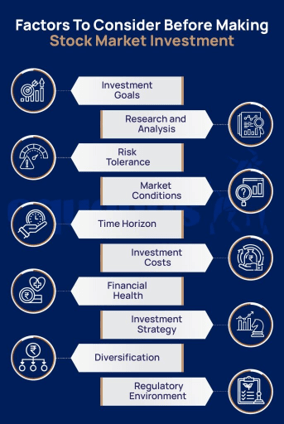
[4] Image Source – Factors to Take Care of before Making Investment Equentis.
[5] EvePlacement. [Online].
Available:
https://eveplacement.com/
Streamline Your Hiring with Eve Placement
Engage, assess, and recruit top talent through tailored AI hiring challenges that go beyond resumes. Ready to hire better? Contact our research team for a custom consultation.