
AI Research tools in Academic Writing: Benefits, Challenges, and Ethical Use
Published: Jul 9, 2026
Key Points
- AI research tools can streamline literature reviews and data synthesis, but they must be used as assistants rather than automated authors.
- Writing a thesis or dissertation demands months of meticulous steps, placing high pressure on researchers to maintain accuracy and meet strict deadlines.
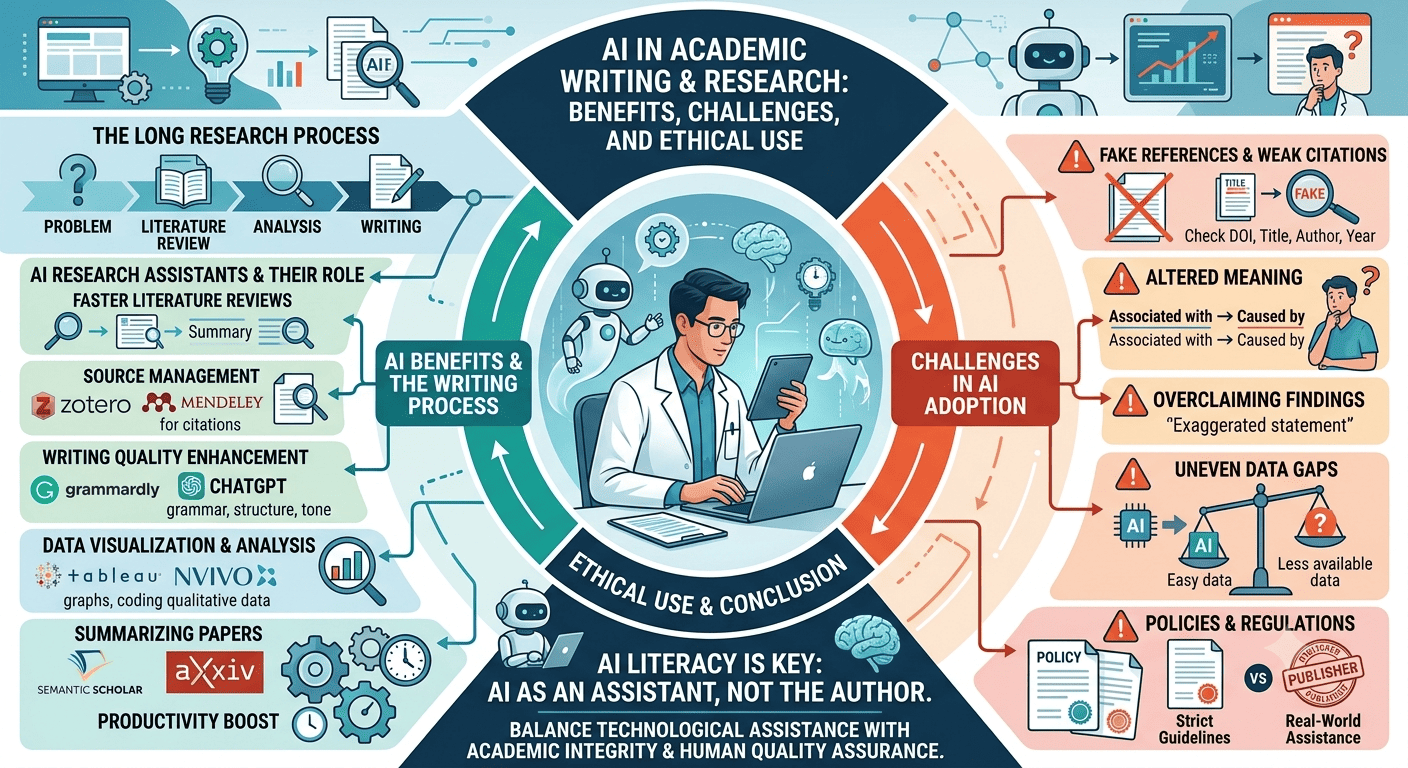
- While AI helps refine grammar and structural flow, it risks changing precise phrasing, such as swapping "associated with" for "caused by."
- A significant limitation of relying entirely on AI software is its tendency to generate fabricated references or suggest weak citations.
- Researchers must manually verify critical source identifiers like the DOI, author name, publication year, and abstract.
- The fundamental role of technology in modern education is to enhance human productivity rather than replace human critical thinking.
Introduction
Explore how AI research tools are transforming academic writing through faster literature reviews, writing support, and research assistance, while also raising concerns about fake references, weak citations, and ethical AI use.
Use of AI in the long process of Research and Academic Writing
Technology has changed almost every sector, and education is no exception. There are advancements like enabling learning environments with integration of digital technologies in classrooms, assistance in automation in several steps in doing research with the use of AI and easier access to digital libraries which makes it easier to learn beyond classrooms.
Writing is key in research and academia. Writings include theses or dissertations which require months of multiple steps of research. It involves a long process and steps like finding an area of the research, a topic, reviewing existing literature around the topic, finding gaps in them and identifying areas on which less data exists in the studies already conducted.
So there is large amounts of data and information that the students or researchers have to handle, often with a lot of pressure to publish. It does not only require going deep into the study but also being skilled in conveying the complex ideas and findings in simple to understand for the reader. There is also a lot of pressure of meeting high standards, accuracy, reliable evidence and deadlines.
It also requires keeping a tone which is formal and academic while also being engaging while reading and simple to understand. A proper structure is important in the writing which ensures a good flow of the text. Given all these requirements and complexity of the process of academic writing, AI has become an important tool in research such that almost nobody can think of doing research without using it.
Today almost every researcher with access to digital media uses AI-assistants in doing research and academic writing. It assists in grammar, structure, enhancing the language, finding references and maintaining disciplinary standards. They improve the quality of academic writing and enhance productivity.
AI assistants and their use in different tasks of the Research
AI assistants are research tools which automate the research process which includes evidence gathering, literature review and analysis across large document sets.
Tools like Zotero and Mendeley are highly used for managing literature reviews, organising sources and creating citations which integrate easily with word processing. For enhancing writing quality, there are popularly used tools like Grammarly and ChatGPT which help in grammar corrections and text generation.
For data analysis, Tableau helps in converting complex statistical data into visual formats that are easy to understand. Tools like ArXiv and Semantic Scholar help to access and summarise relevant academic papers. For qualitative data analysis, there are tools like NVivo which offer features like automated coding, sentiment analysis for large datasets.
Challenges and Limitations
There are many limitations that signal us to be careful in the use of AI in research. Research and academic writing is already a rigorous and a very long process which brings heavy workload for a long amount of time and a pressure to publish. As the use of AI is increasing, there are policies introduced by publishers for regulating the use of AI. However, these policies do not consider the true nature of AI assistance in research.
AI tools do not always ensure quality of the research and academic writing. These are helpful in editing and refining the language of the writing but one cannot carry the process of research rigorously and meticulously if done fully with the use of AI. Also while it makes the texts smoother and easier to understand, they can change certain words or phrases which can drastically change the meaning of your findings or sometimes overclaim statements. For example, it can change “associated with” to “caused by” in a sentence and it can raise confusions.
For literature review, AI tools do help in finding many sources freely available online but those also include references that are weak. These tools can also give fake references which might look convincing but would not be real or existing. So AI literacy is the answer when one uses AI tools in research so that they remain as assistants in our research and not become authors. So it is crucial to check DOI, title, author, year of publication and read the abstract to recognise whether the source is truly trustworthy and relevant to your research.
In some cases, AI tools can also suggest areas where there is more expectation of getting data easily while overlooking areas where less data is expected.
Conclusion
AI is transforming almost every field today and advancing our work by assisting in various aspects. However, AI is not here to replace humans in any of the fields, especially in education. The key is to use AI as an assistant while being careful of quality in every step of the research process and academic writing.
Frequently Asked Questions
1: What are the main benefits of using AI research tools in modern education?
AI assistants automate time-consuming processes like evidence gathering, literature analysis, and summarizing complex papers to boost overall efficiency.
2: Can software fully automate the process of academic writing?
No, AI tools cannot completely replace human input because they lack the capacity to carry out rigorous, meticulous, and deep original analysis.
3: How do digital research tools assist with managing literature reviews?
Applications like Zotero and Mendeley integrate with word processors to effortlessly organize sources, manage reference libraries, and generate proper citations.
4: Why do AI tools sometimes compromise the integrity of academic writing?
They can inadvertently alter specialized terminology, which risks overclaiming statements or distorting the exact meaning of your research findings.
5: What are fake references in AI-generated drafts?
Some language models fabricate plausible-looking citations that do not actually exist in real digital libraries or official academic databases.
6: How can scholars maintain high quality in their academic writing while using AI?
The key is treating AI strictly as a supportive assistant while manually verifying every single insight, claim, and structural layout.
7: How do I verify if a citation provided by digital research tools is real?
You must manually cross-check the DOI, publication year, title, and author, and thoroughly read the abstract to confirm its validity.
8: What impact do AI research tools have on qualitative data analysis?
Advanced tools like NVivo provide automated coding and sentiment analysis, helping scholars parse large textual datasets rapidly.
9: Do publishing houses allow the integration of AI in academic writing?
Many publishers have introduced specific regulation policies, though these guidelines sometimes fail to understand the true collaborative nature of AI assistance.
10: What is the most critical takeaway regarding AI use in school and research?
Technology is designed to transform workflows and improve language clarity, but it should never replace human accountability and oversight.
Citations & References
[1] M. Kremantzis and E. Pantano, “Can we use AI for academic writing? It depends,” Times Higher Education. [Online].
Available:
https://www.timeshighereducation.com/campus/can-we-use-ai-academic-writing-it-depends
[2] M. Khalifa and M. Albadawy, “Using artificial intelligence in academic writing and research: An essential productivity tool,” Computer Methods and Programs in Biomedicine Update, vol. 5, p. 100145, 2024. [Online].
Available:
https://www.sciencedirect.com/science/article/pii/S2666990024000120
[3] R. McCarroll, “Best AI Research Assistant Tools: How AI Is Transforming Academic Research,” AnswerThis. [Online].
Available:
https://answerthis.io/blog/ai-research-assistant-academic-research
[4] EvePlacement. [Online].
Available:
https://eveplacement.com/
Streamline Your Hiring with Eve Placement
Engage, assess, and recruit top talent through tailored AI hiring challenges that go beyond resumes. Ready to hire better? Contact our research team for a custom consultation.