
Pradhan Mantri Kaushal Vikas Yojana (PMKVY) Impact
Published: Sep 2, 2026
Key Points
- PMKVY has trained > 1.5 million individuals, but employment impact is highly heterogeneous across context; Sector characteristics, geography, training center quality, and training quality all drive dramatically disparate labor force outcomes.
- PMKVY has had measurable employment effects in some cases but yielded little returns in others. We find PMKVY had the largest employment impact in urban centers and industrialized states and in higher demand sectors of the economy, whereas impacts remained low in under-developed and rural areas as well as in already well-supplied sectors.
- However, the quality of training provided varied in quality dramatically on almost all criteria; the impact on trainees was significantly conditioned by the quality and instructor expertise of their center and the fact that the more than 2,000 training centers are decentralised and decentralised entities can produce vastly different quality.
- Training quality needs improvement more to address employment creation impacts than skill creation, for skills-development has in itself had huge success.
- Finally, broader labor market structure-limited opportunities for Formal-sector job creation, issues of discrimination based on gender, etc, geographic immobility- means there are likely limits on the maximum employment Creation Impact it can have if more cannot be done in order on the other front. There would be benefits to integrating with job-creation efforts, including getting the private sector more engaged.
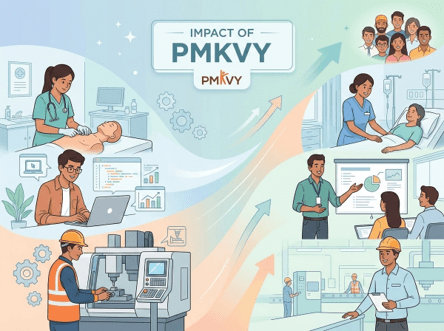
Introduction
India’s young population-about 400 million between 15 and 29 years of age-will be either an incredible resource or an insurmountable problem, depending on how effectively they find jobs and acquire the requisite skills. The Pradhan Mantri Kaushal Vikas Yojana (PMKVY), introduced in 2015, is the greatest and perhaps most innovative effort by the Indian government in the area of skill development, designed to create a pipeline of workers who can fill high-growth sectors of the labor market and simultaneously ease the burden of chronic and deepening underemployment and unemployment faced by millions of young Indians.
The primary aim of the program- short-term, market-responsive training for disadvantaged youth-is both of economic and productivity significance: it calls for market-relevant skill training for youth who otherwise would be unable to acquire them. About 1.5 million people have been trained under the PMKVY in a variety of skill types, ranging from construction, warehousing and retail sector training to healthcare, fashion design, catering and information technology.
But impact assessment uncovers deep intricacy. PMKVY skill training shows concrete employment results for some groups and little to nothing for others. Sub-national differences in program implementation, quality dissonance among training providers and individuals, and ongoing disconnect between skills and needs imply that increasing training intensity without quality controls produces, at best, uneven effects. Drawing conclusions about India’s youth’ employment prospects through PMKVY must go beyond graphing enrollment figures toward analyzing whether training success translates into stable employment, stronger earnings, and preeminent mobility.
1. Scheme Architecture and Implementation — How PMKVY Operates Across India
Two forms of PMKVY exist: short-term training, which takes on immediate skill shortfalls (short term in nature of about 3-6 months); and Recognition of Prior Learning certification, which tests skills acquired at workplaces and through informal apprenticeships.PMKVY covers economically weaker sections of society, especially from the socially backwards classes, rural poor, etc., as the prime targets, and 150+ skill categories that are defined under National Occupational Standards at approx 2000+ training centers of govt.
And private ones with Govt subsidy in the entire cost of the training and monthly stipends to trainees, to bring them closer towards employment and not creating impediments, by having them to spend. The program covers 28 states and 8 union territories through 2000 + Govt. And private institutions imparting training programs under the scheme, which decentralizes training so as to tune it according to the local conditions and skill demand that are local, which looks pragmatic and relevant for the problem of skill-employment gap that, as training reflects reality at ground.
This very advantage also has disadvantages, as the quality of training varies between training centers, which creates differential employment chances, as some centers succeed with a high success rate, some not. The success also depends on the level of available finance; high-powered training centers in urban areas perform better than ill-supported centers in remote and rural areas.
2. Employment Outcomes and Quality Variations — Measuring Success Realistically
Results on employment for PMKVY skill training level graduates are quite unpredictable and vast differences exist due to varying quality of training, specific characteristics of sectors, regional differences in labor markets, etc. Government estimates of placement rate-70-75% of trained individuals- hide the differences in quality between various sectors.
Some sectors-hospitality, construction, and healthcare-have been able to absorb the trained workforce in employment within a few weeks from certification completion, whereas others, which are facing labor surplus, have estimated placement of about 30-40% even after the training has been given. This variation in placement rate is precisely due to the fact that skill training has only helped individuals develop certain skills; however, unless they meet the requirements of demand in the labor market for which they are being trained for, they are not likely to be absorbed.
Further complications include the fact that quality of employment differs significantly. Some graduates find permanent employment with decent wages and room for career development. Others find opportunities in precarious employment, such as in the informal economy, with little financial security or valuable benefits.
The difference between employment and meaningful employment is very significant: a graduate working daily labor within the informal sector with a meager increase in income compared to a graduate working within the formal secto rwith a professional career development path.
Most government placement surveys mix both types together.
3. Regional Disparities and Rural-Urban Divides — Why Implementation Effectiveness Varies
Youth employment outcomes in Indian PMKVY thus vary significantly depending on whether they come from rural or urban localities due to differences in the complexity of labour markets and the capacity of training systems. Cities where large proportions of the working force are in highly organized manufacturing, service, and Information Technology (IT) sectors that are willing to hire trained individuals at a good rate often draw in trained workers. While in many rural settings lack of sufficient numbers of job at training levels.
This often compels young trainees from rural settings to migrate to urban settings or take up underemployment. This mismatch between areas of training and areas of employment significantly attenuates the outcomes of training. This phenomenon also varies by state’s development stage. States that had gained early on industrial development, like Tamil Nadu, Gujarat and Maharashtra, fare substantially better in post-training outcomes, measured in terms of the extent of training in this category vis-à-vis those less developed ones.
A training centre situated in an industrial hub is able to partner well with industries, aware of the demands and able to meet employer requirements, while another that lacks industry presence does not effectively engage industry, resulting in training individuals not really required locally even as there exists skill deficiency in particular localized skills, diminishing potential gains.
4. Quality Assurance and Trainer Competence — The Critical Missing Piece
An ongoing challenge of PMKVY relates to ensuring the quality of training provided through training centers. These centers are highly heterogeneous across several dimensions such as trainers’ knowledge, the quality of facilities available, and curriculum suitability with the market demand. For instance, certain centers have a strong association with employers that helps keeping training personnel updated about the latest market trends, whereas other centers employ instructors based on old syllabi, without practical industry knowledge or recent experience.
This variation of trainers’ expertise directly influences the competencies of students and their employment chances, given that graduates of knowledgeable teachers and trainers associated with current market trends have better employment prospects. In the context of the Indian job market, the Indian government cannot neglect to promote the employability of youth through an effective vocational training system; the overall well-being of young Indian people is determined by whether effective vocational training and development of skills provide the relevant competencies within the job market, as insufficient progress is found due to the quality of training infrastructure.
5. Skills-Employment Mismatch and Structural Labor Market Challenges — Beyond Training’s Capacity
PMKVY expansion alone cannot resolve structural labor market constraints-for instance, the Indian economy suffers from basic scarcity of good-quality, formal-sector employment opportunities whereby formal employment growth has desperately lagged the driving workforce; and where training is unlikely to be a remedy to what is otherwise a dearth of work. When training millions of people in a context of soft employment growth, the predicted consequence is-and remains-that it largely results in trained people ending up in squeezing jobs or not working at all.
Further, even if there is a skill deficit, there are social barriers to employment opportunities. Despite legislation prohibiting caste- or religion-based discrimination, gender bias, and regional bias, interviews reveal that a Hindu man from a small town unable to migrate will face difficulties finding a trained job holder. Female job-seekers are unemployed twice as often as trained vocational participants, pointing to employer discrimination in hiring that is rooted in social rather than skill-based differences.
Lack of geographic mobility-persons who want to work but cannot or will not migrate elsewhere despite limited options at home-also creates skill-employment mismatches that remain ambiguous to training. Based on such structural barriers, there is reason to believe that PMKVY’s ceiling impact on employment too will be governed by factors far beyond skill training in the first place.
6. Policy Evolution and Future Directions — Strengthening PMKVY’s Impact
The recent development of the PMKVY indicates a move toward the integration of apprenticeships, employers, and entrepreneurship into the previously traditional skills training framework, thereby recognizing that actual employment requires a multi-dimensional approach extending beyond the training centers. The apprenticeship element to link training to the job market makes the transition from training to lasting employment greater than solely relying on training centers; entrepreneurship to equip some graduates unable to gain formal jobs but possessing the ability for self-employment may enable another employment pathway to be activated.
The impact of PMKVY skill training can be greatly enhanced by the progressive policy changes that involve more deeply engaging employers in ensuring that training reflects jobs available, developing the competency of trainers with improved certification and ongoing training, monitoring training quality rigorously, and integrating training with job creation programs in addressing underlying structural labor market constraints.
Post-placement support for training graduates, such as mentoring, career counseling, and wage subsidies for the first few months of employment, could facilitate the smooth transition into formal employment. Unless the aforementioned complementary dimensions are addressed appropriately, the impact of PMKVY with expanding scale will continue to be modest as currently it is.
Conclusion: Training as Necessary But Insufficient Solution
PMKVY stands for essential acknowledgment that a conscious push is needed to solve skill deficit issues in Indian youth employment. It has managed to do reasonably well in a few aspects in training, some sectors of high job demand, some urban job concentrations of workers, and has managed some training centers well and done little else. This is also evidence that it has certain structural bottlenecks that limit its impact.
Lack of enough formal employment opportunities to accommodate the trained workforce, even with increases in training efforts; social and institutional barriers to ensure employment for marginalized trained people and quality that doesn’t let training matter-these are some issues that limit the training’s outreach.
Policy making needs a strategic shift from purely training-focused to an integrated approach that holistically addresses different barriers. While training might just be another part of a holistic policy on jobs, it clearly is not enough when enough jobs (particularly formal) don’t get created even with an increase in the size of training, and when discrimination & social exclusions remain the biggest factor for marginalized trainees to not get jobs even when they have the required skill certificate.
PMKVY trainings are the most effective when supported by: employment and entrepreneurship promotion measures, quality assurance measures for training providers, engagement with employers to create demand, and mechanisms for bridging other structural/social/institutional barriers faced by marginalized trainees
Frequently Asked Questions
1. What is the central purpose of the skill training under PMKVY?
The program aims to offer short-term, market-responsive training to young individuals to boost job readiness and reduce unemployment.
2. How does training center quality influence student success?
Variations in trainer expertise, infrastructure, and updated curricula across different facilities directly affect overall workforce readiness.
3. Why do placement rates differ across industry sectors?
Sectors experiencing high immediate labor demand absorb workers far more rapidly than sectors dealing with existing job surpluses.
4. What impact do regional disparities have on training success?
Industrially advanced states and urban regions offer superior industrial partnerships compared to rural settings with limited job choices.
5. Does completing a vocational course guarantee formal sector jobs?
Not necessarily, as structural market constraints often push graduates toward informal labor or continued underemployment.
6. How do social barriers affect candidate placement?
Factors such as geographic mobility limits and gender or social biases can hinder certified individuals from obtaining suitable work.
7. How does Recognition of Prior Learning assist experienced workers?
It formalizes and certifies existing skills acquired informally, aiding career mobility without requiring long-term classroom courses.
8. Why is on-the-job training important for skill development?
Practical exposure bridges classroom learning with practical workplace expectations, significantly easing the candidate transition into real jobs.
9. What additional support helps graduates retain jobs?
Mentorship, career counseling, and temporary wage assistance help candidates transition smoothly into long-term formal roles.
10. What strategic shifts are needed for future policy success?
Policies must evolve beyond simple enrollment numbers to prioritize quality assurance, employer integration, and job creation.
Citations & References
[1] Ministry of Skill Development and Entrepreneurship, “Pradhan Mantri Kaushal Vikas Yojana: Performance Report,” Government of India, 2023. [Online]. Available:
https://pmkvyofficial.org/
[2] World Bank, “Skill Development and Employment in India,” World Bank India Country Office, 2018. [Online].
Available:
https://www.worldbank.org/en/country/india
[3] S. Mehrotra and M. Parameswaran, “India’s Employment Crisis: Rising Education Levels but Falling Headcount Employment Rates for Women,” Economic and Political Weekly, vol. 54, no. 47, pp. 47–53, 2019. [Online].
Available:
https://www.epw.in/
[4] A. Saxenian and Y. Li, “Bay-to-Valley: The Creation and Migration of the Indian Silicon Valley,” University of California, Berkeley, 2003. [Online]. Available:
https://www.sims.berkeley.edu/
[5] K. Ashwani, “Skill Development in India: Challenges and Opportunities,” Journal of Applied Economics and Business Research, vol. 11, no. 2, pp. 125–142, 2021. [Online].
Available:
https://www.jaebr.com/
[6] EvePlacement. [Online].
Available:
https://eveplacement.com/
Streamline Your Hiring with Eve Placement
Engage, assess, and recruit top talent through tailored AI hiring challenges that go beyond resumes. Ready to hire better? Contact our research team for a custom consultation.