
National Development: Creating Inclusive Growth – The Indian Story
Published: Jul 7, 2026
Key Points
- We need to measure India's progress by looking at things like health and education not how much money the country is making.
- We should keep helping places that need it. The Aspirational Districts Programme was an idea and we should not stop helping these places just because they are doing a little better now.
- We need to make sure that people from all backgrounds are treated equally. Just having policies is not enough we need to make sure they actually help people, women and people from lower castes, like the Dalits.
- Technology is good. We also need real people to help others. A program like JAM saved a lot of money but we also need people like the CSC operators and ASHA workers to make sure everyone can use these services.
- India’s rapid economic expansion currently co-exists with deep-seated inequalities across geographic, gender, and caste lines.
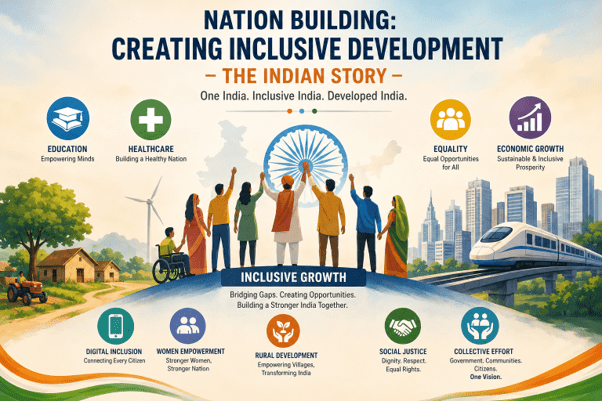
Introduction
National Development in India has always been a special challenge. India is a civilization of immense diversities – linguistic, religious, caste-based and geographic – unlike homogeneous nation-states. Decades of planning have been driven by the promise of a “just, social, economic and political” order in the Constitution.
But India is the world’s fifth largest economy and its central paradox is that rapid growth co-exists with deep structural inequalities. Inclusive development for India is not a moral choice but an existential imperative. The very idea of one Indian nation is continually fractured without the conscious inclusion of its most marginalized citizens – Dalits, Adivasis, women and the rural poor. In this article we examine the reengineering of India’s nation building project for inclusive growth.
National Development: From Hindu Rate of Growth to Amrit Kaal
India’s course of development has taken a sharp turn. From the pre-liberalisation era’s “Hindu rate of growth” of 3–4% to becoming the fastest-growing major economy, the country has built physical and digital infrastructure at scale. But India’s national development can’t be measured by GDP alone. Despite growth, youth unemployment (especially educated) remains a concern and the labour force participation rate of women is below 35 per cent, says the India Employment Report 2024 by the Institute for Human Development and the International Labour Organization.
India needs to bring its urban areas together for development. The Pradhan Mantri Gram Sadak Yojana started in 2000. Has connected almost all rural areas with good roads. But having roads is not enough. People also need good healthcare, schools and access to markets. The Aspirational Districts Programme started in 2018. Is trying to change this by focusing on the most backward areas. It looks at things like health, education and banking. Has shown some good results. For example many areas now have vaccination coverage and people have bank accounts.
Inclusive Growth: Bridging the Gaps
India has some problems that stop it from growing equally. These problems come from differences between castes and also between men and women and even between cities and villages. Caste and money movement are issues. The law says everyone is equal. In reality your caste still decides if you get money, land or a loan. The Stand-Up India plan tries to help people from castes and women by giving them loans. This can help them start their businesses.
-
It is hard for people from castes to get loans, from banks.
-
Many women also face problems getting loans because of their caste or family.
The Stand-Up India scheme gives loans to help people. Loans help people to buy land. Caste still decides who gets loans. Men and women have problems. Urban areas have money.Caste problems are big. Caste affects money. Women face problems. Loans are important. Stand-Up India helps. Caste and money are linked. Economic mobility is hard. Caste and gender are issues. Loans are key. Government helps. People need loans. Caste affects lives. There are still problems. Many people face harassment and delays.
Gender and Formal Employment: Not women in India work in formal jobs. This is changing. Many women are joining self-help groups and working in rural areas. The Deendayal Antyodaya Yojana-National Rural Livelihoods Mission has helped many women join these groups. Many people in India work, in farming. It does not contribute much to the country’s economy. This causes people to move to cities which’re not ready for them. We need to create jobs in areas and help farming communities. The One District One Product scheme tries to do this by creating value chains in areas.
Governance and Digital Inclusion: The Jan Dhan-Aadhaar-Mobile Trinity
The Jan Dhan-Aadhaar-Mobile trinity has helped transfer money to people’s accounts and has saved the government a lot of money. But digital inclusion also has its set of problems. Many people in rural areas do not have good internet connectivity and some people face problems with authentication. However, there are some models like the Open Network for Digital Commerce which can help small retailers participate in the digital economy. If we can make digital commerce accessible to everyone it can be a game-changer.
India is trying to do something big. It wants to bring a huge number of people who are very different from each other. India still has work to do. We will know India is doing well when a woman from a community in Bihar gets the same help as a rich man in Mumbai. Help with doctors, schools and jobs. That is what it means to make sure everyone is included. That is what building a nation is really, about.
Frequently Asked Questions
1: What defines national development in the modern Indian context?
It represents a holistic growth process where economic gains are balanced with social justice and constitutional equality.
2: Why is inclusive growth considered an existential imperative for India?
Without intentional equitable distribution, deep structural inequalities risk fracturing the unified social fabric of a highly diverse nation.
3: How does the India Employment Report 2024 evaluate current national development?
It highlights critical challenges such as persistent youth unemployment and low female labor force participation rates despite rising GDP.
4: Which initiatives specifically target inclusive growth across backward rural areas?
The Aspirational Districts Programme focuses heavily on transforming lagging regions through targeted health, education, and banking infrastructure.
5: What obstacles hinder balanced national development across different castes?
Deep-rooted social biases often restrict marginalized communities from acquiring land, securing bank loans, or achieving upward economic mobility.
6: How does the Stand-Up India scheme promote inclusive growth?
The program directly provides essential structural loans to women and marginalized caste entrepreneurs to launch sustainable businesses.
7: Why must national development strategies address the agricultural sector?
Farming employs a vast portion of the population but yields low economic output, forcing unplanned urban migration.
8: What role does digital identity play in fostering inclusive growth?
Unified digital frameworks enable secure, direct financial welfare transfers to marginalized accounts, bypassing traditional bureaucratic leakage points.
9: Can digital platforms expand the reach of comprehensive national development?
Yes, open infrastructure models allow decentralized, small-scale rural retailers to participate actively in the mainstream digital economy.
10: When will India truly achieve its ultimate inclusive growth objectives?
Success is achieved when a marginalized citizen in rural Bihar seamlessly accesses the same opportunities as a wealthy urbanite.
Citations & References
[1] Basics of Stock Markets, National Stock Exchange of India. [Online].
Available:
https://www.nseindia.com/
[2] Stock Market Investing for Beginners, Investopedia. [Online].
Available:
https://www.investopedia.com/
[3] A. Damodaran, Investment Valuation: Tools and Techniques for Determining the Value of Any Asset, 4th ed. Wiley, 2024.
[4] Image Source – Factors to Take Care of before Making Investment Equentis.
[5] EvePlacement. [Online].
Available:
https://eveplacement.com/
Streamline Your Hiring with Eve Placement
Engage, assess, and recruit top talent through tailored AI hiring challenges that go beyond resumes. Ready to hire better? Contact our research team for a custom consultation.