From Intern to Impact: The Skills Employers Are Looking For in 2026
Published: Oct 2, 2026
Key Points
- Internship skills are becoming more important as employers increasingly focus on demonstrable abilities rather than qualifications alone.
- Strong communication, teamwork, critical thinking, and problem-solving are among the most valuable internship skills for students in 2026.
- AI skills are increasingly relevant, but students also need human skills such as judgment, creativity, and responsible decision-making.
- Adaptability and curiosity help interns learn quickly and handle changing workplace requirements.
- Professionalism and ownership show employers that an intern can be trusted with real responsibilities.
- Feedback can help students strengthen their internship skills and improve their workplace performance.
- Students should demonstrate their internship skills through real projects, achievements, examples, and measurable contributions rather than simply listing them on a resume.
- Building the right internship skills can help students turn an internship into meaningful work experience and future career opportunities.
For years, getting an internship often seemed to come down to having a good academic record, a polished resume and the right degree. But the workplace of 2026 is changing that equation. Employers are increasingly looking beyond grades and job titles to understand what a student can actually do.
An intern today is not expected to know everything from day one. What matters more is the ability to learn quickly, communicate effectively, solve problems, work with others and take responsibility for the work they are given. As artificial intelligence becomes part of everyday work, employers are also looking for students who can use technology without losing the human skills that make good employees valuable.
The shift is already visible in hiring. The National Association of Colleges and Employers (NACE) reports that nearly 70% of employers now use skills-based hiring, while its 2026 research identifies communication, teamwork, professionalism and critical thinking among the most important career-readiness skills.
This means the question for students is no longer simply, “What is on my resume?” It is becoming, “What can I bring to the workplace?” In 2026, the strongest interns are those who can turn their knowledge into action, accept feedback, adapt to change and make a meaningful contribution—even while they are still learning.
1. Employers want skills, not just qualifications
This is probably the most important point for your article.
A degree tells an employer what someone studied. It doesn’t necessarily tell them how well that person can work.
In 2026, employers are increasingly using skills-based hiring, meaning they are paying more attention to demonstrable abilities rather than relying entirely on a student’s degree, major or GPA. NACE’s 2026 research says nearly 70% of employers reported using skills-based hiring.
This gives students an important advantage: skills can be developed outside the classroom.
For example:
- Running a college event → communication + teamwork
- Managing a social-media account → content + analytics + creativity
- Working on a college project → research + problem-solving
- Leading a student team → leadership + responsibility
- An internship → professional communication + execution
- Learning Excel → data analysis + technological literacy
The important thing is being able to explain what you actually did with the skill.
NACE’s 2026 research specifically notes that employers want candidates to provide examples of how they have used their skills rather than simply listing those skills on a resume.
2. Communication is still one of the biggest differentiators
Technology may be changing rapidly, but communication has not become less important.
In fact, when employees work with AI, remote teams and people from different backgrounds, the ability to communicate clearly becomes even more valuable.
An intern who can:
- write a clear email,
- explain an idea,
- ask a good question,
- participate in a meeting,
- present findings,
- listen to feedback,
- and communicate a problem early
can quickly become useful to a team.
NACE’s 2026 Job Outlook research identifies communication, teamwork, professionalism and critical thinking as the most important career-readiness competencies employers seek in new graduates.
So instead of saying:
“I have good communication skills.”
A stronger intern demonstrates it through actual behaviour.
3. Employers want interns who can think, not just follow instructions
One of the biggest changes in the workplace is the value placed on problem-solving.
An employer doesn’t necessarily expect an intern to solve a major business problem independently.
But they do appreciate someone who says:
“I noticed this problem. I tried this approach. It didn’t work, so I researched another solution.”
That shows initiative.
The World Economic Forum’s Future of Jobs Report 2025 ranks analytical thinking as the most important core skill, with 69% of employers identifying it as a core skill. Creative thinking, resilience, flexibility and technological literacy also rank highly.
This is a useful point to humanise your article: employers don’t expect interns to arrive as experts. They want interns who are curious enough to figure things out.
4. AI skills matter—but knowing how to use AI responsibly matters more
This is an extremely relevant section for a 2026 article.
AI is now becoming part of normal workplace workflows. Interns may use AI for:
- research,
- brainstorming,
- data analysis,
- writing first drafts,
- summarising information,
- presentations,
- coding,
- automation,
- and productivity.
But simply knowing how to open an AI tool isn’t a competitive advantage anymore.
The real advantage is knowing when to use AI, how to give it useful instructions, how to check its output and when human judgement is necessary.
KPMG’s 2026 Intern Pulse Survey found that 76% of interns surveyed believe future career success will require both human skills and knowing how to direct AI effectively. The survey also found that critical thinking and problem-solving were among the skills interns most wanted to demonstrate while working alongside AI.
This creates a new expectation:
Don’t compete with AI. Learn how to work intelligently alongside it.
5. Adaptability is becoming essential
The workplace is changing too quickly for someone to rely only on what they learned in college.
New software appears.
New AI tools appear.
Teams change.
Responsibilities change.
Sometimes even the original internship project changes.
Employers therefore value interns who don’t panic when something is unfamiliar.
The World Economic Forum ranks resilience, flexibility and agility as the second-most important core skill among employers, with 67% identifying it as a core skill.
A good intern doesn’t say:
“I don’t know how to do this.”
and stop there.
A better response is:
“I haven’t worked with this before, but I’ll learn how to do it.”
That attitude can make a huge difference.
6. Curiosity can be more valuable than pretending to know everything
Internships are learning experiences.
Nobody realistically expects a student to know everything before entering the workplace.
What employers may find frustrating is an intern who is afraid to ask questions and therefore makes avoidable mistakes.
Curiosity means:
- asking why something is done a certain way,
- researching before asking basic questions,
- learning from experienced colleagues,
- exploring better ways to complete a task,
- and being genuinely interested in the industry.
The World Economic Forum lists curiosity and lifelong learning among the major core skills employers value.
In other words, employers aren’t only hiring what you know today. They are also looking at how quickly you can grow tomorrow.
7. Professionalism matters more than students sometimes realise
Professionalism isn’t about wearing formal clothes every day or using complicated corporate language.
It is often much simpler.
It means:
- arriving on time,
- meeting deadlines,
- replying to messages,
- keeping people updated,
- taking responsibility for mistakes,
- respecting colleagues,
- being prepared for meetings,
- and doing what you said you would do.
A student can have impressive technical skills but still struggle professionally.
On the other hand, an intern who is dependable and easy to work with can become someone a manager trusts.
Recent research published by the Journal of Accountancy found employers emphasising performance and attitude, including the ability to improve from feedback, communicate well and show a desire to learn.
8. Employers want interns who take ownership
This is one of the best themes to make your article sound human.
There is a major difference between:
“I completed the task I was given.”
and
“I completed the task, noticed an issue and suggested a better way of doing it.”
The second person is demonstrating ownership.
Taking ownership doesn’t mean doing everything independently. It means treating your responsibility as something that matters.
For example, if an intern is asked to prepare a social-media report, they might simply create the report.
A stronger intern might also notice:
- which posts performed best,
- why they performed well,
- what audience engagement looked like,
- and what could be tested next.
That is where an intern starts moving from task-doer to contributor.
9. Teamwork still matters
Most internships involve working with other people.
Even highly technical roles require collaboration.
Employers want interns who can:
- listen,
- contribute ideas,
- respect different opinions,
- accept criticism,
- help teammates,
- and communicate when they need support.
NACE’s 2026 employer research specifically identifies teamwork as one of the most important career-readiness competencies.
The best team member isn’t necessarily the loudest person in the room.
Sometimes it is the person who listens carefully, does their part and helps the team move forward.
10. Feedback should be treated as a shortcut to improvement
A common mistake interns make is taking feedback personally.
But feedback is one of the biggest advantages of an internship.
You have experienced professionals telling you:
“Here’s what you’re doing well, and here’s what you could do better.”
Instead of defending every decision, a strong intern asks:
“How can I improve this next time?”
NACE’s guidance on internship quality highlights the importance of mentorship, feedback and reflection in helping interns develop career-readiness competencies.
This also gives you a great human angle:
The best interns aren’t the ones who never make mistakes. They’re the ones who don’t make the same mistake twice.
11. Employers want meaningful contributions—not just an internship certificate
This connects directly with the reference you were given.
An internship should not simply become:
“I worked at Company X for two months.”
The stronger story is:
“I worked on X, helped achieve Y, learned Z and improved my ability to do A.”
NACE’s 2026 internship research shows employers are increasing internship hiring, with companies expecting to hire 3.9% more interns in 2025–26 than in the previous year.
At the same time, NACE reports that internship experience can become particularly influential when employers are choosing between otherwise similarly qualified candidates.
That means students should think about impact, even at a small scale.
Impact doesn’t have to mean making a company millions.
It could mean:
- creating a useful report,
- improving a process,
- increasing engagement,
- researching competitors,
- organising an event,
- finding a data error,
- helping customers,
- building a presentation,
- or making a repetitive task easier.
12. The ability to show your skills is almost as important as having them
This is a very important distinction.
You might actually be good at Excel, research, communication or leadership—but if your resume simply says:
“Good communication skills”
the employer has no evidence.
Instead:
“Coordinated communication with corporate representatives and supported outreach for college placement initiatives.”
That gives context.
The same applies during interviews.
Instead of saying:
“I am a good team player.”
Tell a short story about a time you worked with a difficult team, divided responsibilities and completed the project.
Evidence beats adjectives.
NACE’s 2026 research makes this exact point: employers want candidates to provide examples demonstrating their skills rather than merely listing them.
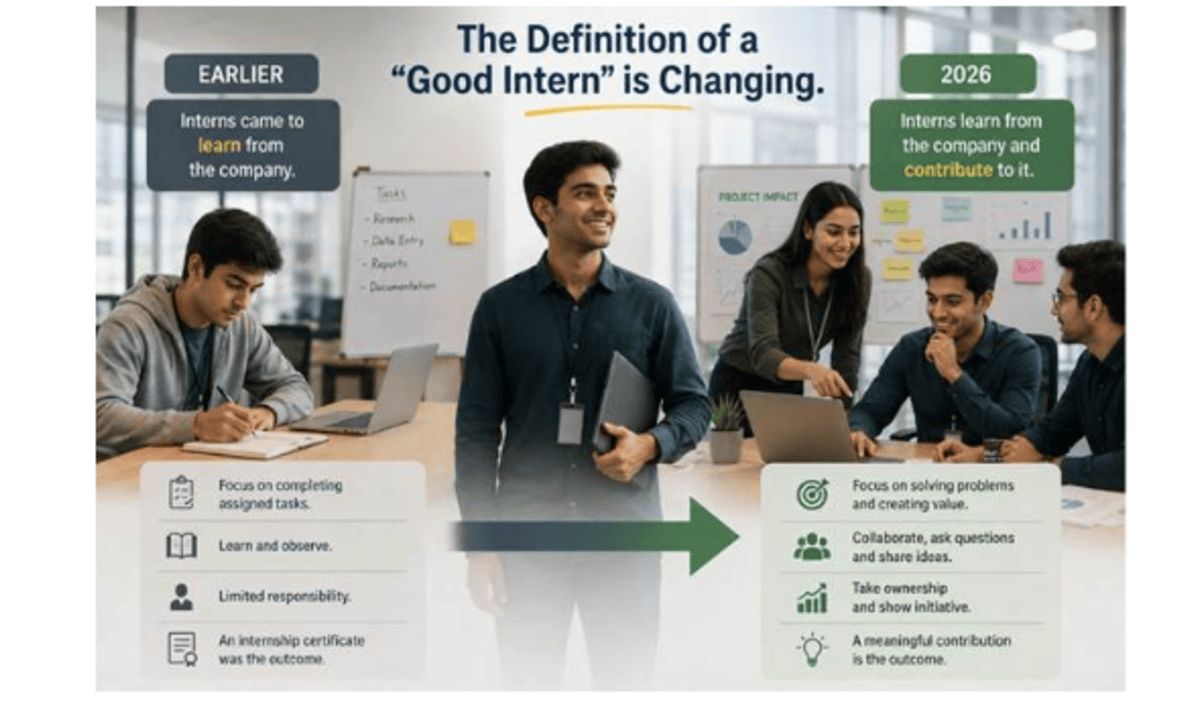
The definition of a “good intern” is changing.
Earlier, an intern might have been viewed mainly as a student who comes to a company to learn.
In 2026, the relationship is becoming more balanced:
The intern learns from the company — but the company also expects the intern to contribute.
That is much more interesting and directly connects with your reference about the market shifting toward skills and meaningful contributions.
Conclusion
The best intern in 2026 is not necessarily the person with the highest GPA, the longest resume or the most impressive list of certificates. It is the person who can learn, adapt and contribute.
Employers are increasingly looking for evidence of skills rather than simply qualifications. They want interns who can communicate clearly, think critically, work well with others, use technology responsibly, respond to feedback and take ownership of their work. The growing influence of AI makes these qualities even more important because technical tools can assist with tasks, but curiosity, judgement, collaboration and accountability remain deeply human strengths.
For students, this shift should not be intimidating. It can actually be empowering. You don’t need to know everything before your first internship. You need to be willing to learn, ask questions, solve problems and make your work matter.
Ultimately, an internship is no longer just a line on a resume. It is an opportunity to prove what you can do. And in a workplace increasingly focused on skills, the interns who stand out will be those who don’t simply ask, “What can I learn here?” but also, “What can I contribute?”
References
[1] NACE — 2026 Student Survey: excellent source for the shift toward skills-based hiring and what students should demonstrate.
NACE — Awareness of Skills-Based Hiring Drives Students to Upgrade Resumes
[2] NACE — Job Outlook 2026: particularly useful for communication, teamwork, professionalism, critical thinking and the importance of demonstrating skills with examples.
NACE — Employers Give New College Grads a Passing Grade on Job Readiness
[3] NACE — Internship & Co-op 2026: useful for current internship-market numbers and employer hiring intentions.
NACE — Employers Plan to Expand Summer Intern Hiring This Year
[4] World Economic Forum — Future of Jobs Report 2025: excellent for analytical thinking, adaptability, creativity, technological literacy and AI-related skills.
World Economic Forum — Future of Jobs Report 2025
[5] KPMG — 2026 Intern Pulse Survey: excellent for the AI + human skills angle, particularly critical thinking and learning to work alongside AI.
KPMG — Summer Intern Pulse Survey 2026
[6] NACE — Internship Experience: useful for explaining why internship experience can influence hiring decisions between similarly qualified candidates.
NACE — Internship Experience Often the Deciding Factor Between Equal Candidates
Frequently Asked Questions
1. What are internship skills?
Internship skills are the technical, professional, and interpersonal abilities that help students perform effectively in a workplace and contribute to real projects.
2. What are the most important internship skills in 2026?
Important internship skills include communication, teamwork, critical thinking, problem-solving, adaptability, AI literacy, professionalism, curiosity, and time management.
3. Why are internship skills important for students?
Internship skills help students apply their academic knowledge to real workplace situations and demonstrate their ability to learn, collaborate, and contribute.
4. Which soft skills should interns develop?
Communication, teamwork, adaptability, critical thinking, professionalism, leadership, time management, and active listening are valuable soft skills for interns.
5. Are technical skills important for an internship?
Yes. Technical skills can help students perform role-specific tasks. The skills required depend on the internship, such as coding for software development or Excel for data-related roles.
6. How can I improve my internship skills?
Students can improve their internship skills through projects, online courses, internships, volunteering, college activities, teamwork, and practical experience.
7. What communication skills do employers expect from interns?
Employers generally value clear writing, active listening, professional communication, asking relevant questions, presenting ideas, and communicating problems early.
8. Is AI knowledge an important internship skill in 2026?
AI literacy is increasingly useful across many roles. Students should understand how to use AI tools appropriately, verify their outputs, and apply human judgment.
9. How can I show internship skills on my resume?
Instead of simply listing skills, provide evidence through projects, responsibilities, achievements, tools used, and specific outcomes.
10. What is the difference between skills and qualifications?
Qualifications describe education or credentials, while skills describe what a person can actually do. Employers may consider both when evaluating internship candidates.
11. Is teamwork an important internship skill?
Yes. Interns often work with colleagues, managers, and other teams, making collaboration, listening, responsibility, and communication important workplace skills.
12. Why is adaptability important for interns?
Interns may encounter unfamiliar software, changing priorities, or new responsibilities. Adaptability helps them learn and respond effectively to these situations.
13. How does critical thinking help interns?
Critical thinking helps interns evaluate information, identify problems, compare possible solutions, ask better questions, and make informed decisions.
14. Why is professionalism important during an internship?
Professionalism helps interns build trust by being punctual, meeting deadlines, communicating responsibly, accepting feedback, and taking responsibility for their work.
15. How can students demonstrate problem-solving skills?
Students can describe projects or situations where they identified a problem, researched possible solutions, tested an approach, and achieved a useful result.
16. Can college projects demonstrate internship skills?
Yes. College projects can demonstrate technical knowledge, teamwork, research, communication, problem-solving, project management, and other relevant skills.
17. How important is curiosity during an internship?
Curiosity encourages interns to ask meaningful questions, learn from colleagues, explore new approaches, and develop their knowledge beyond assigned tasks.
18. How can feedback improve internship skills?
Feedback helps interns understand what they are doing well and where they can improve. Applying feedback consistently can strengthen both technical and professional skills.
19. What internship skills should I mention in an interview?
Mention skills that are relevant to the role and support them with real examples. For example, discuss a project that demonstrates teamwork, problem-solving, communication, or technical ability.
20. How can internship skills help students build a career?
Strong internship skills can help students perform better in workplace environments, demonstrate their capabilities to employers, build professional experience, and prepare for future career opportunities.
Citations & References
[1] NACE — 2026 Student Survey: excellent source for the shift toward skills-based hiring and what students should demonstrate.
NACE — Awareness of Skills-Based Hiring Drives Students to Upgrade Resumes
[2] NACE — Job Outlook 2026: particularly useful for communication, teamwork, professionalism, critical thinking and the importance of demonstrating skills with examples.
NACE — Employers Give New College Grads a Passing Grade on Job Readiness
[3] NACE — Internship & Co-op 2026: useful for current internship-market numbers and employer hiring intentions.
NACE — Employers Plan to Expand Summer Intern Hiring This Year
[4] World Economic Forum — Future of Jobs Report 2025: excellent for analytical thinking, adaptability, creativity, technological literacy and AI-related skills.
World Economic Forum — Future of Jobs Report 2025
[5] KPMG — 2026 Intern Pulse Survey: excellent for the AI + human skills angle, particularly critical thinking and learning to work alongside AI.
KPMG — Summer Intern Pulse Survey 2026
[6] NACE — Internship Experience: useful for explaining why internship experience can influence hiring decisions between similarly qualified candidates.
NACE — Internship Experience Often the Deciding Factor Between Equal Candidates
Streamline Your Hiring with Eve Placement
Engage, assess, and recruit top talent through tailored AI hiring challenges that go beyond resumes. Ready to hire better? Contact our research team for a custom consultation.