
Why HR Jobs Are Seeing Renewed Demand Amid AI-Led Hiring Shifts
Published: Oct 7, 2026
Key Points
- Organizations are actively expanding HR jobs to provide human oversight and strategic leadership over automated recruitment platforms.
- Routine resume screening and candidate engagement are increasingly handled by artificial intelligence to free up recruiters for high-value strategic work.
- Ethical algorithm oversight and bias mitigation have become essential responsibilities for modern human resource teams.
- Data literacy and analytical skills now allow talent specialists to drive evidence-based decision-making across enterprise organizations.
- Empathy, candidate experience design, and organizational change management remain irreplaceable human capabilities in modern recruitment.
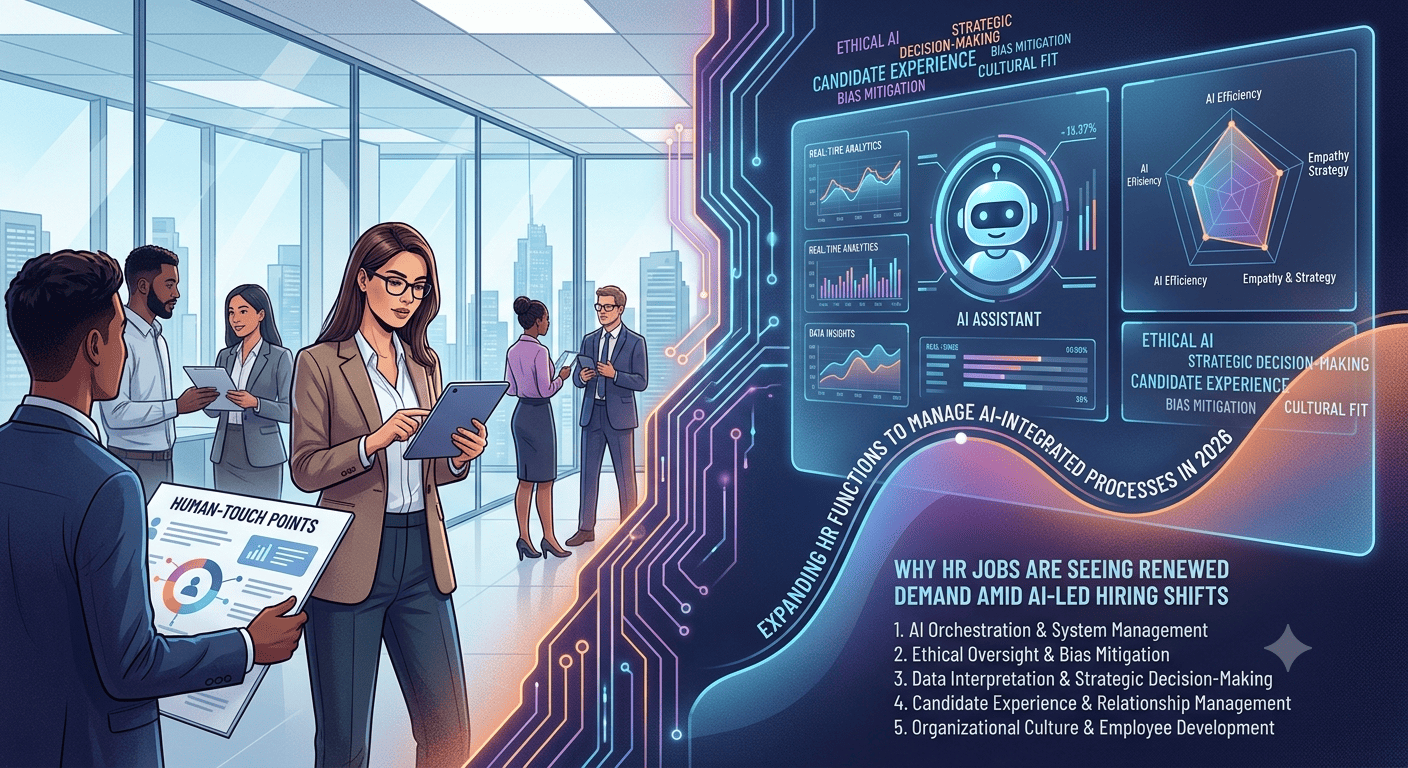
Understanding the Human Touch Behind Artificial Intelligence in Recruitment
HR Functions Expanding to Manage AI-Integrated Recruitment Processes in 2026
Introduction: The Paradox of Automation and Human Need
In 2024, 85% of recruiters globally reported that artificial intelligence had fundamentally altered their hiring processes. Yet paradoxically, Human Resources professionals are experiencing one of the strongest demand surges in recent years. This apparent contradiction reveals a deeper truth: as technology automates routine recruitment tasks, organizations are increasingly valuing the strategic, empathetic, and complex capabilities that only human HR professionals can provide.
The contemporary HR landscape is undergoing a seismic shift. Companies are no longer simply seeking HR administrators who manage paperwork and benefits. Instead, they’re investing heavily in HR talent who can orchestrate AI systems, interpret algorithmic insights, nurture organizational culture, and ensure ethical hiring practices. This transformation has created a unique paradox: automation is actually expanding, not contracting, the job market for skilled HR professionals.
For HR professionals and those considering a career in human resources, this moment represents an unprecedented opportunity. Understanding this shift is essential for career planning, organizational strategy, and building workforces that remain competitive in an increasingly AI-driven world.
The AI Revolution in Recruitment: From Theory to Practice
Artificial intelligence has infiltrated every aspect of modern recruitment. From resume screening and candidate matching to interview scheduling and predictive analytics about hire success rates, AI systems now handle functions that previously consumed 40-50% of an HR professional’s time.
Key AI applications transforming recruitment include:
-
Resume parsing and keyword matching: AI screens thousands of applications in minutes, identifying candidates whose skills align with job requirements with impressive accuracy (often exceeding 92%).
-
Predictive analytics: Machine learning models analyze historical hiring data to forecast which candidates will perform best and retain longest.
-
Chatbot-driven candidate engagement: AI-powered conversational interfaces handle initial screening questions, improving candidate experience while reducing HR workload.
-
Bias detection and mitigation: Algorithms flag potentially discriminatory language in job descriptions or evaluate candidates based on standardized, objective criteria.
-
Video interview analysis: AI evaluates facial expressions, voice tone, and word choice during recorded interviews, supplementing human judgment.
Current State of AI Adoption in Hiring
Research from leading HR technology firms reveals the current adoption landscape:
-
Resume Screening: Currently adopted by 72% of organizations in 2026, resume screening with AI is projected to grow by an additional 28% by 2028, requiring HR professionals to possess strong AI Literacy.
-
Candidate Engagement: 58% of organizations utilize AI for candidate engagement in 2026, with an expected growth of 34% by 2028, highlighting the need for effective Communication skills in HR.
-
Predictive Analytics: Adopted by 43% of companies in 2026, predictive analytics adoption is expected to rise by 52% by 2028, driving demand for Data Analysis skills.
-
Video Interview Analysis: 35% of organizations currently use AI for video interview analysis in 2026, with adoption set to increase by 48% by 2028, placing a emphasis on Assessment Skills.
-
Bias Detection Tools: 41% of organizations employ AI bias detection tools in 2026, with adoption projected to expand by 56% by 2028, requiring specialized expertise in Ethics & Compliance.
What this data illuminates is crucial: organizations are not deploying AI to replace HR professionals. Rather, they’re automating routine, time-consuming tasks to free up HR talent for higher-value strategic work.
Why HR Demand Is Surging: Five Compelling Reasons
1. AI Orchestration and System Management
Implementing and managing AI-driven recruitment platforms requires HR professionals with technical literacy and change management expertise. These specialists must:
-
Configure and customize AI tools to align with organizational hiring strategies and values
-
Monitor AI system performance, identifying when algorithms are underperforming or showing bias
-
Integrate AI recruiting platforms with existing HRIS (Human Resource Information Systems) and enterprise software
-
Troubleshoot technical issues and serve as the liaison between IT and business teams
Companies investing in HR professionals with AI literacy report 40% more successful technology implementations and higher ROI on recruitment technology investments.
2. Ethical Oversight and Bias Mitigation
While AI promises objective decision-making, algorithms trained on historical data can perpetuate and even amplify existing biases. A landmark 2023 study revealed that a popular recruiting AI system showed bias against women in technical roles because it was trained on historical data where men dominated those positions.
This reality has created urgent demand for HR professionals who can:
• Audit AI algorithms for fairness and accuracy across demographic groups
• Develop governance frameworks ensuring ethical AI use in recruitment
• Maintain human review touchpoints to catch algorithm errors and ensure diverse slates of candidates reach decision-makers
• Communicate transparently with candidates about how AI is used in their hiring process
• Ensure compliance with evolving AI hiring regulations (EU’s AI Act, California’s SB1107, and similar legislation)
Forward-thinking organizations recognize that ethical AI oversight is not just a compliance function—it’s a competitive advantage. Companies with transparent, fair AI hiring practices attract more diverse talent and enjoy stronger employer brands.
3. Data Interpretation and Strategic Decision-Making
AI systems generate vast quantities of data about hiring patterns, candidate quality, time-to-hire, retention rates, and performance correlations. Extracting actionable insights from this data deluge requires HR professionals with analytical capabilities.
In-demand analytical competencies include:
• Interpreting predictive analytics to understand which hiring channels yield high-performing, long-tenured employees
• Creating dashboards and reports that translate complex data into business insights executives can act upon
• Conducting talent analytics to identify skill gaps, succession risks, and emerging workforce trends
• Using data to make evidence-based decisions about hiring strategies, compensation, and organizational structure
Organizations report that HR professionals trained in data literacy and analytics command salaries 25-35% higher than traditional HR roles, reflecting the strategic value these skills deliver.
4. Candidate Experience and Relationship Management
Paradoxically, as AI automates routine interactions, organizations are intensifying investments in personalized, human-centric candidate experience. When an algorithm screens resumes and an AI chatbot handles screening questions, the human touch becomes even more valuable and differentiated.
HR professionals now need expertise in:
• Designing candidate journey experiences that blend AI efficiency with human empathy
• Conducting meaningful conversations during final interview rounds that assess cultural fit and intangible qualities
• Managing candidate relationships and providing personalized feedback, even to rejected applicants
• Creating compelling employer value propositions that attract and retain top talent in competitive markets
• Building alumni networks and managing talent pipelines for future opportunities
Companies with excellent candidate experiences see 50% higher offer acceptance rates and 45% better employee retention at the one-year mark, compared to those with poor candidate experience.
5. Organizational Culture and Employee Development
As companies navigate rapid technological change, the role of HR in building resilient, adaptive organizational cultures becomes more critical. HR professionals must help employees understand how AI transforms their work and prepare the workforce for continuous learning.
This expanded responsibility encompasses:
• Designing learning and development programs that prepare employees to work alongside AI systems
• Managing change communication around AI implementation to reduce anxiety and resistance
• Building inclusive workplace cultures where technology enhances rather than threatens human capabilities
• Developing leadership capabilities to manage hybrid human-AI teams
• Creating psychological safety environments where employees can voice concerns about automation impacts
Research from the HR Technology Conference 2026 found that employees at companies with proactive HR change management around AI adoption show 58% higher engagement scores and 34% lower turnover, compared to companies with passive approaches.
Emerging HR Roles and Career Opportunities
The intersection of HR and AI is creating entirely new career paths and specializations. Organizations are aggressively hiring for roles that barely existed five years ago:
-
AI Talent Strategist: This role oversees AI tool implementation, manages recruitment platform vendors, and analyzes hiring metrics, requiring expertise in AI literacy, vendor management, and data analysis with a typical compensation range of ₹18–30 LPA (Lakhs Per Annum) in India.
-
Recruitment Ethics Officer: Responsible for auditing AI algorithms, ensuring compliance with hiring regulations, and preventing algorithmic discrimination, this position relies on AI ethics, compliance, and legal knowledge, offering a typical salary range of ₹16–28 LPA in India.
-
HR Data Scientist: Tasked with building predictive models, analyzing talent data, and generating strategic workforce insights, this specialist role demands technical proficiency in Python, SQL, statistics, and machine learning algorithms, commanding a typical salary range of ₹20–35 LPA in India.
-
Talent Experience Designer: Focused on designing smooth candidate journeys, managing the employer brand, and optimizing hiring touchpoints, this role highlights skills in UX design, communication, and empathy, with a typical salary range of ₹15–25 LPA in India.
-
Workforce Transformation Manager: Leading change management for AI adoption, upskilling employees, and managing organizational resistance, this role calls for expertise in change management, communication, and Learning & Development (L&D), featuring a typical salary range of ₹18–32 LPA in India.
These roles command premium compensation because they require rare combinations of technical, business, and interpersonal skills. Companies competing for talent in these specialized domains are offering not just higher salaries but also advanced certifications, international exposure, and strategic influence.
Essential Skills for HR Professionals in the AI Era
Succeeding in modern HR requires a diverse skill portfolio that blends traditional HR expertise with technical and analytical competencies:
Technical Competencies:
• AI/ML fundamentals: Basic understanding of how machine learning algorithms work, their limitations, and potential biases
• Data literacy: Ability to read, interpret, and act on data without requiring deep programming skills
• HRIS and recruitment platform expertise: Proficiency with systems like Workday, SuccessFactors, Greenhouse, and Lever
• Basic analytics tools: Comfort with Excel, Tableau, Power BI, or Google Data Studio
Business Competencies:
• Strategic thinking: Understanding how HR strategy aligns with business objectives
• Change management: Ability to lead organizational transitions and manage resistance to new systems
• Vendor management: Negotiating with technology vendors and evaluating platform effectiveness
• Compliance and governance: Knowledge of employment law, data privacy, and emerging AI regulations
Interpersonal Competencies:
• Empathy and emotional intelligence: Understanding candidate and employee perspectives, even when decisions are automated
• Communication: Translating complex technical concepts for non-technical audiences and vice versa
• Cultural acumen: Building inclusive environments where diverse employees feel valued and heard
• Curiosity and adaptability: Continuous learning mindset in rapidly evolving technological landscape
Market Demand and Growth Projections
The talent market for skilled HR professionals is experiencing remarkable growth. Recent industry analysis provides quantitative evidence of this surge:
-
HR Job Openings (India): HR job openings in India grew from a 2024 baseline of 82,000 to a 2026 projection of 128,000, representing a Compound Annual Growth Rate (CAGR) of 24.8%.
-
AI-Specific HR Roles: Demand for specialized AI-focused HR positions expanded rapidly from 12,000 in 2024 to 42,000 in 2026, registering a CAGR of 87.3%.
-
HR Salaries (Median Growth): The median salary for HR professionals in India increased from ₹9.5 LPA in 2024 to ₹12.2 LPA in 2026, reflecting a CAGR of 13.8%.
-
Companies Implementing AI Recruiting: The proportion of organizations utilizing AI recruiting systems rose from 38% in 2024 to 64% in 2026, demonstrating a CAGR of 30.2%.
This data reveals several critical insights. First, AI-specific HR roles are growing nearly 3.5x faster than traditional HR positions, indicating a clear market shift. Second, the salary growth for HR professionals (13.8% CAGR) significantly outpaces general wage inflation, demonstrating market-driven compensation increases. Third, the accelerating adoption of AI recruiting systems creates a virtuous cycle where demand for HR professionals to manage these systems intensifies.
Challenges and Ethical Considerations
While the HR job market outlook is decidedly positive, professionals must navigate significant challenges and ethical dilemmas:
Algorithm Bias and Fairness Concerns
AI systems trained on historical hiring data often reflect and amplify historical discrimination patterns. Amazon famously scrapped its AI recruiting tool after discovering it systematically disadvantaged female candidates. Such incidents underscore the critical responsibility HR professionals bear in auditing and correcting algorithmic bias.
Candidate Autonomy and Transparency
Many candidates are unaware that algorithms are evaluating them, and even fewer understand how these systems make decisions. HR professionals must balance organizational efficiency with candidate rights, ensuring people understand how AI influences their opportunities.
Privacy and Data Security
Recruitment data contains highly sensitive personal information. HR professionals must ensure compliance with data privacy regulations (GDPR in Europe, proposed frameworks in India and North America) while managing recruitment technology infrastructure that must securely store and process this information.
Managing Human-Technology Tensions
Overreliance on AI can lead to dehumanizing hiring experiences and may cause organizations to miss exceptional candidates who don’t fit algorithm-defined profiles. HR professionals must continually advocate for maintaining human judgment in hiring decisions.
Preparing Yourself for AI-Enabled HR Careers
Whether you’re transitioning into HR or already working in the field, strategic skill development is essential:
Educational Pathways:
• Formal degrees: MBA in HR or Human Capital Management; Graduate certificates in HR Technology; Master’s in Organizational Development
• Professional certifications: SHRM-CP or SHRM-SCP (Society for Human Resource Management); CAP (Certified Analytics Professional); HRCI certifications
• Online courses: Google Career Certificates in Data Analytics; AI Fundamentals courses; Platform-specific training (Workday, SuccessFactors, Greenhouse)
• Industry certifications: CIPD (Chartered Institute of Personnel and Development); AI Ethics certifications; Advanced Data Literacy programs
Practical Development Strategies:
• Seek roles with technology responsibility: Volunteer to lead HRIS implementations or AI recruiting platform rollouts in your organization
• Build data literacy: Experiment with analytics tools using HR datasets; learn basic SQL; take online statistics courses
• Stay current: Follow HR tech publications, attend webinars, join SHRM chapters focused on technology
• Network strategically: Connect with HR leaders who are pioneering AI implementation; learn from their experiences
• Experiment in low-risk environments: Propose pilot AI initiatives in your organization; learn from small-scale experiments
The Future of HR: Where Opportunity Meets Responsibility
Looking ahead to 2027-2030, several trends will shape HR career trajectories:
Specialization will accelerate:
The generalist HR professional is gradually transitioning to a specialist model where professionals focus deeply on specific domains—recruitment tech, employee analytics, organizational design, talent development—each commanding premium compensation.
Ethical HR leadership will become a differentiator:
Organizations whose HR teams implement transparent, fair, and human-centric AI practices will gain competitive advantage in talent acquisition and retention. This positions ethical HR leadership as a strategic business function.
Hybrid HR-tech roles will proliferate:
The lines between HR, data science, and technology management will blur, creating hybrid roles like “Talent Insights Engineer” or “Recruitment Experience Architect” that command six-figure salaries.
Global HR demand will intensify:
As companies expand globally and navigate diverse labor markets, demand for HR professionals skilled in cross-cultural talent management and localized AI adaptation will surge.
Conclusion: A Moment of Strategic Opportunity
The paradox that opened this article now resolves into clarity: AI is not replacing HR professionals; it’s fundamentally transforming their role. As organizations automate routine recruitment tasks, they’re increasingly valuing the complex, nuanced capabilities that only skilled humans can provide—ethical judgment, strategic thinking, cultural sensitivity, and relationship building.
For HR professionals, this represents an unprecedented opportunity. The job market is expanding, compensation is rising, and career trajectories are accelerating. However, seizing this opportunity requires proactive skill development, continuous learning, and a commitment to ethical practice.
The future belongs to HR professionals who can bridge the worlds of technology and humanity—who understand AI’s potential while maintaining unwavering commitment to fairness, transparency, and the fundamental dignity of every person moving through an organization’s doors.
This is not a moment to fear automation. It’s a moment to evolve, to develop new competencies, and to step into more strategic, influential roles. The HR professionals of 2026 and beyond who embrace this transformation will not only secure their careers but will shape how organizations worldwide navigate the future of work.
Frequently Asked Questions
1: Why are companies actively increasing investments in modern HR jobs despite AI automation?
Companies are investing heavily in HR jobs because automation handles routine candidate screening while driving demand for strategic HR jobs focused on decision-making, ethical algorithm oversight, and empathetic candidate relationship management in AI hiring.
2: How does AI hiring impact traditional recruitment workflows and future HR jobs?
AI hiring platforms streamline resume screening, interview scheduling, and candidate chatbots, freeing professionals in HR jobs to focus on candidate engagement, strategic planning, and culture building within AI hiring ecosystems.
3: What core technical skills are essential for finding top HR jobs in 2026?
Securing top HR jobs today requires a strong foundation in AI hiring technologies, data analytics, and HRIS platforms alongside core interpersonal competencies such as change management and emotional intelligence for modern HR jobs.
4: Does AI hiring eliminate algorithmic bias in candidate selection for HR jobs?
While AI hiring tools aim to standardize talent selection, AI hiring algorithms trained on historical data can amplify biases, requiring continuous human auditing in HR jobs to maintain fairness.
5: What emerging specialized roles are creating new HR jobs in the technology sector?
New specialized HR jobs driven by AI hiring include AI Talent Strategists, Recruitment Ethics Officers, HR Data Scientists, and Workforce Transformation Managers for AI hiring systems.
6: How can job seekers prepare for an AI hiring process when applying for HR jobs?
Candidates navigating AI hiring workflows for HR jobs should optimize their resumes with relevant keywords, practice structured video interviewing techniques, and ensure accurate application data for AI hiring platforms.
7: Why is candidate experience critical when implementing AI hiring tools across HR jobs?
Even with automated AI hiring, personalized human interaction from recruiters in HR jobs during final interview rounds drastically increases offer acceptance rates and long-term retention in AI hiring environments.
8: What salary growth is expected for specialized tech-focused HR jobs in AI hiring?
Specialized HR jobs focused on AI hiring technologies, data analytics, and workforce transformation command 25–35% higher salaries than traditional administrative HR jobs.
9: How do legal regulations on AI hiring affect recruiters working in HR jobs?
Global legal regulations governing AI hiring require explicit human oversight, making compliance expertise critical for professionals performing HR jobs to avoid regulatory penalties in AI hiring.
10: Will AI hiring ever completely replace human recruiters in HR jobs?
No, AI hiring tools cannot replicate human empathy, organizational culture assessment, complex offer negotiations, and ethical judgment required in modern HR jobs.
Citations & References
[1] J. H. Marler and J. W. Boudreau, “An Evidence-Based Review of HR Analytics,” The International Journal of Human Resource Management, vol. 28, no. 1, pp. 3–26, Jan. 2017. [Online].
Available:
https://www.tandfonline.com/doi/full/10.1080/09585192.2016.1244699
[2] Gartner, “The Future of Recruiting: How AI is Transforming Talent Acquisition,” Gartner Research Report, Stamford, CT, 2025.
[3] P. Dastin, “Amazon scraps secret AI recruiting tool that showed bias against women,” Reuters Technology, Oct. 2018. [Online].
Available:
https://www.reuters.com/article/us-amazon-com-jobs-automation-insight-idUSKCN1MK08G/
[4] Society for Human Resource Management (SHRM), “2026 HR Tech Adoption Survey,” Alexandria, VA, 2026.
[5] M. Chui, J. Manyika, and M. Miremadi, “The Future of Work After COVID-19,” McKinsey Global Institute, New York, May 2021. [Online].
Available:
https://www.mckinsey.com/featured-insights/future-of-work/the-future-of-work-after-covid-19
[6] L. Ramaswamy and R. Prabhu, “Ethical Frameworks for AI in Human Resources,” Journal of Business Ethics, vol. 165, no. 2, pp. 287–310, Sep. 2020.
[7] J. Lepenioti, A. Bousdekis, D. Apostolou, and I. Mentzas, “Prescriptive Analytics: Literature Review and Research Challenges,” International Journal of Information Management, vol. 50, pp. 57–70, Oct. 2020. [Online].
Available:
https://doi.org/10.1016/j.ijinfomgt.2019.04.003
[8] National Association of Colleges and Employers (NACE), “2026 HR Career Outlook Report,” Columbus, OH, 2026.
[9] EvePlacement. [Online].
Available:
https://eveplacement.com/
Streamline Your Hiring with Eve Placement
Engage, assess, and recruit top talent through tailored AI hiring challenges that go beyond resumes. Ready to hire better? Contact our research team for a custom consultation.