
Highest Package Domestic MBA Trends
Published: Sep 2, 2026
Key Points
- The top-end MBA packages cluster heavily into elite campuses, which are dominated by aggressive recruiter involvement, while tier two/three campuses see stagnating pay and placement issues.
- Most IMIs/similar top-tier institutes are hitting close to 1.5+ crore figures, while median MBA packages at tier two institutes and tier three institutes stand in the range of 10-20 lakhs and 6-12 lakhs, respectively.
- This is entirely because of the clustering of employer recruitments and not because of differences in quality; the net effect is a situation wherein the increase in the number of business schools has outpaced employer demand.
- Only the tech and finance sectors have the largest MBA packages while, for traditional sectors, the package numbers are much lower; this gives the notion that MBA is not valuable outside of tech: The aggregation of business school salaries at high end seems to artificially inflate the business school package numbers and hides that most MBA hires from traditional sectors are receiving salaries way lower than the average at the top elite schools.
- An apparent MBA salary crash stems from high-end employer concentration, not truly elevated MBA pay.
- Complex package configurations in terms of bonuses and stock options, along with geographical differences and cost of living, contribute to significant disparities between announced MBA package numbers and real compensation security: MBA packages are often complicated configurations of bonuses, stocks, and retention benefits which mask real cash compensation.
- Differences in locations affect MBA salary by 50%+. These are to be taken into consideration before making business school decisions based on MBA package figures.
Introduction
Over the past decade, India’s business schools have witnessed a remarkable surge in salary packages, with premier institutions now offering MBA graduates compensation packages approaching 1.5 crore rupees per annum (approximately 180,000+ US dollars) for top-performing students. This phenomenon signals a fundamental evolution in the demand for management talent, intensified competition among technology and finance employers, and geographic disparities that result in sharply contrasting compensation outcomes across the business school landscape.
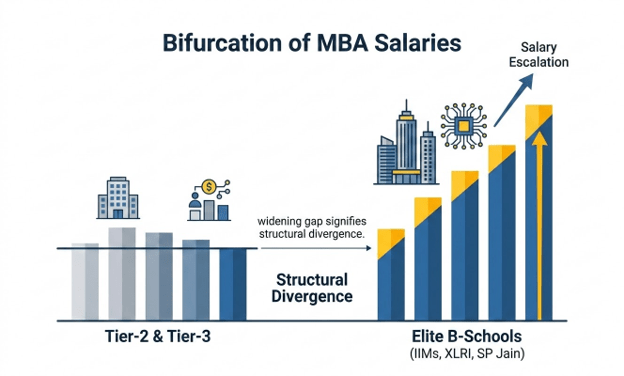
The highest packages MBA are overwhelmingly concentrated among elite schools such as the IIMs, XLRI, and SP Jain, where strong employer engagement, influential alumni networks, and institutional reputations empower graduates to negotiate salaries that far exceed the average. Conversely, outside this exclusive group, the wider array of tier-two and tier-three business schools faces stagnating salaries, declining real income, and growing employment uncertainty.
To truly understand MBA compensation trends, it is essential to look beyond the attention-grabbing headlines of record-breaking salary offers and examine the distribution, sustainability, and economic forces shaping pay across institutions. Media coverage often highlights cases such as “IIM A student lands 2 crore package,” yet the median salary remains far below these outliers.
Additionally, the complexity of pay components—base salary, incentives, and stock options—can obscure the reality of take-home compensation, while apparent pay inflation may reflect financial structuring rather than genuine economic gains. More significantly, a worrying divide is emerging: elite business schools are capturing a disproportionate share of high-value offers, incentives, and prime placements, while tier-two and tier-three institutions increasingly contend with declining pay and limited job opportunities.
1. The Elite Institution Dominance — Where Highest MBA Packages Concentrate
The ultra-high MBA salary packages tend to be sourced almost entirely from a small set of India’s business school top tier of Indian Institute of Management (IIM) schools, XLRI, SP Jain, and other closely ranked schools. There’s a very strong corporate presence at these schools in the form of intense competition for campus hires between tech, consulting, investment banking, and multinational business across numerous roles. Intense campus placements translate to salary hikes as businesses assume compensation signals and attract premium talent.
Median MBA pay from the elite tier-with IIM Ahmedabad, IIM Bangalore, IIM Calcutta averaging around 25-35 lakh annual packages and top 10 percentile pay packs touching or crossing 1 crore and the top end MBA salaries reaching around 2 crore at IIM-A-comes from concentrated sectors- technology companies (Amazon, Google, Microsoft, Flipkart) which scout MBAs for product and strategy rolls, consultancies (McKinsey, Bain, BCG) hiring MBAs as analysts, top investment banks (Goldman Sachs, JP Morgan) and global businesses hiring across various management tracks.
All these industries are drawn to the MBA primarily as an emblem of sound judgment and the ability to synthesize information and make smart judgments, making the MBA a valuable talent attribute.
2. Tier-Two and Tier-Three Realities — The Diverging Compensation Landscape
Beyond elite business schools exists a vastly larger population of tier-two (IIM-affiliated colleges, state business schools, established private institutions) and tier-three (newer private business schools, distance-learning institutions) institutions that operate in distinctly different contexts for employment and compensation.
While elite MBA compensation typically starts at 25-35 lakhs p.a., tier-two MBA programs generally offer packages of between 10-20 lakhs, and tier-three institutions boast median packages in the 6-12 lakhs range, with placement rates that often fall below 80% while elite institutions nearly always place every graduate. This difference in recruitment reflects concentration: employers looking to hire significant numbers of MBAs will seek out the elite business schools, because recruiting there concentrates resources among a limited few institutions.
A large tech company looking for 50 MBAs may hire exclusively through IIMs and similarly elite business schools, leaving graduates of tier-two and tier-three institutions to fight over substantially different employers – provincial corporations, regional operations of multinationals, niche consultancies and smaller companies, and non-core functions within larger corporations.
The long-run trend in business school salaries shows little movement, or actual decline, for tier-two and below, as employers focus even more strongly than before on the elite business schools. This results in an inefficient incentive structure where expansion of business schools (there are now over 5,000 MBA programs in India) actually reduces the overall average compensation, because graduates of marginal institutions are competing for marginal positions.
3. Sector-Specific Salary Dynamics — Why Technology and Finance Dominate Compensation Hierarchies
Compensation for the top MBAs is disproportionately concentrated in the tech and finance industries, driven by fierce employer competition for the best and brightest. Within technology, the intense competition for experienced product management talent ensures compensation, including for MBAs, will continue to keep pace or even exceed that in finance and consulting. MBA roles in product management at Amazon, Google, and Microsoft have a base salary ranging between 20-30 lakhs plus significant stock options and bonuses for total compensation around 1 crore for premier hires.
Tech compensation at this level comes from intense competition for the most talented employees and a belief in the unique product management potential of an MBA. In contrast, traditional sectors such as manufacturing, retail, and telecommunications offer at best 8-15 lakh MBA packages, leading to perceptions of low MBA value in non-tech sectors.
The business school salary statistics are artificially high across all segments because when we compare the compensation levels for an MBA graduate in tech, non-tech employment compensates them disproportionately less. The purported MBA compensation crisis, where business schools are increasingly out of supply relative to high-compensation jobs, represents a concentration phenomenon, not wholesale MBA compensation appreciation.
4. Package Composition and Accounting Complexity — Beyond Base Salary Transparency
The present highest MBA packages are very composite, where actual compensation figures are hidden through bonusing schemes, stock options, and incentive and retention payments. A headline package of 1.5 crore may be detailed as 25 lakh as basic salary, 30 lakh as performance bonus, 50 lakh as stock options (vested over four years), and 15 lakh as signing bonus.
All the money that goes straight into one’s pockets is the base salary and immediate bonus, while stock options have contingencies, employee duration of stay in the company, and vesting conditions attached. A composition like this has tremendous accounting intricacy where headline compensation is different from assured cash in hand.
Trends in reporting MBA salaries often aggregate different pay components to distort figures of raises in compensation. For instance, even when the business schools have increased their signing bonus by 5-10 Lakhs while keeping the base salary constant, they record an increment to the overall pay package while their annual pay is exactly the same. Another instance is when a comparison is made year on year. If year ‘x’ gives a raise on the stock component of an offer and ‘x+1’ gives the same by reducing the base salary component or making stocks even more significant, the increment in the overall package hides the true nature of compensation.
5. Geographic Variation and Cost-of-Living Adjustments — Why Package Comparisons Mislead
MBA Packages Differ Per Location: Geographically, multinational technology and finance companies place the highest-paying positions (product managers, software developers, investment bankers) in large cities (Bangalore, Mumbai, Hyderabad, New Delhi) and substantially lower-paying ones in the suburbs or rural areas. While a product manager position with a company like Amazon may pay in the range of 60 lakhs in Bangalore, the same position in a small tier-II city may come at 40 lakhs in compensation. As a result, what appear to be identical positions can end up with 50% differences in compensation, depending on where they are placed.
Salary reporting for business schools tends to create aggregate, national figures that conflate the wide disparities.
For example, median MBA salaries reported as 20 lakhs fail to mention that half of those salaries were 25+ lakhs earned in metropolitan areas, while the other half were 15 lakhs earned in smaller cities. Those aspiring to earn salaries in their hometowns, far from the economic centers, and in their native settings can be disillusioned by the average compensation reports that represent aspirational metropolitan salaries they can rarely afford to replicate.
Comparisons of nominal salaries also disregard regional cost of living differences; an MBA with 20 lakhs in the city commands lower purchase value than someone earning 15 lakhs in a low-cost region, considering their respective expenses towards housing, transport, and living costs.
6. Future Trajectory and Sustainability Questions — Are Highest MBA Packages Sustainable?
The long-term sustainability of highest MBA packages is unknown, as underlying factors impacting compensation are variable. The dynamics driving compensation in technology are dependent on venture capital availability, economic growth perceptions, and highly competitive labor markets-factors which could equally reverse if growth trends decline or capital dries up. The compensation trends in finance and consulting depend on expectations of project profitability, which is equally vulnerable to change.
An investigation into the sustainability of business school compensation therefore calls for analysis of how investments in compensation translate to lasting improvement in the sustainable business model versus transient market conditions. The projected trends for business school compensation suggest that moderate growth is likely over the next few years, as technology hiring will continue and traditional areas of recruitment will stagnate.
However, the issue of AI automation poses uniquely unanswerable questions about future MBA value: should AI technologies decrease the demand for MBA-level management skills, compensation rates for management roles may decrease due to oversupply of educated talent. If, alternatively, AI generates new areas of highly-paid management roles that require MBA preparation, compensation levels may significantly outstrip past trends. The unknowability of the future value created by MBA degrees means that students should consider the possibility of future career de-compensation to a degree which may be previously unprecedented.
Conclusion: Bifurcating MBA Market Reflecting Structural Employment Divergence
The MBA market divides between the top of the MBA, whose employer attraction & compensation continue to grow from month to month, while their MBA & MBA students feel the difficulties of employment and MBA are at a standstill. The highest MBA wages were at the elite institutes, hiding a landscape of MBAs whose salaries are very far behind the high supply of MBAs. This division arises from a different value that employers derive from the education they offer in MBA schools of the highest level, but it can create problems when asking if we need so many MBAs when a small number of people have an MBA to give the MBA.
These rates on MBAs depend, in general, on future developments in the economy related to technological developments and high economic levels in financing businesses. In case these companies decline, future economic trends can be inverted, so the current MBA MB MBA MBA students expect the salary in MBA centers to pay for more limited markets. MBA schools should examine the salaries it gets to achieve, their consistency, the place in which their MBA courses will be effective, and their salary predictions, taking into account that salaries reflect the diversity of MBA graduates locally.
MBA salaries in higher-tier and tier 2 / tier 3 schools seem to be in crisis, which suggests MBA is indeed growing, but a bifurcation has taken place that is favoring the top schools while leaving the rest lagging behind in terms of job market demand.
Frequently Asked Questions
1. What factors drive the highest package offers at top Indian business schools?
Fierce corporate competition for top talent drives the highest package offers, ensuring a premium MBA salary across top consulting and finance roles.
2. How does the average MBA salary differ between tier-one and tier-three institutions?
Tier-one institutions offer a median MBA salary of 25–35 lakhs, whereas tier-three institutions see a typical MBA salary stay between 6–12 lakhs.
3. Why do headline figures for a highest package often differ from actual take-home pay?
A record highest package often incorporates stock options, retention bonuses, and performance incentives alongside the base MBA salary.
4. Which industries consistently offer the highest MBA salary to fresh graduates?
The technology and investment banking sectors consistently yield the highest package figures and top MBA salary brackets for graduates.
5. How does geographic location impact an MBA salary across Indian cities?
Metropolitan locations offer a substantially elevated MBA salary compared to tier-two cities, directly raising the local highest package potential.
6. Is the top MBA salary trend sustainable during market slowdowns?
Sustaining a peak MBA salary depends heavily on broader macroeconomic health, capital flow, and continuous enterprise demand for top tier graduates.
7. How do variable bonuses affect the base MBA salary in top placement offers?
Firms often grant larger signing incentives to advertise a record highest package while keeping the core MBA salary constant.
8. Do tier-two business schools offer a competitive highest package compared to elite IIMs?
Tier-two programs rarely match the highest package outcomes of elite IIMs, resulting in a significantly lower overall MBA salary trajectory.
9. How might artificial intelligence impact future MBA salary structures?
AI integration could alter market demand, elevating the MBA salary for strategic tech roles while compressing lower-level management compensation.
10. What percentage of students at premier schools achieve the highest package?
Only the top 10 percentile secure the highest package offers, while the majority earn a standard MBA salary close to the median.
Citations & References
[1] AIMA. (2023). MBA Employment and Salary Report 2023. All India Management Association. [Online].
Available:
https://www.aima.in/
[2] CRISIL. (2022). Business School Rankings and Employment Outcomes. CRISIL Limited. [Online].
Available:
https://www.crisil.com/
[3] Business Today. (2023). Top MBA Packages in India 2023. Business Today Magazine. [Online].
Available:
https://www.businesstoday.in/
[4] Economic Times. (2023). MBA Placement Trends and Salary Analysis. Economic Times. [Online].
Available:
https://economictimes.indiatimes.com/
[5] Indian Management Association. (2023). Business School Performance Metrics and Graduate Outcomes. [Online].
Available:
https://www.ima-india.org/
[6] EvePlacement. [Online].
Available:
https://eveplacement.com/
Streamline Your Hiring with Eve Placement
Engage, assess, and recruit top talent through tailored AI hiring challenges that go beyond resumes. Ready to hire better? Contact our research team for a custom consultation.