
The Cinematic Evolution: Building Movies and Screenplays Quickly Using Generative AI
Published: Jun 27, 2026
Key Points
- Generative AI dramatically accelerates the scriptwriting phase by helping writers defeat the "blank page" block and brainstorm dozens of narrative variants instantly.
- Directorial pre-visualization is compressed from weeks to seconds using prompt-based storyboarding software that maintains visual consistency across frames.
- Post-production timelines are shrinking rapidly due to real-time background replacement, digital de-aging, and automated rotoanimation.
- Budget barriers are dropping as deepfake voice-dubbing and advanced visual effects become accessible to independent creators, not just major studios.
- The future of cinema points toward personalized, highly interactive viewing experiences that adapt lighting, sound, and plots to individual audience preferences.
Introduction
The movies’ evolution will not witness as great a leap as when the cinema made a transition from silent films to what is referred to as “talkies.” Given that there is more demand than ever before for original, high-quality digital media, traditional barriers such as lengthy screenplay development processes, costly pre-visualizations, and difficult post-production are beginning to break down. The force driving this revolution is generative AI, a group of technologies that generate text, images, and even video content based on minimal prompts provided by humans.
Screenplay Writing Speeding Up
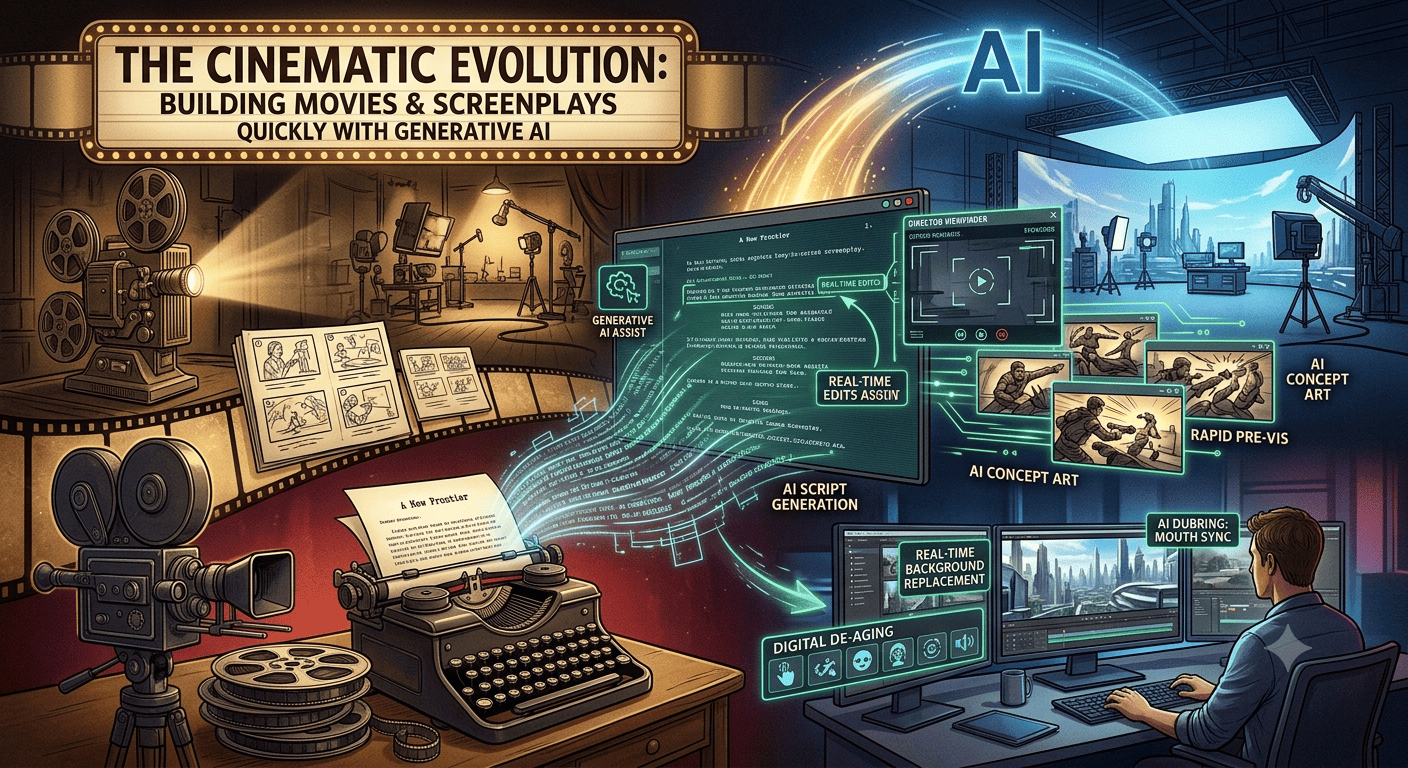
The beginning of every successful movie is always associated with writing its script, a lengthy process that can take months or even years of continuous editing. Nowadays, generative AI is significantly speeding up this stage as a helper in writing. State-of-the-art Large Language Models are able to help writers in creating plot outlines, developing various characters’ lines, or proposing different variants of dialogues needed for one particular scene. The point is not about removing people from the process but rather about eliminating the problem of a “blank page” that hinders creativity.
For example, an author can utilize AI-based technology to play around with their ideas quickly. When a script fails in developing in the second act, then the writer can ask the machine to offer ten different versions of how to develop the narrative line through ten possible variants of characters’ behavior. In this way, the writer will speed up the creation of a good story without waiting for the inspiration coming eventually.
Pre-Visualization and Virtual Storyboarding
Prior to shooting the first scene, directors need to envision their movies by creating storyboards and conceptual illustrations. Traditionally, that has involved employing an entire team of illustrators and spending several weeks creating such drawings. The director can use AI technology to turn any paragraph into a storyboard picture really fast it only takes a few seconds.
The director can also use AI-based software to make sure the characters and lighting look the same in every frame of the generative AI technology storyboard so everything looks consistent, with the generative AI technology. The ability to speed up the process of visualization before the beginning of actual movie production represents a huge leap forward for independent producers. As a result, directors will be able to detect any issues with lighting as well as possible problems that might arise when creating certain action scenes or sets.
Post-Production and Real-Time Visual Effects
Not only are the conventional methods of “fixing it in post” being changed by the emergence of generative AI, but the timeline for doing so is also shrinking considerably. Traditional films require the time-consuming process of adding visual effects (VFX) and color correction well after the shoot date. With the help of generative AI software, filmmakers can perform tasks like real-time background replacement, digital de-aging, and rotoanimation in real time. As a result, post-production becomes a much faster process, allowing films to be released in theaters within an exceptionally short period of time.
In addition, generative AI will be the new frontier in deepfakes, which are commonly used in practical applications such as dubbing. This can also be used on the mouth movements of actors who speak in movies that are not in English, so that the mouth movement is synced with the voice. While this technology was only possible in high-budget movies before, this can now be utilized in any film, regardless of budget. This means that the perception of the video quality that will be considered top-notch will definitely differ from one another. With the use of this technology and artificial intelligence, a standard for video quality will emerge, and artificial intelligence will play a role in making films look good.
Personalized and Interactive Cinema
Moving away from conventional cinema viewing experiences, generative AI is also creating an avenue towards personalized content creation. Imagine a film where the sound track, the lighting, and maybe some side plots adapt to the preferences of the viewer at any moment during the film. This sort of interactivity can only be achieved with the aid of AI’s rapid processing power. For now, the development of “generative cinema” remains in its infancy; however, current efforts by developers include the use of generative AI technology to create realistic textures and environments on the fly.
In addition to personalizing the experience for consumers, generative AI offers an important advantage for movie studios – reducing the cost of experimentation. By providing low-cost solutions, the risks associated with experimental stories, including expensive CGI effects, are minimized considerably, allowing studios to pursue innovative stories and themes, such as the development of global stories, which may have been too expensive or too niche before.
Conclusion
This is a point that one needs to ponder. The reason being that we are not depriving the artist of anything at all. All we are doing is providing the artist with a way through which he or she can create things. As long as the artist is capable of creating things fast, he/she will find it easy to accomplish what he/she wants. Thus, from the moment when the artist begins using the screenwriting software until the end when he finishes editing everything and saves it as an electronic file, the artist will actually be able to create movies. It means that the artist will be able to create movies which were never imagined before.
Frequently Asked Questions
1: How exactly does generative AI speed up the process of screenplay writing?
It acts as a collaborative partner that helps writers rapidly map out character arcs, craft dialogue variants, and construct plot outlines from simple prompts.
2: Will human screenwriters be replaced by automated writing tools?
No, generative AI is designed to eliminate creative blocks and handle repetitive brainstorming layout tasks rather than replacing the authentic human emotional touch.
3: How does AI software improve the pre-visualization stage for directors?
It instantly translates descriptive text paragraphs into visual storyboard images, allowing directors to spot lighting and staging issues before filming starts.
4: Can independent filmmakers benefit from these expensive post-production tools?
Yes, generative AI democratizes high-end visual effects, making tools like digital de-aging and seamless background replacement affordable for low-budget productions.
5: What role does machine learning play in foreign film dubbing?
It syncs the actual mouth and lip movements of actors with the dubbed audio track, dramatically improving the cross-cultural video quality perception.
6: What is meant by the term “generative cinema”?
It refers to a new tier of personalized content creation where film parameters like soundtracks, lighting profiles, and subplots shift on the fly based on viewer data.
7: How do movie studios mitigate financial risk using these new tools?
By lowering the cost of digital experimentation, studios can test highly complex CGI concepts or niche storylines without wasting millions of dollars.
8: Does automated rendering impact the overall artistic integrity of a movie?
The core technology serves purely as a tool for execution; the final artistic vision, pacing, and emotional resonance remain completely under the artist’s control.
9: What is the current developmental state of interactive movie formats?
It is still in its infancy, but ongoing developments utilize generative AI to render real-time textures and dynamic environments to match custom viewer trajectories.
10: How does real-time visual effect processing change standard production schedules?
It reduces the long, traditional “fixing it in post” lag by letting editors perform background swaps and rotoanimation almost instantly during shoots.
Citations & References
[1] I. J. Goodfellow and Y. Bengio, Generative Deep Learning: Teaching Machines to Paint, Write, and Compose, 2nd ed. Sebastopol, CA, USA: O’Reilly Media, 2024. [Online].
Available:
https://learning.oreilly.com/playlists/d756d1b7-6277-41f4-a79f-e28b6aeb5409/
[2] J. M. Smith and L. T. Williams, “The Role of AI in Modern Film Production,” Journal of Cinematic Arts, vol. 58, no. 2, pp. 112-128, 2025.
[3] A. Zisserman and K. Simonyan, “Visual Geometry in the Age of Generative Networks,” International Journal of Computer Vision, vol. 131, no. 4, pp. 89-104, 2023.
[4] EvePlacement. [Online].
Available:
https://eveplacement.com/
Streamline Your Hiring with Eve Placement
Engage, assess, and recruit top talent through tailored AI hiring challenges that go beyond resumes. Ready to hire better? Contact our research team for a custom consultation.