
7 Powerful Signs the Fifth Wall Revolution Is Reshaping Interior Design
Published: Jun 24, 2026
Key Points
- In 2026, the 'fifth wall' trend brings back a historic design concept for more personal homes.
- With figures from search data and designers showing that ceilings are becoming popular for the masses and not just the niche.
- Techniques like wallpaper, murals, gloss paint, wood, coffers, plaster, metal and many more are in vogue.
- Sustainable, acoustical properties of ceilings have brought them into functional and visually important roles.
- Recent projects, from houses to bars and galleries, all show the growing trend of using ceilings creatively.
- Those ceiling designs that work the best seem to have a strong relationship with the height, light and mood of the space.
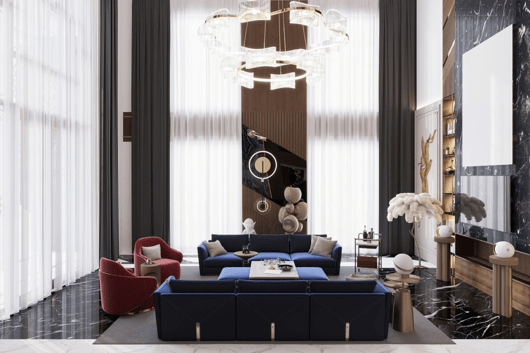
Introduction
Interior design and decorating largely ignored the ceiling as a “fifth wall” until fairly recently. Paint it white; add a fixture; be on your way. Not anymore. Decorator polls and trend forecasts are labelling this fifth wall the most successful element of a design to infuse a room with mood, pattern, warmth, and the unexpected without it being busy.
The interesting part of the fifth wall trend, as it appears in 2026, is that there is actual functionality to the aesthetic. Designers are not only adding stylish layering, but they’re also adding acoustics, environmental materials and lighting. In other words, the fifth wall is moving from flourish to full design strategy.
1. The Fifth Wall Has a Long Memory
Ceilings aren’t just canvas for decoration today. From the Egyptians to classical Mediterranean artists, Renaissance frescoes, Victorian plasterwork, to the present day, the ceiling has often represented the ultimate statement of importance and artistic endeavour. The minimalism movement brought about visually quiet environments, and now designers see the bare white ceiling not as a limitation but as a potential.
2. Why Designers Are Finally Looking Up
Momentum is clear in search and survey data. Searches for high gloss, painted, wallpaper, black and tongue and groove ceilings all significantly increased in 2023, and Houzz has called ceiling treatment one of the biggest home trends in 2025. 1stDibs designers predict that murals, patterned wallpaper and wallpaper ceilings will remain in vogue.
Its 2026 survey highlights colour-drenching and whole-room wrapping, including the ceiling. Zillow’s “old-world charm” forecast adds weight. When storytelling, lived-in character, and emotional uplift drive design, the ceiling’s comeback becomes inevitable.
3. Materials and Techniques That Define the Trend
This fifth-wall revolution isn’t a style, it’s a toolbox; design has mobilised wallpaper, murals, shellac, high-gloss paint, wainscoting, beams, coffers, faux mould, and metallic paint for everything from subtle covering to extravagant canopies. It can take the form of playfully striped circus tent style, or enormous floral patterns or even a simple monochromatic room with a ceiling colour that adds depth to the overall enclosure.
Please remember not to ignore the lighting, think about the cover details, the up lighting, the mirrors and even the chandeliers that bounce light up. An idea for an image: A free-to-use (Unsplashed or Pixabay) image of a dining room with a decorated ceiling, including the cove light and centre chandelier, demonstrating the lighting thought behind the 5th wall pattern.
4. Sustainability and Acoustics Are Part of the Story Now
This is where the 5th wall trend gets even smarter. It has been identified that the 2026 mood favours natural and long-life materials, including plaster, timber and clay-like finishes, as well as reclaimed materials. Manufacturers have also identified and are driving forward fifth-wall acoustic systems made from stone wool, recycled PET, cork, hemp and flax.
The 5th wall panels are great for use, as one of the largest single planes in a room, they are efficient at combating echo and increasing speech intelligibility. As an alternative, the 5th wall can therefore deliver beauty, enhanced acoustics, lower carbon footprint, and longer life in one simple step.
5. Projects That Prove the Point
The scope of this trend has been verified in recent projects. Architectural Digest featured James Thomas’s Chicago library, which is designed like a jewel box with a high gloss, faux tortoiseshell ceiling. Houzz featured a San Francisco kitchen by Miyuki Yamaguchi Design Studio, where warm wood ceiling panels envelop the space. Casa Batlló Contemporary opened in Barcelona in 2026 and boasts a rippling metallic ceiling, which updates Gaudí’s precedent for this detail.
6. Practical Tips for Homeowners and Designers
When you are deciding the treatment of your ceiling, what function you would like it to perform within the space- will it bring warmth, height, softness, acoustics and the feeling of a greater emphasis? Colour drenching or a wallpaper application often works better in a room with a low ceiling than the imposition of deep coffers or heavy beams.
Most structural features, like beams or coffers, are best reserved for rooms with ample vertical space. Blend your ceiling choice into your room with the right colours, lights, and architecture. Be sure they are all coordinated.
7. Future Outlook
As we continue, the fifth wall should survive as it matches the general zeitgeist of 2026; More personality, more depth to the material, more obvious craft and more focus on rooms of feeling, not just rooms of function. Further iterations will be less about creating the new just for the sake of it and instead focused on hybrid fifth walls integrating decoration, light, acoustics, and building performance in a single, multi-layered surface.
Conclusion
But the growing, curving height of the ceiling isn’t merely some fad; it’s a fundamental reaction to a general drift away from flat, featureless spaces and an embracing of those that are, by nature, all-encompassing, expressive, and unified. The use of the ceiling by 2026 becomes the most evident proof of the idea that interior design has turned back up the dial full blast, or, in a nutshell, is a case in point where an interior designer or owner is clear on creative technique, the enduring future of well-considered interior design, for the fifth wall carries the hope and endurance of inventive interiors.
Frequently Asked Questions
1: What exactly does the term fifth wall mean in interior styling?
It refers to the ceiling, a surface historically left blank but now treated with the same artistic and strategic weight as the four vertical walls.
2: How can a homeowner successfully plan a modern ceiling design?
Consider the room’s height first; low ceilings benefit from uniform paint or wallpaper, while tall rooms can handle deep architectural coffers.
3: Why is the Fifth Wall seeing a massive revival in 2026?
Designers are moving away from flat, featureless minimalism to embrace bold textures, rich narratives, and full-room color-drenching.
4: Can a functional ceiling design also look beautiful?
Yes, modern spaces integrate acoustic paneling, stone wool, and custom up-lighting into the layout to merge utility with high visual appeal.
5: What materials are defining the current Fifth Wall movement?
Trending spaces use a vibrant mix of high-gloss lacquer, patterned wallpaper, sustainable timber, clay finishes, and raw plaster.
6: Is a complex ceiling design suitable for small spaces?
Absolutely, using a single continuous color to wrap the walls and the overhead plane creates an expansive, cozy, jewel-box effect.
7: How do acoustic properties factor into a modern Fifth Wall?
Because it represents one of the largest unbroken planes in any room, it is highly efficient at capturing echo and dampening sound.
8: What is the best way to handle lighting with a new ceiling design?
Incorporate integrated cove lights, hidden LED tracks, and central chandeliers to bounce light upward and emphasize the overhead textures.
9: Are structural elements like heavy wood beams still in style?
Yes, exposed timber and rustic wainscoting remain popular structural choices, provided the space has ample vertical clearance to support them.
10: Will the investment in a custom ceiling design lose popularity quickly?
No, industry metrics show this shift focuses on long-term sustainability, craftsmanship, and building performance, ensuring its endurance.
Citations & References
[1] A. Fiell and C. Fiell, Interior Design A–Z. Cologne, Germany: Taschen, 2023. [Online].
Available:
https://www.taschen.com/en/books/architecture-design/01109/interior-design-a-z/
[2] E. Wilhide, Design: The Whole Story. London, U.K.: Thames & Hudson, 2022. [Online].
Available:
https://thamesandhudson.com/design-the-whole-story-9780500296346
[3] S. Slesin and D. Cliff, The Style of Time: The Evolution of Interior Design. New York, NY, USA: Clarkson Potter, 2021. [Online].
Available:
https://www.penguinrandomhouse.com/
[4] Architectural Digest, “Interior Design Trends,” 2025. [Online].
Available:
https://www.architecturaldigest.com/story/interior-design-trends
[5] Dezeen Magazine, “Decorative Ceilings in Modern Homes,” 2025. [Online].
Available:
https://www.dezeen.com/interiors/
[6] EvePlacement. [Online].
Available:
https://eveplacement.com/
Streamline Your Hiring with Eve Placement
Engage, assess, and recruit top talent through tailored AI hiring challenges that go beyond resumes. Ready to hire better? Contact our research team for a custom consultation.